
NoleaWorld of Wine

Piemonte · Italy

Producer profile

Giuseppe Mascarello

Giuseppe Mascarello e Figlio has farmed Nebbiolo in the Langhe since 1881. The estate's core holding is Monprivato, a 6.13-hectare southwest-facing vineyard in Castiglione Falletto of which the family controls approximately 95%. All Barolo is aged in large Slavonian oak botti. Mauro Mascarello first bottled Monprivato as a single-vineyard wine in 1970.

Place
Piemonte · Italy
Known for
Barolo Monprivato DOCG, Barolo Ca d'Morissio Riserva DOCG
Wine context
Barbera · Nebbiolo
Editorial basis
World of Wine editorial profile · 5 sources

World of Wine editorial profile · Source list ↓

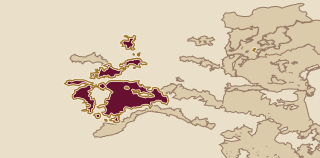
Atlas locationPiemonte · Italy44.57° N · 7.92° E

At A Glance

Producer: Giuseppe Mascarello e Figlio Country: Italy Region: Piemonte, Langhe Villages: Castiglione Falletto, Monforte d'Alba Grape: Nebbiolo Key Wine: Barolo Monprivato DOCG Style: Traditional, long-aged, large Slavonian oak botti Since: 1881

The Producer

Giuseppe Mascarello e Figlio purchased its first cellars in Monforte d'Alba in 1881. The family had farmed Nebbiolo before that, as tenant managers on the Manescotto estate in La Morra, but 1881 is when they became landowners. The estate is now led by Mauro Mascarello, whose children Elena and Giuseppe work alongside him, and whose grandfather made decisions that still shape every bottle produced today.

The cellar position is a deliberate one. No French barriques. No deep-extraction, internationally styled Barolo. Mauro ages all his Nebbiolo in large Slavonian oak botti, some of them decades old, maintained and kept in use rather than replaced. The botti add nothing to the wine's colour or aromatic profile. They hold the wine and allow it to develop slowly, and what comes out carries the character of the grape and the vineyard rather than the wood.

Monprivato, a southwest-facing vineyard in the commune of Castiglione Falletto, is the estate's central holding. The family began acquiring parcels there in 1904 and now controls approximately 95% of the 6.13-hectare site. It is as close to a private vineyard as the Langhe produces.

Place

The estate draws its main Barolo bottlings from two communes with markedly different soils and characters. Castiglione Falletto sits on a ridge between the Tanaro tributaries at 250 to 350 metres, on compact Tortonian marl soils locally called Lequio formation. These soils produce wines of finer extraction and more supple tannin. Monforte d'Alba, home to the Santo Stefano di Perno vineyard, sits higher with heavier, more compact ground. The difference is audible in the glass: Castiglione Falletto gives the more silken Nebbiolo, Monforte gives the denser and more austere.

Barolo as an appellation spans eleven communes in the Langhe hills south of Alba, all growing Nebbiolo and all falling under the same DOCG designation. Within that, the commune name and the vineyard name on the label carry the real address. Monprivato in Castiglione Falletto is about as specific as a Barolo address gets.

Soil And Site

Monprivato faces southwest, which in the Langhe means good afternoon sun exposure and a long, even ripening season for Nebbiolo. The Tortonian marl beneath it, formed in the Helvetian epoch, is dense and compact, with enough calcium to give the roots something to press against and the wine a chalky mid-palate weight. These soils are associated with wines that develop elegance over time rather than force in youth.

Santo Stefano di Perno in Monforte d'Alba sits on heavier soils with more clay content. The resulting Barolo carries more tannin on impact, with the earthy, rustic weight that Monforte is known for across its several important vineyards.

Story

The family accumulated Monprivato piece by piece from 1904 onward. When Mauro Mascarello came to run the estate, the vineyard was largely assembled but its wine was still blended with fruit from other sites, following a practice the family had maintained since 1881. In 1970, Mauro separated Monprivato and bottled it alone. Single-vineyard Barolo was not yet a recognised commercial category. In 1970, Mauro made the family's first single-vineyard Barolo from Monprivato.

Then Mauro went further. His grandfather had planted a sub-parcel of Monprivato in 1921 with the Michét clone of Nebbiolo, an old clonal selection that was already being pulled out across the Langhe because it produced small, irregular clusters and lower yields than the more productive Lampia clone. Mauro kept the vines. In 1983, when those vines were more than sixty years old, he made the first Ca d'Morissio Riserva from them: a separate Barolo from the same vineyard, from a clone his grandfather had refused to abandon.

The Ca d'Morissio is produced only in vintages Mauro judges exceptional enough. The Michét vines are still in the ground.

Vineyards And Cellar

Most of the estate's Barolo comes from Monprivato, with the Villero vineyard, also in Castiglione Falletto, first bottled as a single-vineyard wine in 1978, and Santo Stefano di Perno in Monforte providing a third main site. Farming is traditional: no shortcuts to earlier ripeness, no extraction techniques borrowed from warmer climates.

In the cellar, the Slavonian oak botti are the constant. These large casks impart no vanilla, no toast, and no new wood tannin. Long maceration extracts tannin from the grape skins directly, and the botti hold the wine during ageing without covering what the maceration produced. The botti hold the wine during long, traditional aging. Decades-old botti are actively maintained rather than retired, preserving the cellar's character from one generation to the next.

Wines

Barolo Monprivato DOCG is the anchor of the range. Almost all of the 6.13-hectare vineyard belongs to the estate, and the wine is made from Nebbiolo grown on those southwest-facing Tortonian soils in Castiglione Falletto. It is aged in large Slavonian oak botti. The colour runs garnet with orange-hued highlights at the rim, which in aged Nebbiolo signals that the tannins are beginning to open. The nose is complex, fruity, and layered with spice and floral touches. On the palate, the wine shows full body with power and length. Across vintages, the character shifts from silky and fresh in years like 2009, with fine-grained tannins and ripe cherry fruit, to savoury, intensely perfumed, and concentrated in cooler vintages like 1999.

Barolo Ca d'Morissio Riserva DOCG comes from a sub-parcel of Monprivato planted with the Michét clone, vines now over a century old. It is made only in exceptional vintages. Ca d'Morissio is denser and more demanding than the regular Monprivato, built for a longer cellar life, with a more concentrated and austere tannin profile. It is not an entry point to the estate.

Barolo Santo Stefano di Perno DOCG comes from Monforte d'Alba and gives the range's most distinctly earthy expression. Pine, menthol, spice, graphite, and black fruit rise from the glass. The tannins are chalky, incisive, and prominent rather than silky, carrying the heavier soil signature of Monforte into the wine's whole palate.

Barolo Villero DOCG, from the second Castiglione Falletto site, was first bottled as a single-vineyard wine in 1978 and carries deeply spiced, balsamic character.

The estate also produces Barbera d'Alba, Dolcetto d'Alba, and Freisa, but all four Barolo bottlings are the work for which it is sought.

In The Glass

Nebbiolo aged in large Slavonian oak botti over a long period arrives in the glass with garnet colour and orange-tinged highlights at the rim. The orange edge in Nebbiolo is not a flaw. It is what traditional Barolo looks like when the tannins have had time to settle and the fruit has moved away from primary cherry toward something more complex: dried roses, tar, spice, and graphite in the oldest bottles.

On the nose, Monprivato is dense and layered. Fruit and spice come first, with floral touches underneath. In the mouth, the tannins are the first thing to notice. Young Monprivato carries the grip and dryness that Nebbiolo tannin always delivers. Over time and across the right vintages, they resolve into something fine-grained and long. The 2009 showed silky texture with fresh ripe cherry and fine tannin. The 1999 was savoury, intensely perfumed, and concentrated with spicy earthy fruit. Across both, the finish is long and the acidity keeps the wine alive.

Santo Stefano di Perno in the same glass gives a different reading: chalky tannin on impact, black fruit rather than red, pine and menthol on the nose, and a heavier, earthier weight through the palate. The two wines from two communes show exactly how much the Langhe's distinct soils change the same grape.

A Bottle To Understand It

Start with Barolo Monprivato. It is the wine Mauro Mascarello separated from the blended range in 1970, the wine that comes from 6.13 hectares of southwest-facing Tortonian marl in Castiglione Falletto, and the one that shows what large Slavonian oak botti ageing does for Nebbiolo over time without adding a trace of wood character. In the glass, Monprivato is garnet with orange at the rim, complex on the nose with dried fruit, spice and a floral edge, and long and firm in the mouth with body and grip that ask for time. Give it a decade from a serious vintage, or find a bottle with ten years on it already. The Ca d'Morissio will be more spectacular in exceptional years, but Monprivato is what the estate's method and its primary vineyard produce together, and it is the wine from which everything else follows.

Anecdote

In 1921, Mauro Mascarello's grandfather planted the Michét clone of Nebbiolo in a section of Monprivato. The Michét was already falling out of favour across the Langhe: it produces smaller, more irregular clusters, lower yields, and requires more careful handling in the vineyard than the standard Lampia clone, which was easier to manage and more productive. The vines stayed in. Mauro watched them through the 1950s, 1960s, and 1970s, and in 1983, when those vines were over sixty years old and producing fruit he judged worth separating, he made the first Ca d'Morissio Riserva from them. The decision to wait, and the decision to keep the Michét in the ground at all, belonged to two different generations. The Michét vines his grandfather planted are still there, and the Ca d'Morissio is still produced only in vintages Mauro considers exceptional enough.

Final Word

Giuseppe Mascarello e Figlio has made Barolo from the same vineyard, with the same cellar method, across more than a century of family ownership. The wine is built on Nebbiolo's natural character, unhurried by barriques and uncorrected by modern intervention. Monprivato in Castiglione Falletto is the address. Large Slavonian oak botti is the cellar. Time is the only other ingredient.

Sources

Keep following the thread

Where to go next

placeRead the Piemonte guideSee Giuseppe Mascarello in the wider setting of Piemonte.mapFind Giuseppe Mascarello on the mapKeep the producer, its region and nearby places together.learningUnderstand NebbioloRead the quick library guide to Nebbiolo, which is listed with this producer.