NoleaWorld of Wine

Ambonnay · Champagne · France

Producer profile

Egly-Ouriet

A fourth-generation Ambonnay grower working old Pinot Noir with gentle pressing, extended lees ageing and low dosage.

Place
Ambonnay · Champagne · France
Known for
Old-vine Ambonnay grower Champagne
Wine context
Chardonnay · Pinot Noir
Editorial basis
World of Wine editorial profile · 5 sources

World of Wine editorial profile · Source list ↓

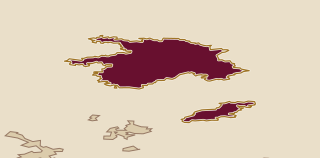
Atlas locationAmbonnay · Champagne · France49.08° N · 4.17° E

At A Glance

Region
Champagne
Village
Ambonnay, Montagne de Reims (grand cru)
Other holdings
Verzenay, Bouzy (grand cru), Vrigny (premier cru)
Main grapes
Pinot Noir, Chardonnay, Pinot Meunier
Signature wine
Brut Grand Cru (non-vintage)
Defining feature
Extended lees ageing, low dosage, unfined and unfiltered bottling

The Producer

Francis Egly is the fourth generation of his family to make wine in Ambonnay. Egly-Ouriet bottles 100% estate wines and is known for old vines, low dosage and extended lees ageing.

The estate held about 20 hectares by early 2025, including 10 grand cru hectares. Francis's children, Clémence and Charles, are now involved at the domaine.

The Brut Grand Cru accounts for roughly half of production. Les Crayères comes from Pinot Noir planted in 1946 on pure chalk.

Place

Ambonnay, Verzenay and Bouzy provide the domaine's grand cru vineyards. Their older-vine fruit supplies the Pinot Noir and Chardonnay used in Brut Grand Cru.

Vrigny adds a different part of the range: Vignes de Vrigny is 100% Pinot Meunier from chalky premier cru vineyards.

Story

The family started with about three hectares of vines in Ambonnay. Francis Egly took over from his father in the early 1980s and chose to bottle everything under the Egly-Ouriet name rather than sell to negociants.

Francis and Anselme Selosse were among the first in Champagne to bottle 100% estate wines. Egly-Ouriet later expanded into a multivillage domaine, and Francis's children Clémence and Charles joined the business.

Vineyards And Cellar

The grand cru vineyards are 70% Pinot Noir and 30% Chardonnay, with vines averaging 40 years of age. The estate practices organic farming but is not certified; regular ploughing and reduced yields are part of the vineyard work.

In the press house, Francis keeps only the first pressing after gentle extraction. Fermentation runs on indigenous yeasts, partly in French oak barrels bought from Burgundian winemaker Dominique Laurent and partly in tank. Cellar work uses no filtration, low temperatures and low sulphur.

Most wines spend three to seven years on the lees, and the V.P. cuvée can reach nine. The domaine links that time on lees to greater complexity and clearer terroir expression and does not shorten the ageing. Dosage is seldom above 2 to 5 grams per litre, and every wine is bottled unfined and unfiltered.

Les Crayères is old-vine Pinot Noir planted in 1946 on a pure-chalk site in Ambonnay.

Wines

The Brut Grand Cru is the largest-volume wine in the range. It runs to roughly 50,000 bottles, about half of the domaine's production. Many Egly-Ouriet wines come from a single harvest even though they are labelled non-vintage.

Vignes de Vrigny is a premier cru Pinot Meunier bottling. Grand Cru V.P. Extra Brut can rest on its lees for up to nine years. Blanc de Noirs Grand Cru Les Crayères comes from Pinot Noir planted in 1946 on pure chalk in Ambonnay. Ratafia de Champagne is the aperitif in the range.

In The Glass

Brut Tradition Grand Cru combines citrus, apple and pear with nut richness, fine herbs, juicy acidity and early toasty maturity after 48 months on the lees.

Les Crayères brings toast, cherry and herbs, backed by acidity, freshness and depth.

A Bottle To Understand It

Start with the Brut Grand Cru. At roughly 50,000 bottles, it accounts for about half of the domaine's production. The blend combines 70% Pinot Noir and 30% Chardonnay from older vines in Ambonnay, Verzenay and Bouzy and spends at least three years in bottle. Red berries, blood orange, incense and blond toast mark one documented release.

Anecdote

Egly-Ouriet kept its 2008 vintage in the cellar for almost ten years. The wine was released only in late 2019.

Final Word

The largest-volume wine spends at least three years in bottle, while the 2008 vintage waited almost ten years for release. At Egly-Ouriet, cellar time is not reserved for a token prestige bottling.

Sources

Keep following the thread

Where to go next

placeRead the Champagne guideSee Egly-Ouriet in the wider setting of Champagne.mapFind Egly-Ouriet on the mapKeep the producer, its region and nearby places together.learningUnderstand ChampagneRead the quick library guide to Champagne, which is listed with this producer.