
NoleaWorld of Wine

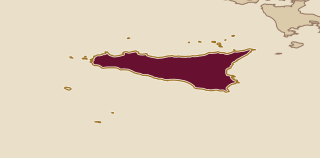
Sicily · Italy

Producer profile

Donnafugata

Family-owned Sicilian producer with historic cellars in Marsala, farming Zibibbo under the UNESCO-listed alberello system on Pantelleria and making wines from four territories across Sicily.

Place
Sicily · Italy
Known for
Passito di Pantelleria (Ben Ryé); multi-territory Sicilian range from western Sicily, Etna and Vittoria.
Wine context
Muscat · Nero d'Avola
Editorial basis
World of Wine editorial profile · 5 sources

World of Wine editorial profile · Source list ↓

Atlas locationSicily · Italy37.79° N · 12.45° E

At A Glance

The Producer

Giacomo Rallo came from four generations of Sicilian wine traders. In 1983 he and his wife Gabriella made a different move: instead of continuing in the wholesale trade, they founded Donnafugata as an estate producer, anchored by the family's historic cellars in Marsala. Giacomo ran the estate until his death in 2016, and their children José and Antonio now lead it.

The name and the range both carry a certain ambition. From Marsala, the estate spread across the island and out to sea: Pantelleria in 1989, then east to Etna's volcanic slopes at Randazzo, then south-east to the Vittoria area where Nero d'Avola and Frappato grow in the heat. Each territory produces wines under its own appellation logic, but the Pantelleria operation is where Donnafugata has invested most deeply, and where the farming decisions are hardest to replicate.

Place

Sicily's four wine territories in this range sit at very different latitudes and altitudes. Western Sicily, centred on the Contessa Entellina estate, is warm, low-lying, and suited to the full-bodied red varieties that produce Mille e Una Notte. Vittoria, in the island's south-east, falls within the Cerasuolo di Vittoria and Frappato di Vittoria DOC zones, where the combination of Nero d'Avola's weight and Frappato's aromatic lift defines the local style. Etna sits at 15 hectares near Randazzo on the northern slope of the volcano, where altitude and volcanic mineral soil push the wines in a cooler direction.

Pantelleria is the outlier: a small volcanic island 70 kilometres south of Sicily and closer to Tunisia than to Palermo, swept by the Sirocco wind from North Africa. The island's DOC, Passito di Pantelleria, covers sweet wines made from Zibibbo, the local name for Muscat of Alexandria. Appellation rules require that Zibibbo grapes be dried after harvest before pressing, concentrating sugar, apricot and dried-fruit character. The alberello bush-training system, in which each vine grows low to the ground without wire support, was developed specifically for Pantelleria's wind conditions.

Soil And Site

Pantelleria's soils are volcanic and sandy. The volcanic composition appears to have protected the island's vines from phylloxera, the root louse that devastated European vineyards in the late nineteenth century and forced growers to graft their vines onto American rootstock. Ungrafted pre-phylloxera vines still exist on Pantelleria, and Donnafugata has worked deliberately to preserve them.

The terrain is steep and terraced, held in place by dry-stone walls built from the island's dark lava rock without mortar. Donnafugata maintains more than 40 kilometres of these walls each year. That number is not a figure of speech: the walls require annual repair to hold terraces against wind and erosion, and keeping them up is a direct cost of farming the island at all.

Story

Giacomo Rallo's decision in 1983 to bottle under a family estate name rather than trade in bulk marked the first turn. The second came six years later, when Donnafugata moved to Pantelleria. The island was producing Passito wine long before the estate arrived, but the market for quality Sicilian sweet wine was not yet developed in its current form, and Pantelleria's labour-intensive alberello farming made production expensive by any comparison.

Over the following three decades, Donnafugata committed to the island in concrete ways. In 1999, the estate restored a Zibibbo vineyard whose ungrafted plants were already more than a century old, choosing genetic continuity over the higher yields a new planting might have delivered. In 2010, a formal experimental vineyard was established with 33 distinct Zibibbo biotypes collected from across the Mediterranean, a long-run project in understanding what variants of the grape exist and how they differ in the glass. Those two decisions, taken more than a decade apart, are not marketing postures. They cost time and money and produce no immediate commercial return.

José and Antonio Rallo inherited an estate that had already spread across four Sicilian territories and built its reputation on a labour-intensive island wine. Their job since 2016 has been to deepen that reputation without simplifying it.

Vineyards And Cellar

On Pantelleria, every vine is farmed by hand. The alberello system, which UNESCO added to its list of Intangible Cultural Heritage, requires workers to crouch at ground level to prune, train and harvest. Vines grow in shallow hollows that channel rainwater to the roots, a technique developed to make the most of a dry island climate. Wire training, which would make mechanical harvesting possible, is not compatible with alberello.

The 53 hectares on Pantelleria include the restored old-vine plot and the experimental biotype vineyard. The old vines, ungrafted and more than a century old, produce smaller crops than younger plantings. Their fruit carries concentration accumulated over decades of slow growth in volcanic sand.

Ben Ryé is made from Zibibbo grapes dried after harvest to concentrate their natural sugars. After pressing, the wine matures for approximately five months in tank, then at least sixteen months in bottle before release. The long bottle age is notable for a sweet wine at this price point: it allows the wine's apricot and dried-fig concentration to integrate with its acidity rather than sitting as a separate layer of sweetness.

Wines

Donnafugata's range is structured by territory rather than by price tier. Each appellation produces a distinct wine type that does not have a direct equivalent elsewhere in the range.

From western Sicily's Contessa Entellina estate comes Mille e Una Notte, the flagship red. The wine draws on the warm-climate varieties that dominate the estate's low-lying vineyards.

From Vittoria in the south-east, Donnafugata produces wines under the Cerasuolo di Vittoria and Frappato di Vittoria appellations. Cerasuolo di Vittoria is Sicily's only DOCG wine, a blend of Nero d'Avola and Frappato that combines the former's dark-fruit weight and tannic grip with the latter's raspberry lift and floral perfume. Frappato on its own tends to be lighter, more aromatic, and easier to drink young.

From the Etna estate at Randazzo, 15 hectares on the volcano's northern flank produce wines that sit at the cooler end of the range. Elevation and volcanic mineral soil give Etna wines their characteristic lean acidity and long finish.

Ben Ryé, the Passito di Pantelleria DOC, is 100 percent Zibibbo made from dried grapes. It carries dense apricot, dried fig, and orange-peel character, with the grape's natural acidity running under the sweetness to prevent the wine from feeling heavy. The maturation protocol of five months in tank and sixteen in bottle produces a wine that is rich but not cloying, and that keeps well after opening.

In The Glass

Ben Ryé opens with concentrated dried apricot and orange blossom, the Zibibbo grape's signature lifted perfume intensified by the drying of the harvest. In the mouth, the sweetness is dense and clear, with dried fig and candied citrus peel at the centre. The grape's natural acidity runs through the finish, preventing the wine from settling into simple sweetness, and there is a faint saline mineral quality, a note that traces back to the volcanic island soil and the proximity to sea. The finish is long and clean, with the fruit fading gradually rather than dropping off.

Mille e Una Notte, from western Sicily, is a full-bodied red whose warm-climate origin shows in its dark-fruit concentration and full-textured palate. Without cellar specifics established in the sourced packet, the detail stops there.

The Vittoria reds divide by variety. Cerasuolo di Vittoria carries more body and tannin from the Nero d'Avola component, with Frappato adding an aromatic, lighter layer of raspberry and violet above it. Frappato-dominant wines from the same area are lighter, more immediately aromatic, and suited to earlier drinking.

A Bottle To Understand It

Ben Ryé Passito di Pantelleria is the right first bottle. It is 100 percent Zibibbo, the island grape grown under the UNESCO-listed alberello system on volcanic sand, made by drying the harvest to concentrate everything the variety offers: apricot, orange blossom, dried fig, and a faint saline edge from the island's soil. The wine matures for five months in tank and at least sixteen in bottle, which gives it more composure than many wines at its sweetness level. Drink it cold, with almond pastry, blue cheese, or alone at the end of a meal. It anchors the estate's Pantelleria work directly and carries the clearest trace of every farming decision made on the island.

Anecdote

In 1999, Donnafugata's team identified a Zibibbo vineyard on Pantelleria whose oldest plants had never been grafted. Phylloxera, the root louse that had swept through European vineyards from the 1860s onward, never established itself in Pantelleria's volcanic sandy soils, and the vines had simply kept growing on their own roots through the twentieth century. By the time the estate found them, some plants were already more than a hundred years old. The choice was whether to replant with younger, higher-yielding vines or to restore what was there. Donnafugata chose to restore, clearing out the overgrown plot and bringing the surviving plants back into productive condition. Those vines still stand in the estate's Pantelleria holdings today, ungrafted, pre-phylloxera, and still producing fruit.

Final Word

Donnafugata is a multi-territory Sicilian producer whose most distinctive work happens on Pantelleria, one of the most labour-intensive wine islands in Europe. The Marsala cellars give the estate its historic roots; Pantelleria gives it its hardest-earned bottles. Ben Ryé is the wine that draws the island's volcanic soil, ancient farming technique, and Zibibbo's concentrated character into a single glass. Start there, then follow the range east to Etna and the DOCG territory of Vittoria.

Sources

Keep following the thread

Where to go next

placeRead the Sicily guideSee Donnafugata in the wider setting of Sicily.mapFind Donnafugata on the mapKeep the producer, its region and nearby places together.learningHow place shapes wineSee how climate, landscape and local choices become part of a wine.