NoleaWorld of Wine

Loire · France

Producer profile

Domaine La Croix St-Laurent

Bué domaine making Sauvignon Blanc Sancerre and Pinot Noir rosé from calcareous marl and flint, with hand harvesting.

Place
Loire · France
Known for
Bué Sancerre from marl and flint
Wine context
Pinot Noir · Sauvignon Blanc
Editorial basis
World of Wine editorial profile · 5 sources

World of Wine editorial profile · Source list ↓

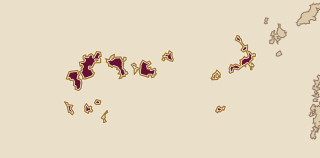
Atlas locationLoire · France43.20° N · 6.57° E

At A Glance

Field
Detail
Region
Loire Valley, France
Appellation
Sancerre
Village
Bué
Main grapes
Sauvignon Blanc and Pinot Noir
Vineyard area
About 11 hectares
Current wines
2023 white Sancerre and 2025 rosé Sancerre
Defining feature
Hand harvesting on calcareous marl and flint soils

The Producer

At the winery in Bué, Joël and Sylvie Cirotte work with their son Fabien, who represents the fourth generation. Domaine La Croix St-Laurent makes Sancerre in white and rosé, with Sauvignon Blanc forming the majority of the plantings and Pinot Noir a substantial component.

Families named Migeon and Crochet held the property from the sixteenth century. The Cirotte family has maintained it since 1932. The domaine's work combines hand harvesting, careful temperature control and separate treatment of Sauvignon Blanc and Pinot Noir.

Place

Bué is one of Sancerre's principal southern villages, and the domaine's winery is located there. The current wines carry the Sancerre appellation in two forms, white and rosé. Sauvignon Blanc supplies the white wine, while Pinot Noir supplies the rosé.

Soil And Site

The domaine's soils are approximately 90% calcareous marl and 10% flint. The flint is planted only to Pinot Noir for rosé.

Grands Chemarin was planted in 1947 and has caillottes soils. La Cochotte is described as Sancerre's highest site, with red clay soils and wines marked by acidity and freshness.

Story

Fabien Cirotte keeps white fermentation out of the harvest rush. While fruit is still being picked and processed, he holds the juice at 5°C and waits until the final pick is in. Harvest comes first. Fermentation follows.

The domaine has held Terra Vitis sustainable viticulture certification since 2013 and gained HVE3 certification in 2021.

Vineyards And Cellar

All grapes are harvested by hand. White grapes are pressed as whole bunches, then statically settled for 24 hours before being moved to fermentation tanks. White fermentation takes place in temperature controlled stainless steel.

After fermentation, Fabien holds the white wine at 7°C to prevent malolactic fermentation. This conversion changes malic acid into lactic acid and can soften acidity. The wine remains on lees before sulfites are added. Cooling equipment allows more closely managed sulfite additions, including avoiding an addition at bottling.

For Pinot Noir, Fabien destems the fruit, gives it a 14 day cold maceration, ferments at 19°C, then follows fermentation with another two week maceration.

Wines

The current range includes Sancerre Domaine La Croix St-Laurent in white from 2023 and rosé from 2025. The standard white Sancerre is made from Sauvignon Blanc, while the rosé is made from Pinot Noir.

The 2022 white was an assemblage of plots divided equally between terres blanches and red clay. The 2022 rosé came equally from silex, the French term for flint, and calcaire, the term for limestone. The bottles therefore separate white Sauvignon Blanc from Pinot Noir rosé while allowing different soils to appear within the wines.

In The Glass

The white Sancerre opens with citrus and white flowers. Passion fruit, lemon, mandarin and subtle lychee appear on the palate. A 2022 white showed pear and citrus, a defined acid line, chalky texture and salinity.

The rosé brings peach, grapefruit and apricot aromas. Its palate is smooth and harmonious, with a long finish. The 2022 rosé was very pale, with citrus and cherry, stony minerality and a juicy, textured feel. Another tasting note found wild strawberry, raspberry, mandarin, peach skin, citrus and dry spice.

A Bottle To Understand It

Choose Sancerre Domaine La Croix St-Laurent in white. It is the standard bottle made from 100% Sauvignon Blanc. Fermentation lasts 15 days in temperature controlled stainless steel, followed by five months on lees before bottling. The rosé sits beside it as the Pinot Noir counterpart in the domaine's Sancerre range.

Anecdote

In the early 2000s, Joël Cirotte began using a full sized chainsaw to curette vines damaged by Esca. Esca is a vine disease, and curettage removes damaged wood from the vine. Joël was a pioneer of the method at the domaine. The technique has since been adapted with much smaller chainsaws, but its first version used a full sized machine.

Final Word

Domaine La Croix St-Laurent makes white and rosé Sancerre in Bué. Sauvignon Blanc supplies the white and Pinot Noir the rosé, with hand harvesting, calcareous marl and flint soils, temperature controlled fermentation, lees ageing and managed sulfite additions in the cellar.

Sources

1. https://wineanorak.com/2023/10/14/exploring-the-centre-loire-1-domaine-la-croix-st-laurent-with-fabien-cirotte/ 2. https://www.wwcellars.com/our-wineries/france/domaine-la-croix-st-laurent/ 3. https://www.wwcellars.com/our-wineries/france/domaine-la-croix-st-laurent/sancerre-blanc/ 4. https://www.wwcellars.com/our-wineries/france/domaine-la-croix-st-laurent/sancerre-rose/ 5. https://www.degrotehamersma.nl/wijn/rose/172365/domaine-la-croix-st-laurent/

Keep following the thread

Where to go next

placeRead the Loire guideSee Domaine La Croix St-Laurent in the wider setting of Loire.mapFind Domaine La Croix St-Laurent on the mapKeep the producer, its region and nearby places together.learningUnderstand Sauvignon BlancRead the quick library guide to Sauvignon Blanc, which is listed with this producer.