
Who makes it
Damilano Azienda Agricola is a family estate based in the Barolo township of Piemonte, making Barolo DOCG from Nebbiolo in four named single-vineyard parcels, with the Cannubi cru at the centre of everything the estate does. Cannubi is a low, south-facing hill in Barolo township, one of the most precisely documented vineyards in the Langhe. Damilano's history in it runs back to the estate's founding.
The winery was established in 1890 by Giuseppe Borgogno. His son-in-law Giacomo Damilano later assumed control, and the estate took the Damilano name under his management. In 1997 three brothers, Guido, Mario, and Paolo Damilano, took over and built the winery's presence in international markets. The range now runs from an entry Langhe Nebbiolo through village Barolo and four separately vinified crus, with the Cannubi Riserva 1752 at the top, requiring close to seven years from harvest to release.
Where it grows
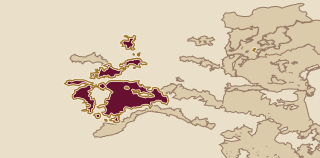
Barolo is a wine zone in the Langhe hills of southern Piemonte, built around Nebbiolo and governed by the DOCG designation. The zone divides broadly into two soil types. The western communes, including Barolo township and La Morra, sit on chalky-clayish marlstone: sedimentary soils formed in the Serravallian and Tortonian geological periods, relatively loose, with high sand content. The eastern communes, centred on Serralunga d'Alba and Castiglione Falletto, rest on more compact, iron-rich limestone. That geological split drives real differences in wine character: the western soils produce Barolo with softer tannin grain and earlier-opening fruit; the eastern soils give wine with more grip and longer ageing curves.
Cannubi lies in Barolo township, on the western side of the zone. A label reading Barolo Cannubi names that specific hill. A label reading Barolo carries the broader DOCG designation across estate parcels.
How it is made
The cellar
The four single-vineyard crus are vinified separately from the moment of harvest. Cannubi fruit goes through a fermentation period of twenty days, followed by thirty days of maceration on the skins. Extended maceration at this length extracts deep colour and builds tannin density, but on Cannubi's sandy marlstone that tannin comes out smooth rather than coarse. After maceration the wine moves to large oak casks, where it ages for five years. Large-format oak transfers less new-oak character than smaller barriques, allowing the Nebbiolo's fruit, acidity, and tannin to develop without heavy wood overlay. Two years of bottle ageing follow before release.
The standard Cannubi Barolo follows a shorter arc: a three-year production cycle. The Riserva 1752 takes the same fruit through the longer, seven-year sequence, building the concentration and layered development that Riserva status requires under Barolo DOCG law.
What they make
The range opens with Langhe Nebbiolo Marghe, a DOC wine from Nebbiolo at entry level, lighter in extraction and earlier to drink than anything in the Barolo line.
The Barolo village-level wine carries the DOCG designation from estate parcels, blended rather than single-vineyard, with the broader fruit and approachability that blending across sites tends to produce.