At A Glance
Château Mouton Rothschild is a red Pauillac wine from Bordeaux, led by Cabernet Sauvignon grown on deep gravel with very little clay. The 2022 vintage combines 92% Cabernet Sauvignon and 8% Merlot with entirely new-oak ageing, concentrated black fruit, graphite, cassis, flinty tannins, mouth-watering acidity and a long life ahead.
The Producer
Mouton Rothschild makes Pauillac in a style marked by ripe black fruit, mineral flavour, spice and a generous, velvety mouthfeel. The estate's gravel-heavy vineyard gives Cabernet Sauvignon the setting it needs to produce dense fruit and firm tannins, while the cellar treatment of the 2022 vintage adds new oak to the finished wine.
The name also carries a distinct visual history. Since 1945, every vintage has featured commissioned artwork by a contemporary artist. Pablo Picasso, Salvador Dalí, Andy Warhol and Jeff Koons have all contributed labels, while Baron Philippe de Rothschild established the Museum of Wine in Art at the estate.
Place
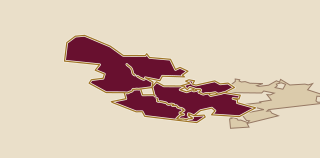
Pauillac is both the village and appellation at the heart of this wine. Within Bordeaux's Médoc, the estate sits on elevated ground that supports natural drainage, while its gravel soils favour Cabernet Sauvignon. The grape's thick skins bring blackcurrant fruit and tannin; Pauillac's gravel helps that fruit ripen while keeping the wine firm enough for extended ageing.
Mouton became a First Growth in 1973, joining the highest level of the 1855 Bordeaux classification. That legal category belongs to the label, but the glass still begins with the same physical relationship between Cabernet Sauvignon, gravel and Atlantic-influenced Bordeaux conditions.
Soil And Site
The estate's soils contain an exceptional concentration of gravel and almost no clay. Gravel drains readily, leaving Cabernet Sauvignon with a site that supports ripe black fruit while preserving a mineral line through the palate. The terrain is among the higher ground in Pauillac, adding further natural drainage.
The vineyard is planted at 10,000 vines per hectare. Vines average 50 years old, and some parcels contain plants more than 130 years old. Dense planting and old vines sit behind the concentrated fruit and depth associated with the wine, while the gravel contributes the graphite and crushed-stone notes found in the 2022 vintage.
Story
The estate spent more than a century outside the First Growth category created in 1855. Baron Philippe de Rothschild campaigned to change that position, and in 1973 a decree signed by Jacques Chirac, then France's Minister of Agriculture, promoted Mouton to First Growth. It was the only change made to the original Bordeaux classification.
The estate's visual history followed a different route. In 1945, a label commemorating the Allied victory introduced the practice of pairing each vintage with contemporary artwork. The vineyard, the classification and the label therefore carry three different timelines, all visible in the same bottle.
Vineyards And Cellar
Ten thousand vines per hectare create a closely planted vineyard, while an average vine age of 50 years and older parcels provide concentrated grapes. Cabernet Sauvignon dominates the 2022 blend at 92%, with Merlot making up the remaining 8%. That balance places cassis, blackberry and firm tannin at the centre of the wine.
The 2022 vintage was aged entirely in new oak barrels. Oak sits beside the fruit rather than replacing it: cocoa bean and chocolate join blackcurrant, graphite and crushed stone, while mouth-watering acidity and flinty tannins keep the palate moving.
Wines
The range centres on Château Mouton Rothschild across vintages. The 2022 is a Cabernet-led Pauillac with concentrated black fruit, cassis, blackberry, graphite, cocoa bean, crushed stone and chocolate. Its new-oak ageing adds another layer to the flavour profile, while fleshy fruit and cool mineral tones keep the wine broad and vivid.
The 2019 vintage offers a different point of recognition through appearance alone. It is an intense garnet red with a purplish hue.
In The Glass
The 2022 opens with blackcurrant and blackberry, followed by graphite and cocoa bean beneath the fruit. On the palate, cassis, crushed stone and chocolate spread across the mid-palate as mouth-watering acidity carries the wine forward. Fleshy fruit fills the centre, flinty tannins provide a mineral grip, and cool tones remain through a velvety finish.
The sequence comes from a Cabernet-led blend grown on gravel and shaped by new-oak ageing. The fruit arrives ripe, but the acidity and tannin keep the wine from feeling heavy. Its depth and shape support development over 50 to 60 years, with a decade of bottle age recommended before opening.
A Bottle To Understand It
Château Mouton Rothschild 2022 is the bottle to open first. It is 92% Cabernet Sauvignon and 8% Merlot from the gravel-dominated Pauillac estate, aged entirely in new oak. Blackcurrant, blackberry and cassis lead into graphite, crushed stone, cocoa bean and chocolate, while mouth-watering acidity, flinty tannins and cool minerality give the wine a velvety but firmly held palate. The vintage brings grape, place, cellar method and ageing potential together, with enough depth to develop for 50 to 60 years.
Anecdote
In 1945, Baron Philippe de Rothschild wanted the first postwar label to mark the end of the Second World War. He asked the artist Philippe Jullian to design it, and Jullian created a V for Victory motif for the bottle. The special label turned a historical event into something that would travel through cellars and dining rooms, one bottle at a time. Mouton continued the practice after that vintage, commissioning a contemporary artist for every subsequent label. Picasso, Dalí, Warhol and Koons later joined the list of artists associated with the estate, but the first mark in the series was a wartime symbol made for the 1945 vintage.
Final Word
Mouton Rothschild is a Pauillac Cabernet Sauvignon wine shaped by deep gravel, low clay content, dense planting and old vines. The 2022 bottle adds new oak, black fruit, mineral flavour, flinty tannins and long ageing potential. Its art labels and 1973 promotion belong to the estate's history; the wine itself remains grounded in gravel, Cabernet Sauvignon and the dark, expansive character of the glass.
Sources
- www.chateau-mouton-rothschild.com
- www.thewinecellarinsider.com/bordeaux-wine-producer-profiles/bordeaux/pauillac/mouton-rothschild-pauillac
- www.millesima-usa.com/blog/the-iconic-labels-of-chateau-mouton-rothschild-art-and-wine.html
- www.chateau-mouton-rothschild.com/the-history/key-dates/key-date-1973
- www.chateau-mouton-rothschild.com/chateau-mouton-rothschild/chateau-mouton-rothschild-2022
- www.chateau-mouton-rothschild.com/chateau-mouton-rothschild/chateau-mouton-rothschild-2019
- www.millesima-usa.com/chateau-mouton-rothschild-2022.html
- www.lagunacellar.com/chateau-mouton-rothschild-2022