
NoleaWorld of Wine

Margaux · Bordeaux · France

Producer profile

Château Margaux

Médoc First Growth estate with Cabernet Sauvignon led reds, a Sauvignon Blanc white, and organic farming.

Place
Margaux · Bordeaux · France
Known for
Cabernet Sauvignon led Médoc reds
Wine context
Cabernet Franc · Cabernet Sauvignon · Merlot · Sauvignon Blanc
Editorial basis
World of Wine editorial profile · 6 sources

World of Wine editorial profile · Source list ↓

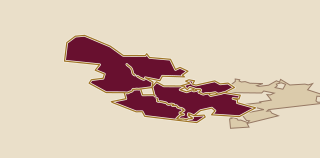
Atlas locationMargaux · Bordeaux · France45.04° N · 0.67° W

At A Glance

Field
Detail
Region
Médoc, southwest France
Place
Margaux
Classification
First Growth, 1855
Red grapes
Cabernet Sauvignon, Merlot, Petit Verdot, Cabernet Franc
White grape
Sauvignon Blanc
Principal wines
Grand Vin du Château Margaux, Pavillon Rouge du Château Margaux, Pavillon Blanc du Château Margaux

The Producer

Château Margaux has a history spanning more than five centuries in the Médoc region of southwest France. The Mentzelopoulos family guides the estate today. Its property covers 265 hectares, with around 100 hectares dedicated to vines.

The estate combines a 1855 First Growth classification with a current programme of organic farming, estate vineyards, and cellar work carried out on the property. Its principal wines divide between two Cabernet Sauvignon led reds and a Sauvignon Blanc white.

Place

Château Margaux sits in Margaux, within the Médoc region of southwest France. The Médoc is the wider regional setting, while Margaux supplies the local name attached to the château and its wines.

The First Growth classification belongs to the estate, not to a grape variety. Bordeaux assigned the rank in 1855, placing Château Margaux within a system based on named properties and their wines.

Story

In 1977, the Ginestet family sold Château Margaux to André Mentzelopoulos amid mounting debts and depressed Bordeaux prices. Mentzelopoulos took over an estate whose ownership had changed under financial pressure, then guided its next phase with the family that still directs it.

Château Margaux began green harvesting in 1986 and became one of the first estates to practise the method. Green harvesting removes some bunches before the final harvest, reducing yields. At Château Margaux, the practice was associated with increased concentration in the wines.

Vineyards And Cellar

The red wine vineyard covers 82 hectares. It is planted to 75 percent Cabernet Sauvignon, 20 percent Merlot, 3 percent Petit Verdot, and 2 percent Cabernet Franc.

Château Margaux maintains its own cooperage on the property. A major cellar renovation was completed in 2015. These are separate parts of the estate's current production infrastructure, one devoted to barrel making and the other to cellar modernisation.

Wines

Grand Vin du Château Margaux is the estate's Cabernet Sauvignon led red, aged for an average of 21 months in new French oak barrels. Pavillon Rouge du Château Margaux is another Cabernet Sauvignon dominated red, aged for around 20 months, with nearly 60 percent of the wine in new French oak barrels.

Pavillon Blanc du Château Margaux is the estate's white wine, made exclusively from Sauvignon Blanc. It is aged for around eight months, with approximately 20 percent in new French oak barrels. The range therefore moves between long aged reds and a shorter aged white, with each bottle defined by its grape and cellar regime.

In The Glass

Grand Vin du Château Margaux has dense, supple tannins supporting a deep, balanced palate marked by length and freshness.

Pavillon Rouge retains concentration and tannin quality comparable to the Grand Vin while offering a more approachable expression of Château Margaux.

Pavillon Blanc opens with white flowers, lemon peel, grapefruit, and ripe peach. Saline energy and a refined mineral core carry through the palate, which combines a full yet taut feel with supple texture and acidity without heaviness.

A Bottle To Understand It

Pavillon Blanc du Château Margaux is the first bottle to open. It is the estate's white wine and the principal bottling made exclusively from Sauvignon Blanc. Its colour and grape set it apart from both red wines, giving the range a distinct white counterpart. The bottle's approximately 20 percent share of new French oak also marks a different cellar regime from the longer aged reds.

Anecdote

In 1810, the Marquis de la Colonilla became the new owner of Château Margaux and set about reinvigorating the estate. He hired the architect Louis Combes to design a new château and cellars. The commission covered both the château and the spaces used for wine production. Those buildings are still used at Château Margaux today. Louis Combes's work therefore remains part of the physical estate, from the château itself to the cellars that continue to serve the property.

Final Word

In 2017, Château Margaux farmed using only organic methods, within an estate whose history spans more than five centuries.

Sources

1. https://chateau-margaux.com/en/ 2. https://www.thewinecellarinsider.com/bordeaux-wine-producer-profiles/bordeaux/margaux/margaux/ 3. https://chateau-margaux.com/en/vins/grand-vin-du-chateau-margaux 4. https://chateau-margaux.com/en/vins/pavillon-rouge-du-chateau-margaux 5. https://chateau-margaux.com/en/vins/pavillon-blanc-du-chateau-margaux 6. https://www.bbr.com/products-20248122861-2024-pavillon-blanc-du-chateau-margaux-bordeaux

Keep following the thread

Where to go next

placeRead the Bordeaux guideSee Château Margaux in the wider setting of Bordeaux.mapFind Château Margaux on the mapKeep the producer, its region and nearby places together.learningUnderstand Cabernet SauvignonRead the quick library guide to Cabernet Sauvignon, which is listed with this producer.