NoleaWorld of Wine

Fuissé · Bourgogne · France

Producer profile

Château Fuissé

Fuissé domaine working more than 100 plots, from Pouilly-Fuissé and Saint-Véran to Gamay Juliénas and Chardonnay Crémant.

Place
Fuissé · Bourgogne · France
Known for
Pouilly-Fuissé parcels and Chardonnay Crémant
Wine context
Chardonnay · Gamay
Editorial basis
World of Wine editorial profile · 9 sources

World of Wine editorial profile · Source list ↓

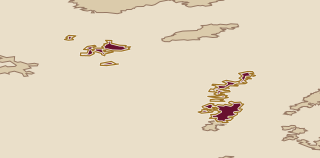
Atlas locationFuissé · Bourgogne · France46.28° N · 4.74° E

At A Glance

Field
Detail
Region
Burgundy, Mâconnais
Village
Fuissé
Vineyards
40 hectares divided into over 100 plots
Documented grapes
Chardonnay in Crémant de Bourgogne, Gamay in Juliénas
Signature site
Le Clos, a 6.67 acres southwest-facing Premier Cru monopole
Cellar
Hand harvests, whole-bunch pressing and barrel ageing

The Producer

The château sits at the heart of Pouilly-Fuissé in Fuissé, in the Mâconnais, with 40 hectares divided into over 100 plots. Antoine Vincent is the fifth-generation proprietor, born in 1975, and trained in oenology and winemaking in Angers and Toulouse. The range includes Pouilly-Fuissé, Saint-Véran, Juliénas and Crémant de Bourgogne.

No universal formula governs the plots. Château Fuissé adapts its methods to the constraints of each area, while the wider family philosophy joins manual harvests, cultivation respecting biodiversity and harmony in work. The range includes still white, red and sparkling wines from separate Burgundy appellations.

Place

In the Mâconnais, appellation names put different addresses on the bottles. Château Fuissé's Pouilly-Fuissé holdings cover 25 hectares across 45 climats, with parcels mainly blended for the Tête de Cuvée. A climat is a named Burgundy vineyard parcel, so the cuvée brings multiple localities together under one appellation.

Saint-Véran keeps the white wines within the Mâconnais. Juliénas moves the range into Beaujolais with Gamay, while Crémant de Bourgogne changes the format to traditional-method sparkling wine.

Soil And Site

Le Clos is a vineyard of 6.67 acres enclosed by a dry stone wall and facing southwest. The vines are over 50 years old. A southwest exposure receives late-day sun, while stone walls can store warmth and release it gradually. Older vines often produce smaller crops and send roots through more layers of soil, physical effects associated with ripening and fruit concentration.

Story

Antoine Vincent studied oenology and winemaking in Angers and Toulouse before becoming the fifth-generation proprietor at Château Fuissé. He manages a domaine whose plots impose different vineyard constraints, and the estate answers with methods adapted to each area instead of one universal formula. That approach appears in the range as separate appellation wines and a Pouilly-Fuissé Tête de Cuvée assembled from different climats.

Vineyards And Cellar

The family practises Lutte Raisonnée, reducing artificial herbicides and pesticides in favour of natural preparations. Manual harvests allow the grapes to arrive at the winery carefully, where gentle whole-bunch pressing limits handling and can reduce the extraction of bitter phenolics from skins and stems.

Malolactic fermentation is encouraged partially or fully depending on the vintage and desired style. This secondary fermentation converts sharper malic acid into softer lactic acid, lowering perceived acidity and adding roundness when the cellar calls for it. The wines generally spend a maximum of nine months in barrel, with exceptional vintages able to reach 12 months.

Wines

The range begins with still white wines from the Mâconnais, including Saint-Véran and Pouilly-Fuissé. Juliénas provides the red wine, made from exclusive Gamay. Crémant de Bourgogne provides the sparkling bottle, made from 100% Chardonnay by the traditional method.

Pouilly-Fuissé Tête de Cuvée is mainly blended from the estate's climat parcels. Le Clos is the named Premier Cru monopole, a classified vineyard controlled by one domaine. The bottles therefore move from broader appellation wines to a single controlled site, with sparkling wine adding a second fermentation and lees ageing to the range.

In The Glass

Saint-Véran 2024 is pale yellow with hints of green. It opens with intense ripe fruit, peaches, apple, citrus and white flowers, followed by a fresh, mineral palate with savory notes. Calcareous clay soils and tank vinification are part of its stated profile.

Juliénas shows the Beaujolais character of small red fruits and delicate spices. Its deep, well-drained soils of granite rock sediments and slate support a wine with soft, fine tannins.

Crémant de Bourgogne is pale yellow with hints of green, fine regular bubbles and a clean, brilliant appearance. Fresh floral aromas bring green apple, while the palate is slightly mineral, fresh and persistent. Traditional-method fermentation gives the wine a constant lace of fine mousse.

A Bottle To Understand It

Choose the Crémant de Bourgogne Brut. It is 100% Chardonnay, made by the traditional method with a second fermentation on the lees for 12 to 15 months. Traditional method means the bubbles form through a second fermentation in the bottle, while lees contact can add creamier texture and finer mousse. The bottle gives the range its sparkling expression and places Chardonnay beside the still white and Gamay red wines.

Anecdote

In 2020, Château Fuissé's Le Clos was raised to Premier Cru monopole status, becoming the sole monopole within the Pouilly-Fuissé appellation. The classification changed the vineyard's official place in the appellation hierarchy. Premier Cru identifies a higher vineyard classification than the village level, while monopole means that one domaine controls the named site. Le Clos entered the Pouilly-Fuissé range with both designations attached to the vineyard name.

Final Word

Château Fuissé works parcel by parcel, hand harvests its grapes and adjusts malolactic fermentation to the vintage and desired style. Its wines carry those choices across still whites, Gamay red and traditional-method Chardonnay sparkling wine.

Sources

Keep following the thread

Where to go next

placeRead the Bourgogne guideSee Château Fuissé in the wider setting of Bourgogne.mapFind Château Fuissé on the mapKeep the producer, its region and nearby places together.learningUnderstand ChardonnayRead the quick library guide to Chardonnay, which is listed with this producer.