NoleaWorld of Wine

Bordeaux · France

Producer profile

Château du Tertre

A Bordeaux estate whose origins trace to the Seigneurie d'Arsac in 1143. Its grand vin puts Cabernet Sauvignon at the centre, bringing freshness, silky enveloping tannins and the capacity to develop for 10 to 25 years after vintage.

Place
Bordeaux · France
Known for
Cabernet Sauvignon in the grand vin, where freshness and silky enveloping tannins support a 10 to 25 year drinking window.
Wine context
Cabernet Franc · Cabernet Sauvignon · Merlot
Editorial basis
World of Wine editorial profile · 5 sources

World of Wine editorial profile · Source list ↓

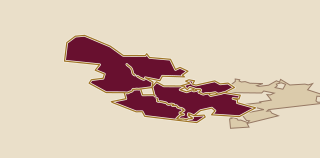
Atlas locationBordeaux · France45.01° N · 0.68° W

At A Glance

Château du Tertre is a Bordeaux producer in France whose origins reach back to the Seigneurie d'Arsac in 1143. Its grand vin places Cabernet Sauvignon at the centre of the drinking experience, bringing freshness, silky enveloping tannins and the capacity to develop over time. The usual drinking window falls between 10 and 25 years after vintage. Les Hauts du Tertre occupies a separate range position, with a blend of Cabernet Sauvignon, Merlot, Cabernet Franc and Petit Verdot, and a silky, spicy, fruity profile.

The Producer

The strongest thread at Château du Tertre runs from an unusually early estate history to a clear grape signature. The Seigneurie d'Arsac appears in records from 1143, while the wines today are understood through Cabernet Sauvignon in the grand vin. That grape supplies freshness and silky, enveloping tannins, giving the wine both lift when young and the shape to develop in bottle.

The range also includes Les Hauts du Tertre, a second wine with its own blend and flavour register. It is made from 40% Cabernet Sauvignon, 35% Merlot, and 25% Cabernet Franc and Petit Verdot. The composition brings a softer, silkier reading of the estate's red wine range, with spicy and fruity notes and aromatic complexity.

Place

Château du Tertre belongs to Bordeaux, in France. That regional setting places the wines inside a blend-led tradition, but the most useful label relationship is more specific: the grand vin is the principal bottle, while Les Hauts du Tertre is the second wine with a separately stated composition. Cabernet Sauvignon links the two, while the additional grapes in Les Hauts du Tertre broaden its fruit and spice profile.

The estate's bottles also carry different time signals. The grand vin is associated with a 10 to 25 year window after vintage, while Les Hauts du Tertre offers a distinct expression through its silky texture and aromatic range. The label names therefore point to both position and style.

Soil And Site

The physical language attached to Château du Tertre here begins with Bordeaux. No named soil, slope, elevation or parcel is needed to understand the main wine distinction. Cabernet Sauvignon supplies freshness and silky, enveloping tannins in the grand vin, so grape choice provides the clearest link between place and glass.

Les Hauts du Tertre changes that reading through its 40%, 35%, 25% blend. Merlot, Cabernet Franc and Petit Verdot join Cabernet Sauvignon, and the stated result is silky, with spicy and fruity notes. The blend changes the wine's aromatic register without obscuring its Bordeaux origin.

Story

The story starts in 1143, when the Seigneurie d'Arsac is recorded in connection with the estate. That date gives Château du Tertre a long historical beginning, but the present wines are not presented as museum pieces. Their character arrives through a grape choice and a range divided between a grand vin and a second wine.

Cabernet Sauvignon carries the longer arc in the grand vin. Freshness and silky, enveloping tannins support a typical drinking window of 10 to 25 years after vintage. Les Hauts du Tertre carries the range forward through a defined blend of four Bordeaux grapes and a more immediately described register of silk, spice, fruit and aromatic complexity.

Vineyards And Cellar

Cabernet Sauvignon is the clearest production choice attached to the grand vin. Its freshness keeps the wine lively, while its silky, enveloping tannins provide the material for bottle development. The drinking window gives that grape role a practical consequence: this is a wine whose character can unfold over a decade or more.

Les Hauts du Tertre makes the range architecture visible in the blend itself. Cabernet Sauvignon accounts for 40%, Merlot 35%, and Cabernet Franc with Petit Verdot the remaining 25%. That proportion is paired with a silky texture, spicy and fruity notes, and aromatic complexity, giving the second wine a defined character of its own.

Wines

Château du Tertre, the grand vin, is the bottle to associate with Cabernet Sauvignon's contribution. Freshness sits alongside silky, enveloping tannins, and the wine carries enough ageing potential to reach optimal drinking between 10 and 25 years after vintage. The 2015 vintage supplies a particularly clear profile, with fresh blackcurrant and black cherry aromas followed by purity on the palate.

Les Hauts du Tertre is the second wine, blended from 40% Cabernet Sauvignon, 35% Merlot, and 25% Cabernet Franc and Petit Verdot. Its stated style is silky, with spicy and fruity notes and aromatic complexity. The blend gives it a separate position in the range, with fruit, spice and texture doing more of the talking than a long cellaring horizon.

In The Glass

Château du Tertre 2015 opens with blackcurrant and black cherry, both fresh rather than heavy. The fruit leads into a palate marked by purity, then Cabernet Sauvignon brings freshness and silky, enveloping tannins. The final impression is shaped by the meeting of clean fruit and soft-edged tannin, with the wine's ageing potential suggesting that these elements can gain depth in bottle.

Les Hauts du Tertre moves differently. Spicy and fruity notes rise first, then the palate takes on a silky texture. Its aromatic complexity comes from the four-grape blend, while the combination of Cabernet Sauvignon, Merlot, Cabernet Franc and Petit Verdot keeps the wine rooted in a Bordeaux red style. The finish returns to silk, fruit and spice.

A Bottle To Understand It

Château du Tertre 2015 is the bottle to open first. It offers the clearest vintage-specific picture of the estate: fresh blackcurrant and black cherry in the glass, purity across the palate, and Cabernet Sauvignon providing freshness with silky, enveloping tannins. The wine also introduces the estate's time scale, since Château du Tertre typically reaches optimal drinking between 10 and 25 years after vintage. One bottle therefore brings together fruit, texture, grape character and the way the grand vin is meant to develop.

Anecdote

In 1143, the name Seigneurie d'Arsac appears in a record tied to the early history of Château du Tertre. The date sits at the far end of the estate's traceable past, long before the modern labels carried a grand vin and a second wine into the market. The record preserves a name rather than a tasting note: Seigneurie d'Arsac, a title rooted in the estate's medieval beginning. Centuries later, Château du Tertre still carries that old name forward, now attached to bottles shaped by Cabernet Sauvignon, Merlot, Cabernet Franc and Petit Verdot. The first date is simple, but it gives the present label a surprisingly deep starting point.

Final Word

Château du Tertre brings together a medieval name, a Bordeaux setting and a range with two distinct bottle roles. The grand vin asks for time, with Cabernet Sauvignon supplying freshness and silky tannins across a 10 to 25 year drinking window. Les Hauts du Tertre offers a different proportion of grapes and a silky, spicy, fruity profile. The 2015 vintage gives the most direct taste of the estate's red fruit and palate purity.

Sources

Keep following the thread

Where to go next

placeRead the Bordeaux guideSee Château du Tertre in the wider setting of Bordeaux.mapFind Château du Tertre on the mapKeep the producer, its region and nearby places together.learningUnderstand Cabernet SauvignonRead the quick library guide to Cabernet Sauvignon, which is listed with this producer.