NoleaWorld of Wine

La Cadière-d'Azur · Provence · France

Producer profile

Château de Pibarnon

Château de Pibarnon is a Bandol estate in La Cadière-d'Azur where Mourvèdre shapes a 90% red, a 65% rosé and Nuances, a pure Mourvèdre rosé from old vines on a dedicated plot.

Place
La Cadière-d'Azur · Provence · France
Known for
Mourvèdre-led Bandol from steep terraces and blue Santonian marls, with hand harvesting, indigenous yeast fermentation, French oak ageing and a range that moves from a 90% Mourvèdre red to the old-vine Nuances rosé.
Wine context
Grenache / Garnacha · Mourvèdre · Tavel & Bandol
Editorial basis
World of Wine editorial profile · 5 sources

World of Wine editorial profile · Source list ↓

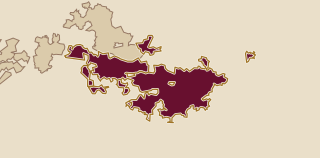
Atlas locationLa Cadière-d'Azur · Provence · France43.18° N · 5.75° E

At A Glance

Château de Pibarnon is a Bandol producer in La Cadière-d'Azur, Provence, built around Mourvèdre. Its red is 90% Mourvèdre and 10% Grenache, the standard rosé is 65% Mourvèdre and 35% Cinsault, and Nuances is a dedicated-plot pure Mourvèdre rosé from the oldest vines.

The Producer

In 1978, Catherine and Henri de Saint Victor made their first wine alone. That vintage gave Château de Pibarnon its family-led form, and Mourvèdre has remained at the centre of the range. The estate is based in La Cadière-d'Azur, a village within Provence's Bandol appellation, so Bandol names the legal place on the label while Mourvèdre identifies the grape that drives the wines.

Eric de Saint-Victor later joined the domaine and represents its new generation of leadership. His arrival connects the estate's founding work with its current direction, while the bottles continue to show the same basic relationship between steep terraces, Bandol and Mourvèdre.

Place

The vineyards rise in steep, terraced terrain around La Cadière-d'Azur. The landform dictates the work: harvest is always by hand because workers cannot treat these slopes like a flat vineyard. That physical difficulty reaches the bottle through careful handling of fruit from terraces, and it helps distinguish Pibarnon's Bandol from a generic Provençal blend.

Bandol also sets the range's grape conversation. The red is heavily Mourvèdre-led, while the standard rosé keeps Mourvèdre in the majority and brings in Cinsault. Nuances narrows the focus further, using Mourvèdre alone from a dedicated plot.

Soil And Site

The vineyard contains blue marls from the Santonian period. The same geological formation occurs at Château Pétrus, Château d'Yquem and Château Chalon. That comparison is geological, not a tasting claim, and the useful detail is the marl beneath Pibarnon's terraces rather than the famous names beside it.

The soil story gives the wines a specific physical address. It sits alongside the steep slopes and the Mourvèdre plantings, linking the Bandol appellation to a site that is worked by hand and expressed through a grape capable of carrying the red, the standard rosé and the pure Mourvèdre Nuances.

Story

Modesto Ramognino established the property in the mid-1950s with 3.5 hectares of Mourvèdre. The estate therefore began with a small, clearly defined grape base before Catherine and Henri de Saint Victor made their first wine alone in 1978. Their work changed the property from an established vineyard into a family domaine with its own wines.

The next movement came when Eric de Saint-Victor joined the domaine and took his place in the new generation. The public record then added two markers of reach: Pibarnon won one of the 10 Trophies of Excellence at the International Wine Challenge in 1997, and the 1990 Red was served at a summit of European heads of state in Paris hosted by Jacques Chirac.

The farming direction changed as well. Organic conversion began in 2004 and was completed in 2006, bringing the vineyard's working method into line with the estate's long-term care of its terraces.

Vineyards And Cellar

Hand harvesting follows directly from the steep, terraced ground. Fruit is gathered by hand from rows that demand physical access, keeping the vineyard method tied to the shape of the land rather than to an abstract farming policy.

The organic conversion began in 2004, finished in 2006, and was followed by official organic certification from the 2019 vintage. The timeline separates the change in farming from the later formal certification, while both dates belong to the way the vineyard is managed today.

In the cellar, fermentation uses indigenous yeasts. The wines then age in a combination of new and older French oak casks. That method places natural fermentation and cask ageing beside the grape and site, without relying on a single new-oak signature to define the bottles.

Nuances 2021 brings the vineyard choices into sharper focus. It comes from the oldest vines at yields around 30 hl/ha and is presented as an intensely luminous Claret Rosé and a vin de garde.

Wines

The red is the central Bandol bottle, composed of 90% Mourvèdre and 10% Grenache. Its place in the range is clear: Mourvèdre leads, Grenache supports, and the wine carries the estate's main red-wine expression.

The standard rosé uses 65% Mourvèdre and 35% Cinsault. It is a blended rosé, so it sits beside the red as another Mourvèdre-led wine while remaining distinct from Nuances, which is pure Mourvèdre from a dedicated plot.

Nuances 2021 occupies a different register. The old vines and yield of around 30 hl/ha give the bottle concentrated fruit, seed tannin, citrus freshness and a finish that lasts beyond the first sip. Its Claret colour and vin de garde role place it closer to a cellar-worthy rosé than a simple early-drinking pour. Across the range, fruit, tannin, freshness and finish are visible in different proportions, with Nuances making all four easiest to feel at once.

In The Glass

Nuances 2021 opens with pomegranate juice, nectarines, apricots and blood oranges. The fruit moves from red to white-fleshed tones as the wine enters the mouth, where its concentrated palate carries the weight of the old-vine selection.

Then the detail turns savoury and aromatic. Liquorice, sage, lavender honey and wax follow the fruit, while saffron, anise, lavender and Mediterranean spice broaden the middle of the palate. Citrus zest keeps the wine lifted through the finish, and the seed tannins leave a dry, lightly grained impression after the fruit has receded.

A Bottle To Understand It

Start with Nuances 2021. It is a pure Mourvèdre Claret Rosé from a dedicated plot of the estate's oldest vines, harvested at around 30 hl/ha and made as a vin de garde. The luminous colour, concentrated fruit, seed tannin, citrus zest and Mediterranean spice give it more to follow than a quick aperitif rosé.

This bottle gathers the main Pibarnon choices in one place: Bandol's leading grape, a defined parcel, old vines, low yields and a cellar role built for time. It is the most direct way to encounter how the estate turns Mourvèdre into a rosé with grip, flavour depth and a lingering finish.

Anecdote

In 1990, Château de Pibarnon's Red travelled from La Cadière-d'Azur to Paris. It was served at a summit of European heads of state hosted by Jacques Chirac. The bottle came from the estate's Bandol vineyards, where Mourvèdre leads the red blend, but the setting was far from the terraces: a formal gathering of European leaders in the French capital. The vintage was 1990, the wine was Pibarnon Red, and the host was Chirac. Those details fix the scene in time and place. A Bandol bottle left its Provençal hillside and appeared at a Paris summit table.

Final Word

Château de Pibarnon makes Bandol legible through physical choices: steep terraces, hand harvesting, blue Santonian marls, organic farming and a range led by Mourvèdre. The red shows the grape with Grenache, the standard rosé pairs it with Cinsault, and Nuances isolates it in a low-yield old-vine rosé with fruit, tannin, citrus freshness and a lasting finish.

Sources

Keep following the thread

Where to go next

placeRead the Provence guideSee Château de Pibarnon in the wider setting of Provence.mapFind Château de Pibarnon on the mapKeep the producer, its region and nearby places together.learningUnderstand MourvèdreRead the quick library guide to Mourvèdre, which is listed with this producer.