NoleaWorld of Wine

Champagne · France

Producer profile

Champagne Perrier-Jouët

Épernay Champagne house known for floral wines, from Grand Brut to Belle Époque Brut and Rosé.

Place
Champagne · France
Known for
Floral Champagne cuvées
Wine context
Chardonnay · Pinot Noir
Editorial basis
World of Wine editorial profile · 5 sources

World of Wine editorial profile · Source list ↓

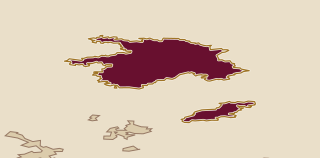
Atlas locationChampagne · France49.04° N · 3.96° E

At A Glance

Field
Detail
Region
Champagne
Base
Épernay, Avenue de Champagne
Main grape varieties
Chardonnay, Pinot Noir, Pinot Meunier
Main cuvées
Grand Brut, Belle Époque Brut, Belle Époque Rosé
Defining feature
Floral Champagnes

The Producer

Perrier-Jouët describes its house style as floral Champagnes. It is a large Champagne house owned by Pernod Ricard and based in Épernay, with a range built around Grand Brut, Belle Époque Brut and Belle Époque Rosé.

Grand Brut is the recurring house Champagne made in a nonvintage style. Belle Époque Brut and Belle Époque Rosé are vintage cuvées, giving the range two different ways to express Champagne. The house also describes its work as a quest for perfection.

Place

Épernay's Avenue de Champagne is Perrier-Jouët's home address. Champagne is a sparkling wine region and appellation where the wine undergoes a second fermentation in bottle. That process creates the bubbles, while contact with spent yeast during lees ageing can bring bread, biscuit and creamier texture.

Perrier-Jouët's wines stay within this traditional Champagne format. Grand Brut uses the nonvintage approach, while Belle Époque Brut and Belle Époque Rosé attach the bottle to a single vintage.

Story

In 1811, Pierre-Nicolas Perrier and Rose Adélaïde Jouët founded the house. Later in the nineteenth century, Perrier-Jouët expanded into Grand Cru areas including Avize and Cramant. Grand Cru is Champagne's highest village classification, so the move brought fruit from top-ranked villages into the house's vineyard base.

The founding and the later expansion shaped both sides of the producer's history. Pierre-Nicolas Perrier and Rose Adélaïde Jouët established the maison, then the house widened its holdings into Grand Cru areas while continuing its Champagne production.

Vineyards And Cellar

Grand Brut uses 20% Chardonnay, 40% Pinot Noir and 40% Pinot Meunier. Chardonnay generally contributes acidity and citrus, Pinot Noir brings body and red fruit, and Pinot Meunier contributes fruit and roundness.

Champagne production begins with a base wine before the second fermentation takes place in bottle. Lees ageing follows, with the spent yeast adding texture and notes such as brioche and biscuit. The bubbles are created in the bottle, while the grape varieties set the balance between freshness, fruit and weight.

Wines

The range has three distinct roles. Grand Brut is the house Champagne made from several harvests, with a relatively soft mousse and an aperitif role. Belle Époque Brut is the vintage white cuvée, while Belle Époque Rosé is the vintage pink expression.

This progression moves from a recurring house style to wines defined by a single year and a more specific colour. The rosé adds a separate visual and aromatic register to the Belle Époque line, while the Brut keeps the focus on white Champagne.

In The Glass

Grand Brut opens with brioche, hay, crisp green apple, faint rhubarb and pine sap. The palate is clean and balanced, with creamy green apple fruit, a zesty bite, biscuit and a touch of yeast. Its finish is cleansing, marked by minerality and citrus. The mousse and mouthfeel are relatively soft, which suits its aperitif role.

Belle Époque Brut has a long, harmonious finish. Belle Époque Rosé 2013 is pale onion skin in colour, with delicate raspberry and strawberry aromas layered with spices, ginger, florals, chalk and minerals. Bright acidity gives the wine intensity, while the persistence stays delicate.

Belle Époque Rosé 2012 is even paler, with an ethereal character and complex layers of red fruit, pink grapefruit, citrus, florals and spices. It has balance and very long persistence.

A Bottle To Understand It

Choose Grand Brut. It is the house's nonvintage Champagne and its aperitif cuvée, made from the three principal Champagne grape varieties. Several harvests contribute to the style, so the bottle presents Perrier-Jouët through a recurring house format instead of one declared year.

Belle Époque Brut and Belle Époque Rosé can follow as vintage cuvées, where the year becomes part of the bottle's definition. Grand Brut establishes the distinction between the house Champagne and the named Belle Époque wines through the label and production format.

Anecdote

Around 1902, Émile Gallé created a decorated magnum featuring Japanese anemones for Perrier-Jouët. Michel Budin and Pierre Ernst rediscovered the design in 1964 and revived it. Perrier-Jouët then launched Belle Époque commercially in 1969. A decoration created for a magnum became the signature bottle design of the cuvée, carrying Japanese anemones from an Art Nouveau object into the house's Champagne range.

Final Word

Perrier-Jouët is an Épernay Champagne house whose range moves from Grand Brut to Belle Époque Brut and Rosé, all within a floral house style.

Sources

Keep following the thread

Where to go next

placeRead the Champagne guideSee Champagne Perrier-Jouët in the wider setting of Champagne.mapFind Champagne Perrier-Jouët on the mapKeep the producer, its region and nearby places together.learningUnderstand ChampagneRead the quick library guide to Champagne, which is listed with this producer.