At A Glance
Champagne J.M. Labruyère is based in Verzenay, a Champagne village placed among the region's top three crus in an unofficial 1873 ranking. Its clearest comparison sits between two bottles: Page Blanche, made entirely from Chardonnay, and Prologue, a blend led by Pinot Noir. Barrel ageing appears in both wines, at 20% for Page Blanche and 34% for Prologue, while the glass moves from citrus and saline length to cherry, toast and generous red fruit.
The Producer
J.M. Labruyère begins with a place name and two different readings of Champagne. Verzenay supplies the village anchor. Page Blanche uses 100% Chardonnay and presents the grape through precise citrus, a taut palate and a long savoury finish. Prologue shifts the balance to 73% Pinot Noir and 27% Chardonnay, with cherry fruit, brioche, toast, anise and menthol around a fuller red-fruited palate.
The range is small enough to compare directly. Page Blanche isolates one grape and a cooler, citrus-led register. Prologue blends the two principal grapes in a Pinot Noir-led proportion, then moves toward a more generous and harmonious style. The bottles make the producer legible through composition, barrel use and taste.
Place
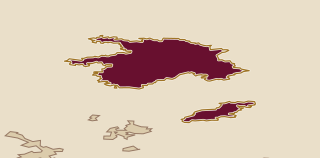
Verzenay is a village in Champagne and the fixed geographical reference for J.M. Labruyère. An unofficial ranking from 1873 placed it among the three leading crus in the region, a historical detail that places the estate inside Champagne's village hierarchy without reducing the wines to a prestige label.
That village name sits beside two different grape choices. Page Blanche uses Chardonnay alone, so the wine carries citrus and saline persistence as its main line. Prologue places Pinot Noir at the centre, with Chardonnay in support, and carries cherry and red fruit into a broader palate. The same Champagne address therefore appears through two different bottle styles.
Soil And Site
The bottles are presented through Verzenay rather than a named soil, slope or parcel. The site story therefore stays close to the village and the grapes. Page Blanche reads the range through Chardonnay, while Prologue reads it through a Pinot Noir-led blend; their differing barrel proportions add a cellar distinction to the geographical one.
This keeps the physical claim exact. Verzenay supplies the place name and historical cru reference. The wines supply the finer contrast through colour, aroma, fruit and mouthfeel, with no unsupported parcel or soil description added to the label story.
Story
J.M. Labruyère's clearest story is carried by the movement between two bottles. Page Blanche takes Chardonnay on its own, with 20% of the wine aged in oak barrels. Prologue changes both the blend and the barrel proportion, using 73% Pinot Noir, 27% Chardonnay and 34% barrel ageing. Those decisions move the range from citrus-led freshness toward cherry fruit, toast, brioche and a more generous palate.
The shift is visible before the first sip. Page Blanche is green gold with silvery highlights. Prologue is bright golden yellow. One bottle narrows the frame around Chardonnay; the other broadens it through Pinot Noir and red fruit. The estate's story arrives through that side-by-side reading.
Vineyards And Cellar
The available wines show cellar choice most clearly through the proportion aged in oak barrels. Page Blanche has 20% barrel ageing behind its 100% Chardonnay composition. Its pure citrus nose and long saline finish keep the wine's profile focused, without a specific oak flavour being assigned.
Prologue raises the barrel-aged portion to 34% while combining 73% Pinot Noir with 27% Chardonnay. Its cherry fruit sits alongside toasted and brioche notes, followed by anise and menthol. The higher barrel proportion belongs to a wine with more overt red fruit and a rounder, more indulgent palate, while the grape blend remains the primary guide to its character.
Wines
Page Blanche is the range's pure Chardonnay bottle. Its green-gold colour carries silvery highlights, and the nose is very pure, with precise citrus notes. On the palate it is energetic, taut and refined, with a long, sapid finish. The label composition and the taste profile point in the same direction: Chardonnay first, with freshness and saline persistence at the centre.
Prologue occupies the Pinot Noir-led position. The blend is 73% Pinot Noir and 27% Chardonnay, and 34% is aged in oak barrels. It shows a bright golden yellow colour, beautiful cherry fruit, toasted and brioche notes, then secondary aromas of anise and menthol. Flavourful red fruit carries the palate, which is generous, indulgent and harmonious.
Together, the bottles offer two clear range levels without requiring a full portfolio map. Page Blanche is the single-grape, citrus and saline reading. Prologue is the blended, cherry and red-fruit reading. Barrel ageing is present in both, but the different proportions accompany different grape balances and different sensory registers.
In The Glass
Page Blanche opens with a green-gold appearance edged in silver. The nose rises cleanly with precise citrus. In the mouth, the 100% Chardonnay composition carries energetic freshness and a taut, refined feel, while the finish stretches into saline persistence. Its 20% barrel ageing sits behind the wine without displacing the citrus-led profile.
Prologue starts brighter and more golden. Cherry arrives first, followed by toast and brioche, with anise and menthol adding a cool herbal lift. The palate brings flavourful red fruit and a fuller, more indulgent impression. Its 73% Pinot Noir and 34% barrel-aged portion place fruit, warmth and harmony more visibly in the foreground.
A Bottle To Understand It
Start with Page Blanche. It is 100% Chardonnay, so the grape comparison begins with a single variety rather than a blend. The wine is green gold with silvery highlights, pure on the nose and marked by precise citrus. In the mouth, it is energetic and taut, then finishes long and saline.
The 20% barrel-aged portion adds a cellar detail without overwhelming the bottle's central shape. Page Blanche is the clearest first pour for understanding how J.M. Labruyère places grape composition, barrel use and Verzenay in one glass. Prologue can follow as the contrasting Pinot Noir-led bottle.
Anecdote
In 1873, an unofficial ranking placed Verzenay among the top three crus in Champagne. The ranking was not a formal modern classification, but it fixed the village inside a conversation about Champagne's leading places. More than a century later, Champagne J.M. Labruyère is based in Verzenay, and its two clearest bottles carry the village name into sharply different wines. Page Blanche is 100% Chardonnay, with precise citrus and a long sapid finish. Prologue is 73% Pinot Noir and 27% Chardonnay, with cherry, toast, brioche, anise and menthol around flavourful red fruit. The old line names Verzenay; the bottles show how differently one producer can read it.
Final Word
Champagne J.M. Labruyère is easiest to understand through contrast. Page Blanche brings pure Chardonnay, citrus, taut freshness and saline length. Prologue brings Pinot Noir-led fruit, cherry, toast, brioche and a more generous palate. Verzenay supplies the place anchor, while the grape proportions and barrel choices carry the story into the glass.