
At A Glance
Type: Grower cooperative Village: Terlan Zone: Alto Adige DOC, northeastern Italy Lead grapes: Pinot Bianco, Sauvignon Blanc Vineyards: 190 hectares across 143 member growers Flagship bottles: Vorberg Pinot Bianco Riserva, Quarz Sauvignon Blanc Aging range: Entry whites for early drinking through prestige Riservas built for ten to fifteen years
The Producer
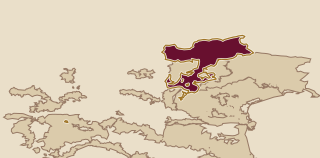
Cantina Terlan sits in the village of Terlan, halfway up the Adige valley in Alto Adige, the Alpine wine zone at the far northeastern tip of Italy. The cooperative draws fruit from 143 member growers farming 190 hectares of steep, terraced vineyards above the valley floor. Most of the region's cooperatives built their commercial reputation on fresh, high-acid whites for early drinking. Terlan took a different position: its prestige range is built around white wines that need years, sometimes a decade or more, to show what they are.
Pinot Bianco and Sauvignon Blanc carry that ambition. They are not the most fashionable grapes in Alto Adige, but on the porphyry slopes above Terlan they produce wines that hold and develop in ways that have made the cooperative a reference point for the zone's aging argument.
Place
Alto Adige was part of Austria until 1919 and carries that history in everything from its bilingual road signs to the German name on every bottle. Kellerei Terlan and Cantina Terlan are the same winery. The appellation law reads Alto Adige DOC, and village-level labelling allows Terlano as a sub-designation. The slopes that supply Terlan's vineyards climb steeply from the valley floor, where cold air drains overnight from the surrounding peaks, preserving acidity in the grapes even when the days are warm enough to build fruit concentration. That combination, warm afternoons and cold nights on steep ground, is what allows white wines here to accumulate both richness and the acidity needed to age.
Soil And Site
The vineyards above Terlan sit on red porphyry, a volcanic igneous rock formed from ancient magma that cooled slowly beneath the earth's surface before being exposed by erosion. Porphyry is hard, well-drained, and poor in nutrients, which forces vine roots deep and limits berry size. The mineral flint note that appears on the nose of Vorberg traces directly to this geology: quartz crystals embedded in the porphyry give the soils their characteristic mineral signature, and that character survives the cellar and lands in the glass.
Story
Alto Adige built its export reputation on whites that were ready young: bright, aromatic, cleanly made, reliably fresh. For decades that was what the market wanted from this corner of northeastern Italy, and most producers in the zone obliged. Terlan's cooperative members farmed the same volcanic slopes, picked from the same porphyry ridges, and arrived at a different conclusion. The prestige range would be built not around immediate drinkability but around aging potential. Vorberg would spend its first years closed, mineral, and slightly austere before the fruit began to open. Quarz would carry lees weight and barrel contact that had no commercial precedent in regional Sauvignon Blanc.
That decision set Terlan's aging wines against Alto Adige's fresh commercial style. The wines are now the clearest evidence in the zone that its volcanic geology, managed with patience, produces white wine with a longer horizon than its commercial image suggested.
Vineyards And Cellar
The 190 hectares are farmed by cooperative members on terraced slopes, with Pinot Bianco and Sauvignon Blanc holding the highest ground. The steep terrain requires hand work through the canopy and limits mechanisation. Altitude and aspect vary by parcel, but the underlying porphyry is consistent across the Vorberg zone.
In the cellar, the winemaking for Quarz sets the method apart from regional convention. The Sauvignon Blanc is whole cluster pressed gently, then clarified by natural sedimentation rather than mechanical fining or filtration. Fermentation runs slowly at controlled temperature. The wine then ages for nine months on its lees in a split of 50% large wooden barrels and 50% stainless steel tanks. The wood is old and large-format, so no oak flavour transfers to the wine. The barrel component adds texture and weight; the lees contact adds complexity. Quarz is 100% Sauvignon Blanc, produced through gentle whole cluster pressing, natural sedimentation, slow fermentation at a controlled temperature, and nine months aging on the lees, half in large wooden barrels and half in stainless steel tanks.
Vorberg follows a different path through the cellar, with the focus on preserving the mineral and fruit character of the porphyry slope through careful élévage and extended aging before release.
Wines
The range moves from everyday whites through single-vineyard Riservas.
Primo is the entry-level Pinot Bianco, made for drinking in its first few years. Lighter body, clean fruit, early accessibility.
Vorberg Pinot Bianco Riserva is the winery's most recognised white. Sourced from a named slope within the Terlan zone, it is made from Pinot Bianco and released as a Riserva after extended aging. The nose carries ripe honeydew melon, white peach, pear, and Golden Delicious apple alongside quince jelly, camomile, and pineapple, with mineral notes of flint underneath. The Riserva is built for ten to fifteen years of development. Recent vintages are documented as drinking well through 2040. The fruit is concentrated and the minerality runs through the whole palate, not just the finish.
Quarz Sauvignon Blanc is 100% Sauvignon Blanc from the Terlan zone. The lees aging, natural sedimentation, and large-barrel component give Quarz textural weight and complexity that reads differently from the tank-fermented, early-release style common in Alto Adige. The grape's aromatic signature is present, but the wine has a depth and breadth on the palate that requires time.
Red wines including Lagrein and Pinot Nero sit alongside the whites in the range but are not the focus of the prestige tier.
In The Glass
Vorberg opens with a wide aromatic lift: melon and peach at the front, then pear and Golden Delicious apple, then a cooler layer of camomile and quince jelly, and underneath everything, the mineral flint that the porphyry drives up through the fruit. On the palate, the wine is full but not heavy, with bright acidity that carries the fruit into a long, mineral finish. The concentration comes from the steep, volcanic slope; the acid line comes from altitude and cold nights. Young Vorberg can feel tight and reserved. Ten years in, the fruit softens and the minerality becomes the dominant character.
Quarz shows differently. The Sauvignon Blanc aromatics are present but quieter than in a tank-made version. The nose carries citrus, stone fruit, and a herbal note, but the lees contact and old-barrel aging build a creamy mid-palate weight that keeps the wine from feeling linear. The finish is long, mineral, and dry, with the acidity carrying through without sharpness. It is a Sauvignon Blanc that takes its time.
A Bottle To Understand It
Vorberg Pinot Bianco Riserva. A single named slope, volcanic porphyry soil, Pinot Bianco, long aging. The nose gives melon, peach, and camomile, with the flint note rising as the wine opens in the glass. The palate is concentrated and mineral, the acidity firm, the finish long. Drink it at eight to ten years from vintage and it shows what the porphyry slopes of Terlan produce at full development. Buy it now, put it in a cellar, and come back to it. That is what Terlan built its prestige range to demonstrate.
Anecdote
For most of the twentieth century, Alto Adige's wine cooperatives competed on the same terms: fresh whites, clean fermentation, early bottling, reliable supply. A buyer in Munich or Hamburg knew what an Alto Adige Pinot Grigio was going to taste like, and that predictability had commercial value. Terlan's cooperative members farmed the same Alpine slopes as everyone else. At some point the winery decided that the porphyry geology under their vineyards was producing something the market had not yet asked for: white wine that needed time. The cooperative committed the prestige range to that idea. Vorberg would not be released young. Quarz would spend nine months on lees in old barrels, not stainless tanks. Both wines would develop for a decade before reaching what the winery considered their proper form. The regional market was selling freshness. Terlan was making patience.
Final Word
Cantina Terlan is a cooperative that chose an argument and followed it through. The argument is that volcanic porphyry slopes, farmed carefully and vinified without shortcuts, produce white wines with a decade of life in them. Vorberg and Quarz are the proof. In a region associated with immediate pleasure, they require and reward patience.