
NoleaWorld of Wine

Toscana · Italy

Producer profile

Cantina Bonacchi

Four-generation Tuscan family farming 78 hectares across Chianti Montalbano, Chianti Classico, Brunello di Montalcino, and Bolgheri, producing over three million bottles a year under Andrea Bonacchi.

Place
Italy
Known for
Vin Santo del Chianti (70% Trebbiano, 20% Malvasia, five years in chestnut caratelli); Chianti Montalbano from the Montemagno Estate; Brunello di Montalcino.
Wine context
Cabernet Sauvignon · Merlot · Sangiovese · Vermentino
Editorial basis
World of Wine editorial profile · 4 sources

World of Wine editorial profile · Source list ↓

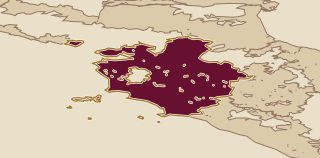
Atlas locationToscana · Italy43.86° N · 10.95° E

At A Glance

**Country**
Italy
**Region**
Tuscany
**Home Appellation**
Chianti Montalbano
**Generation**
Fourth (Andrea Bonacchi)
**Annual Production**
Over 3,000,000 bottles
**Key Bottles**
Vin Santo del Chianti, Vernaccia di San Gimignano
**Appellations**
Chianti Montalbano, Chianti Classico, Brunello di Montalcino, Rosso di Montalcino, Bolgheri

The Producer

Enrico Bonacchi started growing grapes in the late nineteenth century on a small Tuscan plot. The vines he planted still produce fruit on the same land. Four generations later, his great-grandson Andrea runs a winery sending over three million bottles a year to more than twenty countries, with estate vineyards spread across four Tuscan appellations. The scale is industrial by any honest measure. What holds it together is not a single grand cru ambition but a century of deliberate territorial accumulation, each generation claiming a new zone and adding it to the family map.

The home base is Chianti Montalbano, a DOC appellation in the Pistoia and Prato hills northwest of Florence, where the Montemagno Estate gives Bonacchi its largest and oldest vineyard block. From there, the portfolio reaches south into Chianti Classico's Castelnuovo Berardenga zone, further south to the volcanic hills around Montalcino, and west to the coastal strip of Bolgheri, added in 2022. Across those four appellations sit 78.4 hectares of estate vines.

Place

Chianti Montalbano occupies a cluster of hills between Pistoia and the Arno valley, separated from the more famous Chianti Classico zone by geography and by wine law. The appellation permits Sangiovese as its primary grape, supported by Canaiolo and small proportions of white varieties. Altitudes across the zone vary, giving producers options between earlier-ripening valley slopes and cooler, later-ripening upland parcels. The Montemagno Estate, Bonacchi's core holding at 40 hectares, sits within this zone.

Chianti Classico, where Bonacchi farms 23 hectares at the Casalino Farm near Castelnuovo Berardenga, is the southern extension of the Chianti hills and carries its own DOCG designation. Brunello di Montalcino and Rosso di Montalcino, the two appellations sharing Bonacchi's 11 Montalcino hectares, are built entirely on Sangiovese Grosso, locally called Brunello. Bolgheri, the newest addition at 4.4 hectares, sits near the Tuscan coast in the Maremma, where international varieties such as Cabernet Sauvignon and Merlot have long grown alongside Vermentino.

Soil And Site

Chianti Montalbano soils are predominantly galestro, a friable schist-limestone mix, and alberese, a compact clay-limestone combination typical of the Chianti hills. Both drain well and push vines toward lower yields and more concentrated fruit. The Montemagno Estate benefits from the altitude variation characteristic of the zone, which moderates summer heat and helps preserve acidity in the harvested grapes.

Story

Enrico Bonacchi founded the estate in the late nineteenth century as a smallholder, selling grapes and bulk wine the way most Tuscan growers did at the time. His son Pio began buying neighbouring parcels, converting the family from a single plot into a small but growing vineyard operation. The scale was still modest when Giovanni, Andrea's father, took over in the middle of the twentieth century.

In 1965, Giovanni made the acquisition that changed the estate's weight in Tuscany. He bought the Montemagno Estate: 100 acres of established Chianti Montalbano vineyards, a named property with its own name inside the appellation. That purchase gave Bonacchi a core from which to argue that it was more than a grower. Andrea, who leads the winery today, extended the argument further. Chianti Classico, Brunello di Montalcino, and Bolgheri were each added under his watch. The bottling infrastructure grew to match: two automated lines capable of handling over twelve thousand bottles per hour, and storage capacity exceeding 60,000 hectoliters. ISO 9001/2015, BRC, and IFS certifications were obtained to govern quality across that volume.

The direction is clear across four generations: accumulate, consolidate, certify. The Bonacchi model is a family estate that chose breadth across Tuscany's most valued appellations rather than depth in a single one.

Vineyards And Cellar

The Montemagno Estate is Bonacchi's largest single vineyard block at 40 hectares in Chianti Montalbano. The Casalino Farm in Castelnuovo Berardenga accounts for 23 hectares of Chianti Classico. Montalcino contributes 11 hectares split between Brunello and Rosso di Montalcino production. The Bolgheri parcel, 4.

In the cellar, Bonacchi operates across both modern and traditional methods. Stainless steel tanks handle the majority of volume and preserve freshness in earlier-drinking wines. Oak barrels, barriques, and tonneaux are used for wines that require ageing, with the combined liquid capacity exceeding 60,000 hectoliters.

The most labour-intensive cellar process belongs to the Vin Santo del Chianti. After harvest, Trebbiano and Malvasia grapes are hung to dry for approximately two months. The drying concentrates sugar and shifts the aromatic profile toward candied fruit and caramel. Once pressed, the thick, sweet must is transferred into small chestnut caratelli, traditional sealed barrels, where it ages for five years under slow, controlled oxidation. The partially filled barrels allow oxygen contact over that period, deepening the amber colour and building the toffee and citrus complexity that defines the finished wine.

Wines

The Bonacchi portfolio runs from Chianti Montalbano and Chianti Classico as volume anchors through Brunello di Montalcino at the prestige end, with Vin Santo del Chianti as the traditional Tuscan sweet wine sitting apart from the dry range.

The Chianti Montalbano wines, sourced from the Montemagno Estate, are built on Sangiovese with supporting varieties as permitted by the DOC. They represent the family's longest continuous production from a single named property. Chianti Classico from the Casalino Farm in Castelnuovo Berardenga draws on a southerly, warmer sub-zone of the Classico area. Brunello di Montalcino, from 11 Montalcino hectares, is made entirely from Sangiovese Grosso and requires a minimum of five years ageing before release under DOCG rules, with Rosso di Montalcino offering an earlier-drinking counterpart from the same zone.

The Vernaccia di San Gimignano is a dry white made from 100% Vernaccia di San Gimignano grapes at 12.5% alcohol. Vernaccia is the grape of San Gimignano, a medieval hilltop town in the Siena hills southwest of Florence, and one of Italy's oldest documented white varieties. It produces wines with pronounced acidity and a characteristic bitter almond note on the finish.

The Vin Santo del Chianti is a traditional Tuscan passito sweet wine: 70% Trebbiano, 20% Malvasia, and 10% other varieties, amber in colour, with five years in chestnut caratelli giving it depth that straightforward dessert wines rarely achieve.

In The Glass

The Vin Santo del Chianti is the wine that most clearly shows the Bonacchi cellar working at full stretch. On the nose, the amber wine offers a layered sequence: honeyed peach and caramelised orange arrive first, then give way to toffee and candied fruit that build in weight as the glass warms. The two-month appassimento drives sugar concentration and pulls the fruit register decisively toward dried and candied rather than fresh. In the mouth, the wine is genuinely sweet but the freshness does not vanish. Citrus threads through the caramel centre, and the long five-year oxidative ageing in chestnut wood contributes a savoury undertone that keeps the finish from tipping into cloying territory. The wine closes with length.

The Vernaccia di San Gimignano at 12.5% is the dry white counterpart: a tighter, more angular wine by nature of its grape, where bright acidity and the variety's characteristic faint bitter finish do the structural work that sweetness does in the Vin Santo.

A Bottle To Understand It

Start with the Vin Santo del Chianti. It is a 375ml amber dessert wine made from Trebbiano and Malvasia grapes dried for two months, then sealed into chestnut caratelli for five years. Nothing in the Bonacchi range takes longer to make or requires a more deliberate commitment from the cellar, and nothing else in the portfolio shows with such clarity what traditional Tuscan winemaking looks like when followed without shortcuts. The nose is honeyed and caramelised, the palate sweet but cut by a citrus line that keeps it moving, and the finish runs long. Serve it cold with cantuccini, or alongside a piece of aged pecorino where the salt sharpens the wine's fruit. It is a bottle that earns its place at the end of a long meal.

Anecdote

In 1965, Giovanni Bonacchi was looking for land. The family had been growing grapes in Chianti Montalbano for three generations, first under Enrico, then Pio, who spent years buying parcels from neighbouring farmers plot by plot. Giovanni wanted something larger and more coherent. He found it in the Montemagno Estate: 100 acres of established Chianti Montalbano vineyards already planted and producing, sitting in the hills that the family knew well. He bought the whole property. Overnight, Bonacchi went from an expanding smallholding to an estate with a named core. The Montemagno acquisition gave the family a fixed centre of gravity, and every subsequent move, the Chianti Classico farm in Castelnuovo Berardenga, the Montalcino parcels, the Bolgheri purchase in 2022, has been plotted outward from that 1965 decision.

Final Word

Cantina Bonacchi is a Tuscan wine family that has grown deliberately across a century, from a single smallholding to four appellations and three million bottles. The Vin Santo del Chianti, made by a method that demands patience from the winery and attention from the person drinking it, is the bottle that most clearly separates this producer from high-volume Tuscan commodity wine. The range is wide, the scale is real, and the Montemagno Estate gives the whole operation an anchor in the hills that Enrico Bonacchi first farmed in the late nineteenth century.

Sources

Keep following the thread

Where to go next

mapFind Cantina Bonacchi on the mapKeep the producer, its region and nearby places together.learningHow place shapes wineSee how climate, landscape and local choices become part of a wine.