Who makes it
Brovia was founded in 1863 by Giacinto Brovia in Castiglione Falletto, a hilltop village in the Langhe hills of Piedmont and one of the eleven communes of the Barolo DOCG. The estate makes four single-vineyard Barolos from crus within that same commune: Rocche, Villero, Ca' Mia, and Garblét Sué. Today it is run by sisters Cristina and Elena Brovia alongside winemaker Alex Sanchez.
The total output across all four bottlings is roughly 1,400 cases a year. That figure is a constraint, not a marketing claim. Rocche and Villero each reach about 450 cases. Ca' Mia reaches 300. Garblét Sué, the smallest, reaches 200. For collectors, allocation is the practical ceiling, not preference.
Where it grows
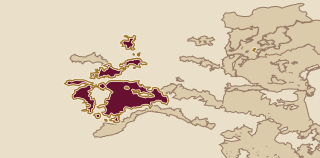
Castiglione Falletto sits at the geographical centre of the Barolo production zone, surrounded by communes including Barolo, La Morra, Serralunga d'Alba, and Monforte d'Alba. The Barolo DOCG requires 100% Nebbiolo and mandates a minimum ageing period before release, including time in wood. Castiglione Falletto holds some of the appellation's most argued vineyard land. Rocche and Villero, two of Brovia's four crus, are cited among Barolo's ten greatest vineyards.
The Barolo DOCG label on a Brovia bottle carries no sub-zone designation beyond the cru name itself. The cru name is the meaningful address: it tells you which of the four parcels the wine came from, and because the cellar treatment is identical across all four, the cru name is also the terroir claim.
How it is made
The cellar
Brovia ferments Nebbiolo at 28 to 30 degrees Celsius for a month or longer. This is a warm, extended maceration by any standard. The heat and the time extract colour, tannin, and aromatic compounds from the skins, giving the wine depth that supports long bottle ageing.
After fermentation, the Barolos go into 30-hectoliter barrels of Slavonian and French oak for at least two years. Large-format oak at that volume contributes slow, gentle oxidation without imposing primary wood flavour. The wine absorbs oxygen over time rather than oak character, so what comes out of barrel reflects grape and vineyard rather than cellar.
What they make
All four Barolos are 100% Nebbiolo, as required by Barolo DOCG law.
Barolo Rocche di Castiglione is drawn from one of the appellation's most documented vineyards. The vines are 50 to 60 years old and the parcel is cited among Barolo's ten greatest crus. At 450 cases per year, it is one of the two largest Brovia bottlings. In the glass it shows the aromatic signature common to old-vine Nebbiolo from Castiglione Falletto: rose petal, dried herbs, and the characteristic tar that emerges after the long maceration settles into the wine.
Wines to try
First bottle
Start with the Barolo Rocche di Castiglione. It is the natural entry point: 450 cases per year makes it the most available Brovia wine, and Rocche is one of Castiglione Falletto's most documented crus, which means there is a reference point for comparison. The wine is 100% Nebbiolo from 50 to 60 year old vines, fermented for a month or longer and aged in large Slavonian and French oak for at least two years before bottling. In the glass it delivers rose petal, dried herb, and tar aromatics with firm, drying tannin, a long savoury finish, and the acid line that will carry it forward for years.