At A Glance
Location: Hopland, Mendocino County, California Grapes: Chardonnay, Zinfandel, Petite Sirah (blending), Rosé blend Range: Bonterra, The Econic Certifications: USDA organic (since 2000), climate neutral (2021), regenerative (2021) Owner: Viña Concha y Toro
The Producer
Bonterra Vineyards farms certified organic fruit in Mendocino County, a long coastal California county where Pacific fog holds temperatures down and extends the growing season well past what the Napa Valley norm allows. The estate operates formally as Fetzer Vineyards DBA Bonterra Organic Estates, a name that records the transition from a family-estate past to an explicitly sustainability-led present. Since 2000, every vineyard in the operation has held USDA organic certification. In October 2021, Bonterra became the first organic winery anywhere in the world to receive climate neutral certification, a distinction that required a full third-party audit of vineyards, winery, and supply chain.
Sheep graze between the vine rows. The practice is not decorative: it eliminates tractor passes for weed management, which cuts diesel consumption and compaction across the entire farmed area. Bonterra operates at commercial scale, making Chardonnay and Zinfandel as the two central wines of the range, with a rosé and a sub-line called The Econic alongside.
Place
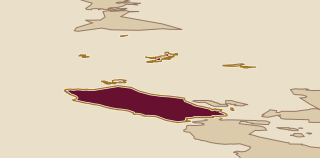
Mendocino County sits roughly 160 kilometres north of San Francisco, running from the Pacific coast inland through a series of valleys and ridges. Hopland, where Bonterra is based, lies in the Redwood Valley and Cole Ranch area of inland Mendocino, where afternoons are warm enough to ripen Zinfandel fully but mornings cool quickly. The county as a whole has a longer, slower ripening season than Napa or Sonoma, and the elevation shifts between coastal and inland zones mean grapes retain their natural acidity without intervention. For Chardonnay, that translates to fruit that can be picked with freshness intact. For Zinfandel, the warmth gives ripe berry character while the night temperatures keep the wine from reading as overripe or flat.
Mendocino has a farming culture that predates the current organic movement by decades. The county has long attracted producers committed to land stewardship, and Bonterra's certifications sit inside that regional character rather than against it.
Soil And Site
Mendocino's inland valleys run over a mix of volcanic, alluvial, and sedimentary soils, with well-drained sandy loam common in the Hopland area. Good drainage keeps vines under mild stress during the growing season, which concentrates flavour in the fruit without pushing yields too high. Specific soil mapping for individual Bonterra parcels is not publicly documented, but the county's geology is diverse enough that different blocks within the estate respond differently to the same season.
Story
Bonterra earned its USDA organic certification on September 13, 2000, at a moment when commercially scaled organic viticulture was rare in California. Organic farming at volume was widely considered economically difficult, and the county's earlier generation of growers had mostly farmed conventionally. Bonterra's certification formalised a farming commitment that set it apart from the California mainstream for the following two decades.
The producer's public name shifted again in August 2022, when the umbrella brand was renamed from Fetzer to Bonterra Organic Estates. The change moved the brand's front-facing story away from family provenance and toward farming philosophy. CEO Giancarlo Bianchetti was direct about the reasoning: organic wine was no longer a niche category, and the new name was meant to reflect that shift rather than obscure it. For the labels, the consequence was a cleaner alignment between what the vineyards do and what the bottles say they are.
The 2021 climate neutral certification was the furthest step in that direction. To qualify, the estate had to account for carbon across every stage of production, not only the vineyard. The sheep grazing program, which had been running as a farming practice, became part of that documented carbon story: no tractor passes meant measurable diesel savings, and those savings fed into the certification audit.
Vineyards And Cellar
Bonterra farms organically across Mendocino County vineyards. No synthetic herbicides, pesticides, or fertilisers are used, and the sheep grazing program handles weed management mechanically through animal labour rather than machinery. The regenerative certification earned in 2021 goes beyond organic requirements and addresses soil health, biodiversity, and carbon sequestration as active farming goals rather than passive side effects.
In the cellar, the Zinfandel spends twelve months in French oak barrels before bottling. French oak at that duration adds spice and a soft vanilla frame to Zinfandel's naturally jammy berry character without loading the wine with obvious wood tannin. Petite Sirah is blended in to deepen colour and add grip and perfume. The Chardonnay receives oak treatment that shows on the palate as a creamy texture and subtle toast on the finish, and the wine's acidity is managed to stay present enough to carry the wine forward over four additional years of cellaring.
Wines
The two anchors of the range are Chardonnay and Zinfandel, both from certified organic Mendocino County fruit and both made for accessible drinking with enough cellar life for short-term aging.
The Bonterra Chardonnay is white, with a nose that moves between fresh fruit and baked aromatics: pear, green apple, and citrus alongside jasmine, candied ginger, and a buttered popcorn note that signals some oak contact. On the palate it is round and creamy with uplifted acidity and a finish that carries subtle toast. It will drink well from release and continue to develop for up to four years.
The Bonterra Zinfandel is red, built around Mendocino Zinfandel with a Petite Sirah component for structural depth and colour intensity. Twelve months in French oak gives the wine a spiced, slightly vanilla-edged frame over Zinfandel's characteristic dark berry fruit. The Petite Sirah brings firmer tannin and a floral lift to a grape that can otherwise read as one-dimensional at lower price points.
The Econic is a sub-line within the range. Specific grape compositions and cellar details for The Econic are not publicly confirmed. The rosé is also part of the range; exact grape proportions are not documented.
In The Glass
The Chardonnay opens with fresh pear and green apple, then deepens toward jasmine and candied ginger as it sits in the glass. The palate is softer than a leaner Burgundian style: the creaminess comes through immediately, the acidity keeps the wine from feeling heavy, and the subtle toast on the finish is a quiet oak signature rather than a dominant one. It is a wine built for everyday drinking that rewards another four years of patience.
The Zinfandel leads with dark berry fruit, the kind of ripe plum and blackberry character that Mendocino's warm afternoons produce in this grape. The French oak adds baking spice and a rounded vanilla background, while the Petite Sirah component tightens the mid-palate and gives the finish more length and colour depth than Zinfandel delivers on its own. The tannins are present but not demanding: this is a wine to drink with food over the next few years rather than a bottle to age seriously.
A Bottle To Understand It
Start with the Bonterra Zinfandel. It carries the producer's core decisions in one bottle: certified organic Mendocino fruit, twelve months in French oak, and a deliberate Petite Sirah addition that shows how the winemaking team works to build complexity rather than rely on the grape alone. The wine is ripe and warm, with dark berry fruit, spiced oak, and a finish that has more substance than a simple California Zinfandel typically offers at this price. It is also the bottle where the farming philosophy is most legible: organic viticulture at this scale producing a red wine that tastes like the county it comes from.
Anecdote
In October 2021, Bonterra submitted its operation for climate neutral certification. No organic winery had done it before. The process required auditors to trace carbon through every stage: the vineyards, the winery buildings, the barrels, the packaging, and the supply chain from first farming input to finished case. The sheep that had been walking between the vine rows for weed management turned out to matter. Every pass a flock made was a tractor pass that did not happen, and every tractor pass not made was diesel not burned, a number the auditors could write down. When the certification came back confirmed, Bonterra held a credential that no other organic producer anywhere in the world had yet earned. CEO Giancarlo Bianchetti had been arguing publicly that organic wine was becoming a mainstream category rather than a specialist one. The certification gave that argument a specific date.
Final Word
Bonterra is not a fine wine estate chasing scores or collector attention. It is a large, credentialed organic producer making Chardonnay and Zinfandel from Mendocino County fruit, with a farming record that is longer and more formally documented than almost anything else in California wine at commercial scale. The climate neutral certification arrived in 2021, the organic certification in 2000, and the sheep are still in the vineyard. For anyone who wants to buy California organic wine with confidence about what is behind the label, Bonterra is the clearest place to start.