NoleaWorld of Wine

Levante · Spain

Producer profile

Bodegas Santa Margarita

A 2003 Castilian estate farming 140 hectares under the Tierra de Castilla IGP, with a generational nursery heritage and a three-tier portfolio running from award-winning Hoya Hermosa to the naturally blue Euforia frizzante.

Place
Spain
Known for
Tierra de Castilla IGP wines across thirteen white and red varieties, plus a novelty blue frizzante derived from natural grape-skin anthocyanins.
Wine context
Cabernet Franc · Cabernet Sauvignon · Champagne · Chardonnay
Editorial basis
World of Wine editorial profile · 3 sources

World of Wine editorial profile · Source list ↓

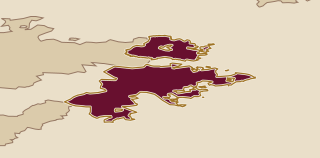
Atlas locationLevante · Spain38.68° N · 0.95° W

At A Glance

The Producer

Bodegas Santa Margarita farms 140 hectares of its own vineyards in Castilla-La Mancha and bottles under the Tierra de Castilla IGP, a geographic designation that covers a broad sweep of central Spain where the plateau climate allows for a wide range of grape varieties to ripen fully. The estate was founded in 2003, but the family's connection to vines runs considerably deeper. Their ancestors spent generations in vineyard plant nursery work, supplying rootstocks and young vines to other growers across the region. When the family founded the winery, they brought that rootstock-level knowledge of soil compatibility, variety behavior, and vine establishment into their own cellar for the first time.

The portfolio today divides into three clear tiers. Hoya Hermosa is the flagship, award-winning range. Pasion Wines is the export label sold under the Tierra de Castilla IGP across international markets. Euforia is a frizzante range built around a naturally blue wine whose color comes from anthocyanins in grape skins rather than from any added dye. Each tier points at a different buyer, and together they describe a producer oriented toward volume, variety, and international reach rather than appellation depth or single-variety focus.

Place

Tierra de Castilla is a protected geographic indication covering parts of Castilla-La Mancha, the elevated central plateau of Spain that sits roughly between Madrid and the southeastern coast. The designation is deliberately broad, covering a large and climatically varied area, and it appears on labels as a geographic marker rather than a guarantee of specific variety, soil type, or elevation. Wines labeled Tierra de Castilla can draw from a wide range of approved grapes, which explains why Santa Margarita cultivates thirteen varieties across both white and red styles without contradicting the label.

The plateau climate in this part of Spain runs to continental extremes: hot summers that push red varieties to full phenolic ripeness, cold nights that help preserve acidity in white grapes, and low annual rainfall that keeps yields in check without irrigation. Those conditions favor varieties like Tempranillo, Monastrell, and Garnacha in red, and Verdejo and Sauvignon Blanc in white, all of which appear in the estate's declared variety list.

Soil And Site

No parcel-level or elevation data has been confirmed for the estate's 140 hectares within the Tierra de Castilla area. The designation covers a geographically diverse region, and without confirmed soil profiles or plot maps, claims about specific ground type would go beyond what the sources establish. What is confirmed is the scale: 140 hectares of own-farmed vineyards, monitored by an in-house technical team from vine to cellar, giving the estate consistent control over fruit quality across the full harvest.

Story

The family's origin in vineyard nursery work is not a footnote. A nursery operation builds vine-specific knowledge from the root system outward: which rootstocks perform in which soils, how clone selection affects fruit expression years later, what early vigor signals in young vines. Generations of that work mean the founding of Bodegas Santa Margarita in 2003 was not the beginning of a viticulture learning curve but the end of one. The family already knew how to grow vines before they made wine from them.

The range architecture that followed reflects an export-first logic. Hoya Hermosa was developed as the label capable of winning international competition awards and supporting a premium price point. Pasion Wines was built to move volume across multiple territories under a consistent Tierra de Castilla IGP. Euforia arrived as a third distinct market position, targeting buyers drawn to visual novelty and a lighter, fresher frizzante style. Three ranges, three buyer profiles, one 140-hectare estate supplying the fruit for all of them.

Vineyards And Cellar

The estate operates modern winemaking facilities alongside traditional practices, a combination that in practical terms means contemporary temperature control and pressing equipment runs alongside cellar methods inherited from regional convention. A technical team monitors the vineyards through the growing season, following fruit development from bud break to harvest and adjusting the pick date for each variety independently. With thirteen grape varieties across white and red styles, the harvest calendar spreads across several weeks, and each variety arrives at the winery at the ripeness point suited to its range destination rather than to a single house style.

No confirmed barrel regime, lees time, or specific fermentation protocol is available for the Hoya Hermosa or Pasion Wines ranges. The cellar approach for Euforia Blue produces a light frizzante style with sufficient CO2 to give a soft mousse on the palate, chilled to between five and seven degrees Celsius for service.

Wines

The estate's declared variety list runs to thirteen grapes. In white: Verdejo, Chardonnay, Sauvignon Blanc, and Macabeo. In red: Tempranillo, Merlot, Cabernet Sauvignon, Cabernet Franc, Garnacha, Pinot Noir, Petit Verdot, Monastrell, and Syrah. The breadth is a distribution strategy made visible in the vineyard: a lineup this wide can serve buyer preferences across European, Asian, and American markets without committing to a single variety as the estate's argument.

Hoya Hermosa is the premium tier, positioned as the award-winning line and carrying the highest price point in the portfolio. No confirmed tasting notes or variety breakdown per cuvée are available in verified sources.

Pasion Wines is the international label, bottled under the Tierra de Castilla IGP and distributed widely across multiple export markets. It is the volume range of the house.

Euforia Blue Frizzante is a naturally blue sparkling wine. The color is clean and visually brilliant, derived entirely from anthocyanins, the pigment compounds concentrated in grape skins, rather than from added colorants. In standard red winemaking, the pH environment shifts anthocyanin expression toward red and purple. Euforia Blue achieves and maintains a blue hue through a different production approach at the cellar level. The wine is lightly sparkling, not fully effervescent in the Champagne sense, and is built for immediate drinking at cold temperatures.

Winabis is listed in official portfolio materials as a fourth brand line. No product details have been confirmed.

In The Glass

Across the range, confirmed tasting detail is limited to Euforia Blue Frizzante. The wine opens with fruity aromas and tropical notes, the kind of lifted, accessible character that reads clearly at cold temperature. On the palate, the light frizzante mousse adds a soft texture without weight. There is no tannin, no oak character, and no structural complexity. The wine is designed for immediate pleasure: chilled, casual, visually arresting. Acidity at this serving temperature keeps the fruit from going flat, but the wine does not build toward a long finish.

For Hoya Hermosa and Pasion Wines, the range of varieties and the Continental climate of Castilla-La Mancha suggest red wines with warm-climate ripeness, firm but approachable tannin from Tempranillo and Garnacha, and white wines where Verdejo's natural acidity gives freshness that prevents the plateau heat from reading as flat or heavy on the palate. Those inferences follow from place and variety, but they are not confirmed by tasting notes in verified sources.

A Bottle To Understand It

Euforia Blue Frizzante is the most fully documented wine in the portfolio. It is a lightly sparkling wine whose blue color comes entirely from natural anthocyanins in grape skins, served between five and seven degrees Celsius. The nose is fruity with tropical lift. The palate is light and fresh, with a soft mousse and no structural weight. It is not a conventional premium entry point, and it does not represent the estate's full range of white and red winemaking. What it demonstrates concretely is the producer's willingness to work outside regional convention: a naturally derived color effect that requires specific cellar technique, presented as a commercial product in a broad export portfolio. Start here if the technical curiosity interests you. For the Hoya Hermosa range, the award-winning premium tier is the more conventional entry into the estate's serious side, though detailed tasting notes are not available.

Anecdote

Before Bodegas Santa Margarita made a single bottle of wine, the family made vines. For generations, the founding family operated a vineyard plant nursery, the unglamorous half of the wine industry that supplies grafted rootstocks and young plants to growers who want their names on the label, not on the nursery tag. A nursery family learns what most winemakers never do: which rootstock handles clay, which clone starts slowly and finishes hard, which young vine in which soil becomes a difficult vintage fifteen years later and which one doesn't. When the family founded the winery in 2003, they planted their own 140 hectares with the kind of accumulated specificity that most estates spend decades acquiring through trial and error. The vines went in with intent.

Final Word

Bodegas Santa Margarita is a 2003 Castilian estate whose founding advantage was not capital or classification but generations of vine knowledge inherited from nursery work. The 140 hectares, the thirteen varieties, and the three-tier export range are all downstream of that starting point. The premium Hoya Hermosa range and the Tierra de Castilla IGP Pasion Wines address serious buyers across international markets, while Euforia Blue Frizzante offers something genuinely unusual: a naturally blue wine whose color is a technical achievement, not a marketing shortcut.

Sources

Keep following the thread

Where to go next

mapFind Bodegas Santa Margarita on the mapKeep the producer, its region and nearby places together.learningHow place shapes wineSee how climate, landscape and local choices become part of a wine.