Who makes it
Angela Osborne arrived in California from New Zealand in 2006 with one declared purpose: make Grenache. A year later she had a vineyard source, a first vintage, and a name. The project began with one wine and expanded to vineyards across California.
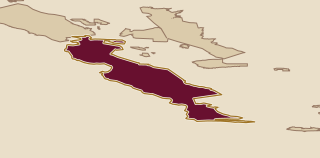
The label draws fruit from across California, from high-desert Santa Barbara County to the Sierra Foothills of Amador County and the cooler coastal influence of Santa Ynez Valley. Single-vineyard wines sit alongside a Santa Barbara County blend. The 2024 Santa Barbara County Grenache combines fruit from three sites. The range is among the most forensic explorations of what Grenache does differently at altitude, on quartz, or in heat across the state.
Where it grows
A Tribute to Grace is not a single-appellation producer. The single-vineyard Grenaches span several California growing areas, and the differences between those geographies translate directly into what goes into each bottle.
Santa Barbara Highlands Vineyard, in Santa Barbara County, is a high-desert site. The combination of intense heat and strong light creates the conditions Grenache needs to ripen fully while holding acidity. This was Osborne's founding source, the vineyard she turned to in 2007 when the label was new.
How it is made
The cellar
Clone 362 is Osborne's preferred Grenache selection across her sites. The clone is associated with smaller berries and more concentrated, transparent fruit character compared to some other Grenache selections, and features in several of her vineyard sources. The producer describes Besson and Hofer as organically farmed, and identifies Chris King as overseeing organic farming at the leased Vie Caprice vineyard.
In the cellar, the red wines go through whole cluster fermentation at high percentages, documented at 67% for at least one cuvée. Native yeasts carry the fermentation over approximately 19 days. Foot-treading happens twice daily rather than mechanical pump-over, which keeps the extraction gentle and the tannin supple. Ageing takes place in neutral French 220-litre barrique for approximately 11 months. No new oak. The barrel role is to allow slow micro-oxygenation without contributing wood flavour.
What they make
The range includes single-vineyard red Grenache, Santa Barbara County Grenache, rosé and Grenache Blanc. Vineyard designates identify a particular source; the Santa Barbara County wine brings several sites together.
Santa Barbara Highlands Grenache carries the warmth and generosity of its high-desert origins. The fruit is ripe and concentrated, with the lifted perfume characteristic of well-ripened Grenache: dried wild herb, red cherry, a hint of iron. The body is generous but not extracted.
Wines to try
First bottle
Shake Ridge Ranch Grenache is the clearest first bottle. Clone 362 on rose quartz and slate in the Sierra Foothills, whole cluster fermented at 67% with native yeasts, foot-trodden twice daily, aged 11 months in neutral French oak. No new wood. No extraction. The wine shows what Osborne is building toward across the range: Grenache that is transparent to its site, with the delicacy and acidity of altitude fruit and the capacity to develop further in bottle. Start here to understand what the label does and what California Grenache can be when it is farmed carefully and made with as little interference as possible.