
Who makes it
Viotti farms the Monferrato hills in Castel Rocchero and makes one of the few commercially available bottles of Albarossa in Piedmont. Albarossa is a crossing of Barbera and Nebbiolo di Dronero, two Piedmontese heritage grapes, bred in 1939 and left almost entirely unplanted for the next six decades. Around 2000, Guido Viotti and his daughter Bianca chose to bottle it as a monovarietal, committing a rare grape to a full production cycle: stainless steel fermentation, a year or more in large oak barrels, then another year in bottle before release.
The estate sits well south of Barolo and Barbaresco, in a zone that wine buyers rarely navigate by appellation name alone. Castel Rocchero lies between Alta Langa Astigiana and Alto Monferrato, two of the gentler, less publicised corners of Piedmont. The family has farmed here across seven generations, with the winery formally established in 1969.
Where it grows
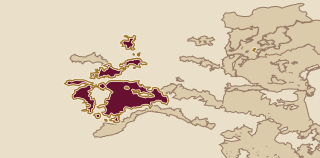
Castel Rocchero sits in the Monferrato hills, a broad arc of elevated terrain in southeastern Piedmont between Asti and Alessandria. The zone is distinct from the Langhe: gentler gradients, more varied grape planting, and less alignment around any single prestige appellation. Alta Langa Astigiana and Alto Monferrato overlap near Castel Rocchero, placing the Viotti estate in a transitional corridor where Barbera and Brachetto both ripen well.
Brachetto d'Acqui DOCG, the appellation that governs sparkling wines from the Brachetto grape, reaches into the southeastern Monferrato hills and covers the ground around Acqui Terme. Viotti's Brachetto d'Acqui Cartòs carries that DOCG label, which means the fruit comes from within the designated zone and meets the sparkling production requirements for that appellation. The Albarossa, by contrast, is labelled outside any named cru or single-vineyard hierarchy: the grape's rarity makes the variety itself the address.
How it is made
The cellar
Viotti's Albarossa passes through two distinct phases before it reaches the bottle. Fermentation happens in stainless steel, which keeps the primary fruit and acidity clean and unobscured by wood contact during extraction. After fermentation, the wine moves into 25 hl Allier oak barrels, large enough that the wood contact is gentle rather than dominant, and stays there for at least twelve months. A further minimum twelve months of bottle ageing follows before release. The total minimum is two years from harvest to shelf, and the actual timeline is often longer.
The large-barrel choice matters for a grape like Albarossa, which carries Barbera's deep colour and firm acidity alongside tannin contributed by the Nebbiolo di Dronero parentage. A smaller barrel would impose more oak character on a wine that already has weight. The 25 hl format allows slow oxygenation without adding flavour, letting the grape's own character settle and integrate.
What they make
The Viotti range is small and built around two very different grapes.
Albarossa is the monovarietal red and the estate's most distinctive bottle. Barbera's genetics bring deep colour, high natural acidity, and a fruit profile that runs toward dark cherry and plum. Nebbiolo di Dronero's contribution adds a tannin frame and some of the drying, earthy character associated with the broader Nebbiolo family. The extended oak and bottle ageing softens the edges and builds a wine with some development arc. This is not a quick-release red; the two-year minimum before release suggests the estate treats it as a wine worth cellaring.
Wines to try
First bottle
Start with the Albarossa. Viotti began bottling it as a monovarietal around 2000. Fermented clean in stainless steel, then aged for over a year in large Allier barrels and a further year in bottle, it arrives with dark fruit, firm acidity, and a tannin frame that holds the whole together. The two-year minimum means the wine has already done some of its work before it leaves the estate. Open it with red meat or aged cheese and give it time in the glass to open.