
At A Glance
- **Founded**
- 1884
- **Location**
- Rio Tinto, Douro Valley, Portugal
- **Estates**
- Quinta da Soalheira, Quinta de Simaens, Quinta do Ôro, Quinta de São Simão da Aguieira
- **Grapes**
- Touriga Nacional, Azal Espanhol, Preto de Mortágua
- **Styles**
- Douro red, Vintage Port
- **First Bottle**
- Quinta da Soalheira Douro Red
The Producer
Vinhos Borges is a Douro Valley wine house and Port producer that has operated without interruption since 1884, when brothers António and Francisco Borges founded it in Rio Tinto. That is not a small claim in a region where phylloxera, two world wars, the Salazar years, and repeated ownership changes have broken many long-running houses. Borges survived all of it and today operates four quintas across the valley, distributing bottles to more than 60 countries.
The anchor estate is Quinta da Soalheira, 340 hectares in the Douro acquired in 1904. It is where the house's most clearly labelled wine comes from and where the clearest argument for what Borges is can be made: a large, historically rooted Douro producer producing both estate reds and Vintage Port from schist hillside vineyards above the river.
In 2012 the house won the AWC Vienna award for Best Wine Producer of Portugal, a competition-circuit recognition that confirmed the range had the breadth to perform across categories.
Place
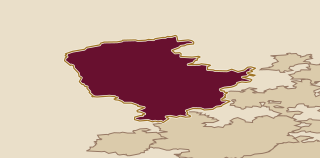
The Douro Valley runs east from Porto through steep, terraced hillsides cut by the Douro river. This is one of the oldest demarcated wine regions in the world, with boundaries established in 1756 to protect Port from adulteration. Table wines made here carry the Douro DOC designation; Port carries its own classification and is produced under the Port Wine Institute's rules.
The Douro divides into three sub-zones: Baixo Corgo in the west (cooler, higher rainfall), Cima Corgo in the centre (the historic heart of Vintage Port production), and Douro Superior in the east (hotter, drier, with younger vineyards). Quinta da Soalheira sits within this river landscape, where altitude and aspect control ripeness as much as latitude does.
The valley's extreme topography forces most viticulture onto terraced slopes. Where the vines grow relative to the river and which direction they face determines whether grapes ripen toward concentrated fruit and high alcohol or retain the acidity and aromatic lift that Touriga Nacional can carry at its best.
Soil And Site
Schist dominates the Douro's vineyard geology. This fractured, dark metamorphic rock holds heat through the night, drains quickly after rain, and forces vine roots deep in search of water and nutrients. Quinta da Soalheira's vines have an average age of around 12 years, a consequence of substantial replanting after the 1998 ownership change. Young vines on schist still produce concentrated grapes, though the complexity that comes from very old root systems takes decades to develop.
The estate covers 340 hectares, a large footprint by Douro standards. Vines grow across slopes that see the river valley's intense summer heat, tempered by altitude and the valley's own wind patterns.
Story
António and Francisco Borges founded the house in 1884, coming from a banking background connected to Banco Borges e Irmão. Wine rather than finance became the family's lasting enterprise.
Twenty years on, in 1904, the brothers made the purchase that shaped everything that followed. Phylloxera had devastated the Douro's vineyards through the 1880s and 1890s, collapsing land values across the valley. Borges moved into that wreckage and bought Quinta da Soalheira, 340 hectares of Douro vineyard land, for what sources describe as a distressed price. The estate became the production anchor the house still operates from today.
The Lello brand, established in 1913, extended the portfolio and became one of the longest continuously marketed Douro wine labels in the house's range. Fita Azul, a branded everyday wine, followed in 1934 and built the volume business that sustained the house across the mid-twentieth century.
In 1998 the private company José Maria Vieira S.A. took ownership. That change triggered a near-complete replanting of Quinta da Soalheira, replacing phylloxera-compromised and ageing vines with new plantings. The average vine age today reflects that decision: young by Douro standards, but on old schist soils with a long view toward maturity.
Vineyards And Cellar
Quinta da Soalheira Douro Red is built on three grapes: Touriga Nacional, Azal Espanhol, and Preto de Mortágua. Touriga Nacional is the Douro's signature red variety, giving deep colour, black fruit, and floral aromatic lift when grown on schist. Azal Espanhol and Preto de Mortágua are indigenous varieties that add their own character to the blend, contributing to the wine's fruit register and palate weight.
After fermentation, the red wine ages in oak for 9 to 12 months. Across the Douro table wine range, oak aging runs from 4 to 6 months at entry level to 24 months for upper-tier wines. The Quinta da Soalheira red sits in the middle of that arc, long enough to take on some oak-derived texture and to integrate the black fruit that comes from schist-grown Touriga Nacional, without pushing toward a heavily extracted or over-oaked style.
For Vintage Port, the fruit is typically fortified during fermentation to stop sugar conversion and fix sweetness, then aged in cask before bottling. Borges Vintage Port shows the classic Douro ruby colour and fruit-forward character that the Vintage category is built on.
Wines
The Borges range divides across two broad registers: estate wines and branded wines.
Quinta da Soalheira Douro Red is the estate wine. Touriga Nacional, Azal Espanhol, and Preto de Mortágua, harvested from the 340-hectare flagship quinta and aged 9 to 12 months in oak. The wine shows ripe black and blue fruit on the nose, plum and chocolate in the mid-palate, and leather on the finish, with a dry palate, balanced acidity, and length. It won a Silver Medal at the London Wine Competition 2024.
Borges Vintage Port sits above the table wine tier. Ruby in colour, it carries blackberry, raspberry, plum, and spice on the nose. In the mouth it is medium-bodied with well-integrated tannins. Vintage Port is a long-lived category: bottles sealed with a natural cork continue to develop for decades in the right cellar.
The branded range includes Fita Azul, established 1934, and Gatão, everyday wines built for volume distribution. Lello, established 1913, is among the oldest labels in the portfolio. These brands give the house a broad commercial reach across the 60-plus countries it distributes to, while the Quinta da Soalheira and Vintage Port tiers carry the estate character.
In The Glass
Quinta da Soalheira Douro Red opens with ripe black and blue fruit and a plum note that Touriga Nacional carries well on schist. There is a chocolate and leather character in the middle of the wine, a product of the oak aging and the concentration that comes from the valley's heat. The palate is dry with balanced acidity and a finish that runs long enough to confirm that the 9 to 12 months in oak have given the wine some cellar ambition without burying the fruit.
Borges Vintage Port arrives in the glass with a dense ruby colour. The nose is immediately fruit-forward: blackberries and raspberries with ripe plum and a spice note behind them. On the palate it is medium-bodied, with tannins that have softened enough to sit comfortably but still give the wine grip. The fortification holds the sweetness in balance rather than pushing toward cloying weight. It is a classic Douro Vintage Port style: fruit first, with complexity behind it.
A Bottle To Understand It
Start with Quinta da Soalheira Douro Red. It is a Touriga Nacional-led blend from the house's flagship estate, aged 9 to 12 months in oak, and it shows what the Douro's schist hillsides do to black-fruited grapes grown in intense valley heat. On the nose there is ripe plum and dark fruit; in the mouth a dry palate with chocolate and leather and an acid line that keeps the finish clean. It is not a light wine. The concentration comes from the place and the grape, and the oak gives it enough texture to work at the table or to sit in the cellar for a few years. At the Silver Medal level from the London Wine Competition 2024, it sits in the range's clearest position: the estate red that explains where and how Borges makes wine.
Anecdote
In 1904 the Douro Valley was still recovering from two decades of phylloxera. The pest had moved through the valley's vineyards through the 1880s and 1890s, destroying root systems across the schist hillsides and collapsing land values to a fraction of what they had been at the height of the Port trade. Quinta da Soalheira was a 340-hectare estate in this devastated landscape, its vineyards either dead or compromised, its owner unable to find a buyer at anything close to a real price. Borges stepped in and purchased it for what sources describe as the equivalent of roughly 40 euros in modern terms. The price was not a bargain in the ordinary sense; it was the price of a vineyard that nobody else wanted. What Borges had that the valley lacked in 1904 was the conviction that the schist would recover, that the Douro's terraced hillsides would produce wine again, and that 340 hectares above the river was worth holding. The estate became and remains the production heart of the house.
Final Word
Vinhos Borges is a large Douro house with over 140 years of continuous operation and an anchor estate acquired in one of the valley's worst moments. The portfolio runs from branded everyday wines to Vintage Port and the Quinta da Soalheira Douro Red. Start with the estate red to understand what the house does with Touriga Nacional on schist.
Sources
- www.vinhosborges.pt/en/home
- portwinecountry.com/index.php/borges
- www.internationalbeveragenetwork.com/57650/Sociedade-dos-Vinhos-Borges-SA
- www.houseofgrauer.com/blog/2021/07/borges-porto-vintage-port
- londonwinecompetition.com/en/winner-brands/wines/2024/sociedade-dos-vinhos-borges-3334/quinta-da-soalheira-douro-red-2021-7476.htm