Who makes it
Sokol Blosser began when Susan Sokol and Bill Blosser planted vines in the Dundee Hills in 1971. That original planting remains the physical centre of a family-owned Oregon winery that now works beyond one hill, while still holding its founding estate. Alex Sokol Blosser became winery president in February 2023 after roles in sales, winemaking and vineyard oversight, linking the current leadership to the practical path from vineyard rows to bottled wine.
The estate’s story starts with first vines, then widens through land. From the 1971 Dundee Hills planting, Sokol Blosser has grown into a 128-acre operation across three AVAs, with the original estate still carrying the oldest thread. That expansion gives Pinot Noir more than one Oregon setting: the founding Dundee Hills blocks remain in view while later vineyard work brings Eola-Amity Hills and Yamhill-Carlton into the cellar’s annual choices.
Where it grows
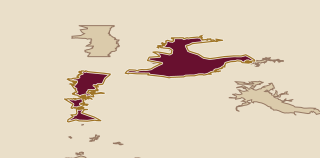
The winery’s 128 acres are spread across three Oregon AVAs: Dundee Hills, Eola-Amity Hills and Yamhill-Carlton. An AVA on a wine label identifies the recognised growing area behind the grapes, so these names distinguish where Sokol Blosser’s Pinot Noir and other varieties begin. Dundee Hills is the original home; Yamhill-Carlton enters through Kalita Estate Vineyard. The result is a range built from several Oregon places rather than a single undifferentiated estate source.
The Dundee Hills Estate lies 28 miles southwest of Portland and covers 89 certified-organic acres originally planted in 1971. Its red volcanic Jory soils are a defining physical feature of the Dundee Hills AVA, placing Pinot Noir, Pinot Gris and Riesling on the ground that shaped the estate’s first crop. Soil alone is not a tasting note, but it fixes the Dundee Hills wines to a particular hillside origin instead of treating Oregon as one broad label.
How it is made
The cellar
Certified-organic farming is documented at the Dundee Hills Estate and at Kalita Estate Vineyard, which Sokol Blosser acquired in 2021. Kalita sits in Yamhill-Carlton, where 22 certified-organic acres are planted to Pinot Noir, with a small amount of Pinot Meunier. Those acreage and grape decisions give the winery a clear vineyard structure: the Dundee Hills estate supplies Pinot Noir, Pinot Gris and Riesling, while Kalita adds another Pinot Noir source. No house oak recipe or cellar vessel defines the supplied picture; the useful distinction begins with where each grape is grown.
What they make
Sokol Blosser’s documented range starts with grapes and sites. Pinot Noir is planted at the Dundee Hills Estate and at Kalita, creating a red-wine thread across two named AVAs. Pinot Gris and Riesling grow at the Dundee Hills Estate, extending the range beyond Pinot Noir into white grapes with their own fruit, acidity and body questions. When comparing bottles, start with the AVA and grape on the label: Dundee Hills points back to the original 89-acre estate, while Yamhill-Carlton Pinot Noir can point to Kalita’s later addition.
Wines to try
First bottle
Start with Sokol Blosser’s Dundee Hills Estate Pinot Noir. It brings the first-planted estate, the 1971 date, red volcanic Jory soil and the winery’s central grape into one bottle. In the glass, approach it as a Pinot Noir: look for red-fruit character, assess the weight of the body, then track acidity, tannin and the finish. It comes first because its Dundee Hills origin returns directly to the land where Susan Sokol and Bill Blosser began planting vines.