Who makes it
Simonsig is an independent, family-owned Stellenbosch farm closely associated with the Malan family. Its 210 hectares support more than one wine style, so the estate is best understood through named bottles rather than a single house flavour: Kaapse Vonkel for sparkling wine, Langbult Steen for single-vineyard Chenin Blanc, then Redhill Pinotage and Labyrinth Cabernet Sauvignon for reds.
The Malan connection reaches back to Jacques Malan, a Huguenot who arrived in the Cape in 1688; his descendants still run Simonsig. That continuity sits beside a practical wine decision made much later: the 1971 release of Kaapse Vonkel put bottle-fermented sparkling wine alongside the estate’s still-wine work.
Where it grows
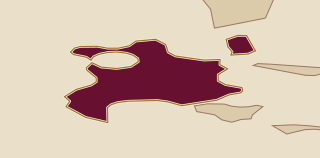
Simonsig lies in the northern part of Stellenbosch, in the Western Cape. The vineyards experience a maritime climate strongly influenced by the Atlantic Ocean, so ripening occurs within a coastal pattern rather than in heat alone; that matters when reading acidity, fruit weight and harvest timing across wines as different as sparkling Chenin-based styles and structured reds.
The estate’s altitude range, from 50 to 280 metres, adds another variable. Higher and lower blocks do not ripen on the same timetable, allowing vineyard decisions to respond to parcel conditions before fruit reaches the bottle.
How it is made
The cellar
All estate-grown grapes are harvested by hand. On vineyards spread from 50 to 280 metres, manual picking allows separate blocks to be brought in when they are ready, rather than treating the whole farm as one harvest. The same hands-on approach applies to pruning, which follows the Simonit & Sirch method.
Danna de Jongh has overseen Simonsig’s white and sparkling wines since 2022, placing wines such as Kaapse Vonkel and Langbult Steen under a defined part of the cellar team’s work. Since 2019, solar panels have supplied approximately 30% of the estate’s electricity needs; the change belongs to the farm’s daily operation rather than a separate wine line.
What they make
Kaapse Vonkel is the historical sparkling anchor. Traditional-method bottle fermentation sets it apart from wines simply charged with carbon dioxide: the wine develops its mousse in bottle, and lees contact becomes part of how its palate is read.
Langbult Steen is the range’s site-specific Chenin Blanc. Its old-vine designation from 2022 and its single-vineyard name direct attention to one parcel, while Chenin’s natural acidity and ability to carry both fruit and body make it a different proposition from the sparkling wine.
Wines to try
First bottle
Start with Kaapse Vonkel. It is Simonsig’s traditional-method sparkling wine, first released in 1971, and its bottle fermentation puts mousse, acidity and lees texture at the centre of the experience. It comes first because one bottle joins the estate’s Stellenbosch setting, its cellar method and a concrete South African wine milestone without asking the drinker to navigate the whole range at once.