Who makes it
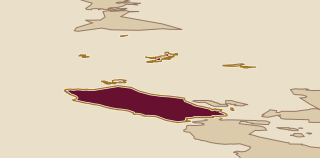
Racines brings together Burgundian experience with Pinot Noir and Chardonnay and Péters's Champagne background for sparkling wine from California's Central Coast. The project is based around the Santa Rita Hills area, where cool maritime conditions support grapes with freshness and long growing seasons. The label therefore carries several kinds of information at once: Pinot Noir and Chardonnay identify the grapes, Sta. Rita Hills identifies the appellation, and vineyard names narrow the focus to a particular site.
The range is deliberately tied to place. Racines works with Sanford & Benedict, Bentrock, La Rinconada and Wenzlau, alongside its own estate vineyard, which entered the range with the 2023 vintage. These are not interchangeable sources in the cellar. Each single-vineyard bottling keeps the vineyard name visible, so the bottle can be read through its slope, soil and grape.
Where it grows
Santa Rita Hills is an area of Santa Barbara County shaped by the Pacific. Racines focuses on vineyards with maritime influence, and its Chardonnay sites sit several miles from the ocean on ancient marine seabeds. That setting supports a white wine style with freshness, mineral flavour and saline length, even when the fruit has enough ripeness to carry richness.
For Pinot Noir, the same cool influence supports wines with fresh fruit and a lifted aromatic register. The appellation is not a decorative address on the label. It explains why Racines can work across still red wine, still white wine and sparkling wine while keeping acidity central to the range.
How it is made
The cellar
The Racines team farms Wenzlau Vineyard using organic practices. That claim belongs to Wenzlau, not automatically to every vineyard in the range. Keeping the farming detail attached to its named site preserves the connection between vineyard work and bottle.
In the cellar, Pinot Noir ferments with native yeast, whole clusters and pigéage throughout fermentation, followed by extended élevage. Whole-cluster fermentation brings lift and spiciness to the wine, while pigéage works the fermenting grapes through the cap. The resulting Pinot Noir is shaped by perfume, spice and a longer development in the cellar, not by fruit alone.
What they make
Pinot Noir is the main red-wine strand, with small-quantity single-vineyard bottlings from Sanford & Benedict, Bentrock, La Rinconada and Wenzlau. The range moves from the cool Santa Rita Hills appellation into named parcels, allowing the bottles to differ through site while sharing the grape and maritime climate.
The 2020 Sanford & Benedict Pinot Noir shows how Racines handles élevage: it spent 19 months in French oak, with 30 percent new oak. That is a clear cellar marker, alongside native yeast, whole clusters, pigéage and extended ageing. The wine's likely shape is therefore linked to time, spice, lift and oak seasoning, with the vineyard remaining central.
Wines to try
First bottle
Start with the 2020 La Rinconada Pinot Noir. It is a single-vineyard Sta. Rita Hills red, and its taste is unusually complete in the available range: concentrated yet supple and silky, with fresh red fruit, savoury herbs, wet stone, anise and smoke. The wine carries several textures in sequence, from concentration at the centre to a softer, silky feel through the palate, followed by savoury, mineral and smoky notes.