
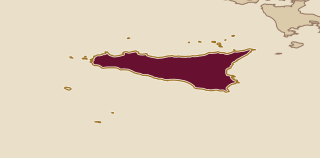
At A Glance
- **Country:** Italy
- **Region:** Sicily
- **Territories:** Menfi (western Sicily), Vittoria and Noto (southeast), Mount Etna (northeast), Capo Milazzo (north coast)
- **Key Grapes:** Nero d'Avola, Nerello Mascalese, Carricante, Frappato, Chardonnay
- **Farming:** Certified organic across all cultivated land
- **Winemaker:** Alessio Planeta (CEO and winemaker)
The Producer
Planeta is a Sicilian estate that has spent thirty years mapping the island, territory by territory, grape by grape. Its vineyards spread across five distinct zones from the western heartland around Menfi to the volcanic soils of Mount Etna in the northeast, from the sun-baked Noto DOC in the southeast to the north coast at Capo Milazzo. Alessio Planeta serves as CEO and winemaker. Francesca, Santi and Chiara joined the business.
The Planeta family has owned the underlying land for more than seventeen generations. For most of that history the property fed the bulk wine trade. The shift to estate bottling came in the 1990s and grew directly from a decision made a decade earlier by Diego Planeta, Alessio's uncle, who held the presidency of the Instituto Regionale della Vite e del Vino from 1985 to 1992 and used that institutional position to press for a wager that had no precedent on the island.
Place
Sicily is large enough that a producer with estates in five of its territories is effectively working five different climates, soils and elevation profiles under one name. Planeta's western base at Menfi sits close to the coast in a warm, limestone-influenced zone where international varieties including Chardonnay ripen fully. Moving southeast, Noto and Vittoria produce the island's two best-known native reds: Nero d'Avola in Noto, Frappato in Vittoria. These are lower-elevation zones with sandy soils and long, dry summers.
Mount Etna changes everything. The volcano's north-facing slopes carry vineyards at altitude on black basalt and volcanic ash, where the Carricante grape produces whites with pronounced acidity and mineral cut, and Nerello Mascalese gives reds with a translucency rare in southern Italy. The wines from Etna carry the Etna DOC appellation on the label, a designation tied to the volcano's unique farming conditions. Planeta produces Etna Rosso from Nerello Mascalese and Etna Bianco from Carricante. Capo Milazzo on the northern coast adds a fifth territory.
Each territory produces wines in its own appellation or DOC. The bottle on the shelf carries the name of the place it came from.
Soil And Site
The soil profiles across Planeta's five territories reflect their geological distance from one another. Western Sicily around Menfi is calcareous clay, warm and well-drained, suited to full ripening of both international and native varieties.
On Etna, the soils are volcanic in origin: black basalt rubble and fine ash deposited across centuries of eruption. These soils are low in organic matter, free-draining, and deeply permeable. Carricante and Nerello Mascalese grown here retain natural acidity that the warmer, richer zones of the island do not produce.
Story
The Planeta family grew grapes on its western Sicilian land for most of seventeen generations without putting their name on a bottle. Grapes went to cooperatives and bulk buyers. In the mid-1980s, Diego Planeta held a formal leadership role across Sicilian viticulture. He concluded that the island could produce wines worth bottling under an estate name, and he persuaded his siblings to act on that conclusion by planting Chardonnay, then an unheard-of choice on the island, alongside other international varieties.
The bet was unusual because Chardonnay was an unconventional variety at the time. Diego was not an outsider advocating for change; he ran the regional viticulture institute while the planting was happening. The winery that came from that decision was formally established in the 1990s, and the family quickly moved beyond its western base.
Planeta pushed the geographic expansion across the island through the following decades. Vittoria and Noto came first, then Etna and Capo Milazzo. Each move followed research into where each grape performs rather than proximity to the original estate.
In 2019, Planeta and the Oddo family jointly acquired roughly 270 acres near Sambuca di Sicilia for the independently operated Serra Ferdinandea project.
Vineyards And Cellar
All cultivated land across Planeta's five territories, including vineyards, olive groves, almond groves and grain fields, is certified organic. The decision to farm without synthetic inputs applies across the whole agricultural estate rather than to selected parcels.
The Chardonnay comes from two named vineyards, Ulmo and Maroccoli, both in western Sicily. It is fermented and aged in French oak, which contributes texture and a warm, rounded mid-palate weight to the wine's tropical fruit character. The Etna wines include whites from Carricante and reds from Nerello Mascalese.
Santa Cecilia, the flagship Nero d'Avola from Noto, draws on selected vineyard parcels in the southeast. Its first vintage was 1997.
Wines
From western Sicily, the Planeta Chardonnay is the estate's oldest international-variety wine and one of its most widely recognised. Made from 100% Chardonnay from the Ulmo and Maroccoli vineyards, it is fermented and aged in French oak, producing a full-bodied white with ripe citrus and stone fruit, a creamy mid-palate from oak contact, and a warm finish.
Santa Cecilia is a single-variety Nero d'Avola from Noto. First made in 1997, it is the estate's benchmark for the grape in the DOC: deep-coloured, with ripe dark fruit, firm tannin from both grape and oak, and the long finish that Nero d'Avola from calcareous southeastern soils delivers at its best.
On Etna, Planeta makes Etna Rosso from Nerello Mascalese and Etna Bianco from Carricante. The Etna Bianco Contrada Taccione, first made in 2012, is a single-parcel version from a named vineyard, with greater depth and concentration than the entry Etna Bianco.
Didacus is named after Diego Planeta.
In The Glass
The two poles of the Planeta range are the Chardonnay and the Etna whites, and they taste like different philosophies from the same producer. The Chardonnay from Ulmo and Maroccoli opens with ripe peach, golden apple and a hint of vanilla from the French oak fermentation. In the mouth it is broad and warm, with oak-derived texture giving weight to the mid-palate and the warm western Sicilian climate driving the fruit forward. The finish is rounded and long.
The Etna Bianco Contrada Taccione works in the opposite direction. Carricante on volcanic soils produces a pale, clear white with pronounced acidity, citrus peel, white stone fruit and a mineral, faintly saline finish that comes from the basalt and ash underfoot. It is a wine that feels taut rather than generous, with a freshness in the mouth that the volcanic altitude and the grape's natural acidity produce.
Santa Cecilia sits at the concentrated end of the red range. Nero d'Avola from Noto gives deep colour, dark plum and black cherry fruit, firm grippy tannin, and the warmth of a grape that ripens fully in the southeast. The Etna Rosso is made from Nerello Mascalese.
A Bottle To Understand It
Start with Santa Cecilia. It is a single-variety Nero d'Avola from the Noto DOC in southeastern Sicily, first made in 1997. The grape is native to Sicily, the site is calcareous and warm, and the wine shows what Nero d'Avola at full ripeness produces: deep ruby colour, dark plum and black cherry fruit with a violet note, firm tannin with some oak weight behind it, and a long, warm finish.
Anecdote
Diego Planeta ran the Instituto Regionale della Vite e del Vino, the body responsible for Sicilian viticulture, from 1985 to 1992. He spent those years advising producers, attending regional vine trials, and watching what the island could and could not do. Then he went home to the family property in western Sicily, a piece of land the Planeta family had farmed for seventeen generations without ever putting their name on a bottle, and told his siblings to plant Chardonnay. Nothing like it had been done on the island at scale. The family's land had fed the bulk trade its entire recorded history. Diego planted anyway, added other international varieties that had no precedent in the territory, and formally established the winery in the 1990s. That Chardonnay, fermented and aged in French oak from the Ulmo and Maroccoli vineyards, is still in production today.
Final Word
Planeta is one of the few Italian estates whose range requires a map rather than a hierarchy to understand. Five territories, five DOCs or appellations, and a founding decision from the mid-1980s that treated Sicily not as a bulk-wine region but as a place worth exploring grape by grape and hill by hill. Santa Cecilia from Noto, Etna Bianco Contrada Taccione from the volcano's slopes, and the original Chardonnay from the western heartland each represent a different answer to the same question the family has been asking for thirty years: what does this piece of Sicily actually produce?