Who makes it
The Rombone farm in Treiso sits in the Langa hills of Piedmont, where the Nebbiolo grape produces Barbaresco under the same regional classification as the more famous wines made a few kilometres west, in the commune of Barbaresco itself. Carlo Nada bought that farm in 1921. His grandson Bruno persuaded the family to shift from selling grapes in bulk to bottling their own wine in 1982, and Bruno's son Danilo now leads the estate alongside his father.
The estate currently covers around 10 hectares, spread across the communes of Treiso and Barbaresco. The work in the vineyard is manual throughout: hand-hoeing, cluster thinning, hand harvesting into crates. Each parcel is vinified separately, a practice that shapes both the cellar work and the range of wines the estate releases.
Where it grows
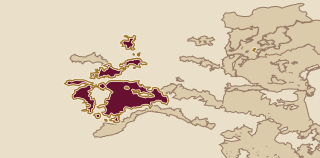
Treiso is a self-governing commune in the Barbaresco production zone. Nada Fiorenzo's Rombone and Manzola vineyards lie within Treiso; the estate's Montaribaldi vineyards sit across the boundary in the commune of Barbaresco. All three named sites fall within the Barbaresco DOCG, the appellation that covers the hills around Alba where Nebbiolo is grown for long-ageing red wine.
Within that common classification, the two home vineyards have distinct characters. The importer describes Manzola as quieter and more transparent, letting the hillside speak where Rombone is more forceful. Both vineyards face southwest, giving them the afternoon sun that Nebbiolo needs to ripen on these clay-dominant slopes.
How it is made
The cellar
The 10 hectares are planted to Nebbiolo, Barbera, and Dolcetto. Nebbiolo fills the Barbaresco-appellation parcels in both Treiso and Barbaresco; Barbera and Dolcetto grow alongside it. Each parcel is harvested separately, with the fruit brought to the cellar in crates.
In the cellar, soft crushing is followed by maceration and alcoholic fermentation with the grape skins and seeds, using temperature-controlled vats with pumping over and plunging. Malolactic fermentation precedes barrel ageing. The Barbarescos can spend up to two years in oak, followed by several months in the underground cellar after bottling. The Langhe Nebbiolo receives 12 months in oak and six months in bottle. Seifile, the Barbera-and-Nebbiolo blend from Rombone, spends 18 months in oak and six months in bottle.
What they make
The range runs from the Langhe Nebbiolo, which draws on the coolest rows at harvest and the estate's youngest vines in Treiso, up through Seifile and then to the two Barbaresco crus.
Seifile is a blend of 80% Barbera and 20% Nebbiolo Lampia, both from Rombone, with the Barbera coming from vines planted in 1946 and the Nebbiolo from 1964 plantings. It carries the richness of those old-vine Barbera roots alongside the austerity of Rombone Nebbiolo, and is classified as a red wine rather than Barbaresco, given its Barbera-dominant composition.
Wines to try
First bottle
Barbaresco Manzola is the bottle that shows what the estate has built around parcel separation. It is Nebbiolo Lampia and Michet from a single southwest-facing Treiso vineyard, fermented with skins and seeds, aged 24 months in oak and six months in bottle. On the palate it brings red berries and orange peel over a bed of tar and dried rose, with firm, dry tannins that need several years to soften into the floral, savoury harmony the estate describes. A 2020 professional blind tasting put the drinking window out to 2045. That long horizon is the point: this is a wine to open a decade from purchase rather than the week it arrives.