
At A Glance
- **Founded**
- 1956
- **Base**
- Calamandrana, Asti, Piedmont
- **Grapes**
- Nebbiolo, Barbera, Cortese, Moscato
- **Key Vineyards**
- Cerequio and Cannubi (Barolo); Asili, Faset and Montestefano (Barbaresco); La Court (Nizza); Rovereto (Gavi)
- **Winemaker**
- Stefano Chiarlo
- **Ownership**
- Family-owned
The Producer
Michele Chiarlo started with no land. In 1958, two years after founding his winery at Calamandrana in the Asti hills, he bought grapes and bottled a Barolo. It was the first move in a decades-long project to acquire the vineyards behind the wine.
Today the house holds named parcels across the four appellations that define Piedmontese winemaking: Barolo, Barbaresco, Nizza and Gavi. Sons Alberto and Stefano now run the business, Alberto directing global sales and marketing while Stefano makes the wine. The policy their father established holds: no international varieties, no blending. Every bottle carries a single indigenous grape, grown in a named Piedmontese place.
Three production facilities spread across the region reflect how seriously the house takes appellation logic. The home winery and bottling facility sit at Calamandrana. A dedicated facility handles Cortese from Gavi. A third, beside the Cannubi vineyard, vinifies the Barolo-zone wines close to where the grapes grow.
Place
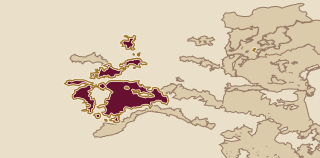
Piedmont wraps around Turin in the northwest corner of Italy, sheltered by the Alps to the north and the Apennines to the south. The Langhe hills at the heart of the region are where Nebbiolo produces Barolo and Barbaresco, the two appellations that anchor Italian wine at the serious end of the market. Barolo, a DOCG in the southwestern Langhe, demands a minimum of two years in oak and five total for Riserva bottlings; the wines age for decades in the right vintages. Barbaresco, on the eastern side of Alba, is lighter and earlier to open, though no less serious in ambition.
Michele Chiarlo's range moves across both appellations and beyond. The Nizza DOCG, southeast of Asti, is a sub-appellation of Barbera d'Asti dedicated solely to Barbera; La Court is the house's holding there. Gavi, further east in the Alessandria province, produces Cortese-based whites with firm acidity and clean fruit. Moscato d'Asti comes from the hills around Canelli and Santo Stefano Belbo, where the grape produces low-alcohol, lightly sparkling sweet wine entirely distinct in character from the Nebbiolo-led bottles.
The spread means the house sells across every register of the regional table: sparkling Moscato at one end, age-worthy single-vineyard Barolo at the other.
Soil And Site
Cerequio is the most precisely documented holding in the portfolio. The six-hectare parcel sits at 320 metres above La Morra, facing south and southwest. Vines planted between 1972 and 1990 grow in Tortonian calcareous clay marl, a marine sedimentary soil with a basic pH, low organic matter and elevated magnesium and manganese. Those conditions work directly on Nebbiolo: the clay holds moisture through dry summers, the calcareous component keeps acidity bright, and the low organic matter concentrates the vine's energy into the fruit rather than the canopy. Cerequio's soils are broadly recognised as among the finest for Nebbiolo in the Barolo appellation.
The Cannubi vineyard, the named cru in Barolo, adds a different soil type to the portfolio: sandy marl with lower clay content, which produces Nebbiolo with finer tannins and earlier aromatic development than the heavier Tortonian soils at Cerequio.
Story
Michele Chiarlo arrived in Piedmont's wine trade as a broker before he became a producer. The 1956 founding of the winery and the 1958 Barolo were early steps; the more consequential work was technical. Chiarlo was credited as one of the first producers in Italy to adopt malolactic fermentation, the secondary conversion that softens malic acid into the rounder lactic form and stabilises wine for ageing. In the Piedmont of the 1950s and 1960s, where Barolo was made to be hard, austere and patience-demanding, introducing a process that moved the wine toward greater early approachability was a real departure.
The Cerequio chapter came later and in stages. Chiarlo first leased vines in the cru in 1983. In the same year he began green harvesting, cutting fruit from the vine before harvest to concentrate what remained. The practice was not standard in Piedmont at the time. In 1988 the house acquired the six-hectare Cerequio holding outright. Stefano Chiarlo has since guided the house toward integrated sustainability, including membership in the Italian SQNPI system from 2016, with agronomic rules governing crop protection and weed control across the vineyards.
Vineyards And Cellar
Green harvesting at Cerequio reduced yields and extended ripening time, giving the Tortonian clay marl more opportunity to transfer its magnesium and manganese into the grapes. The logic applies across the Nebbiolo parcels: lower crop loads mean each cluster carries more concentrated pigment, tannin and aromatic material into the cellar.
In the cellar, the house uses soft pressing to protect fruit aromas, temperature-controlled fermentation to preserve fragrance, and rotating sprayers during maceration to wet the cap gently without the harshness of pumping over. Tortoniano, the appellation-level Barolo, macerates on its skins for 15 to 18 days in steel tanks under this gentle shower system. It then spends 18 to 24 months in average-sized oak casks before bottle refinement, reaching a minimum of three years total before release. Barbaresco Reyna, the access-level Nebbiolo from the Barbaresco zone, receives 9 to 12 months in medium and large casks before bottling.
Nivole, the Moscato d'Asti, is made by whole-grape soft pressing. The must rests in steel at minus 2 degrees Celsius, then ferments slowly in temperature-controlled autoclaves until the wine reaches roughly 5 percent alcohol with a light natural mousse. The cold rest preserves the grape's peach, apricot and citrus aromas before fermentation begins.
Wines
The range divides cleanly by grape and appellation. Nebbiolo occupies the top of the portfolio. Barolo Cerequio is the single-vineyard flagship: six hectares of Tortonian clay marl above La Morra, vinified with the house's gentle maceration method and aged in oak for a minimum of two years before bottle refinement. The wine develops floral violet and rose notes early, then dried cherry, tar and leather as it ages, with firm tannins that need time to resolve and a long, mineral finish. Barolo Cannubi, from the sandy marl of the named cru in the appellation, produces finer tannins and earlier aromatic development than Cerequio.
Tortoniano is the Barolo at appellation level, blended from Nebbiolo across the Barolo zone, with 15 to 18 days of skin contact and at least three years before release. It opens with red cherry and dried rose, with firm but not aggressive tannins and the characteristic bitter finish that Nebbiolo carries from this soil type.
Barbaresco Reyna, the access-level bottle from the Barbaresco zone, spends 9 to 12 months in cask. The wine shows red fruit, violet and a floral lift on the nose, with silkier tannins than the Barolo and a medium-length finish. Barbaresco Faset, from the cru of the same name, is more mineral in character, with firmer acidity and a tighter grain of tannin.
Barbera La Court, from the Nizza DOCG, works with the grape's natural high acidity and low tannin to produce a wine with dark cherry fruit, medium body and the kind of cut that pairs with rich northern Italian food. Gavi Rovereto is Cortese-based white wine with clean citrus and green apple fruit and a firm acid line. Nivole, the Moscato d'Asti, is low in alcohol at around 5 percent, with a gentle natural mousse, peach and apricot aromas, and a sweet but fresh finish that the grape's natural acidity keeps from becoming heavy.
In The Glass
Nebbiolo from Cerequio rises from the glass with dried rose and violet, then a deep core of dark cherry and plum beneath. In the mouth the wine is full-bodied, with the firm, grippy tannin that Tortonian clay marl extracts from Nebbiolo, and an acid line that runs cleanly through to a long, mineral and slightly bitter finish. The oak registers as texture more than flavour: the average-sized casks integrate without dominating, leaving the grape and soil in charge. Cerequio Barolo needs five to eight years minimum before the tannins soften enough to show the wine's full depth.
Tortoniano is less concentrated, with bright acidity, firm tannins, red cherry and dried herb. Barbaresco Reyna is lighter in body, with a finer tannin grain and a shorter finish, but shares the floral lift that runs through all the house's Nebbiolo.
Nivole is a different register entirely: peach, apricot and orange blossom on the nose, a gentle mousse in the mouth, sweetness balanced by the grape's crisp natural acidity, and a clean, refreshing finish. Nothing about it prepares you for the Cerequio Barolo, but they come from the same conviction: one grape, one place, no additions to the blend.
A Bottle To Understand It
Barolo Tortoniano is the right first bottle. It is made from Nebbiolo sourced across the Barolo appellation, macerated for 15 to 18 days and aged for a minimum three years before release, so the wine carries the house's full technical signature without asking you to pay for a single-vineyard parcel. In the glass it opens with red cherry and dried rose, then broadens into tar and leather as it breathes. The tannins are firm and demand food, ideally braised beef or aged Piedmontese cheese. The acid line is long and clean. Start with Tortoniano to understand what Michele Chiarlo does with Nebbiolo in the cellar; move to Cerequio when you want to know what a specific piece of Tortonian clay marl adds to that foundation.
Anecdote
In 1983 Michele Chiarlo leased vines in the Cerequio cru above La Morra and made a decision that unsettled his neighbours: he cut fruit from the vines before harvest, leaving clusters on the ground to rot. Green harvesting was not common practice in Piedmont at the time, and the sight of viable Nebbiolo grapes discarded in the rows disturbed people enough that a group of Cerequio residents went to the local priest and asked him to go and talk Chiarlo out of it. The priest went. The conversation did not change anything. Chiarlo completed the harvest with the reduced crop, then returned the following year and did it again. He acquired the six-hectare Cerequio holding outright in 1988, and the parcel has been farmed on the same principle ever since: fewer grapes per vine, longer on the vine, the Tortonian clay doing its work on a concentrated rather than a diluted crop.
Final Word
Michele Chiarlo built a range from purchased grapes in 1958 and spent the next thirty years acquiring the land behind the wine. The house now holds some of the most precisely situated Nebbiolo parcels in the Langhe, farmed with lower yields than Piedmont expected and vinified with technology that was, in its day, genuinely forward-looking. Tortoniano is the accessible entry; Cerequio Barolo is the argument. Both are native grapes, one place, no concessions to international taste.
Sources
- www.michelechiarlo.it/en
- www.kobrandwineandspirits.com/brand-page/michele-chiarlo/about
- www.winespectator.com/articles/italian-winemaker-michele-chiarlo-known-for-barolo-and-barbera-dies
- www.michelechiarlo.it/en/about/sustainability
- www.michelechiarlo.it/en/cru-and-vineyards
- www.michelechiarlo.it/en/cru-and-vineyards/cerequio-cru
- www.michelechiarlo.it/en/wines/barolo-docg-tortoniano
- www.michelechiarlo.it/vini/moscato-dasti-docg-nivole
- www.michelechiarlo.it/en/wines/barbaresco-docg-reyna
- www.michelechiarlo.it/en/wines/barbaresco-docg-faset
- www.michelechiarlo.it/en/wines