Who makes it
Mas Champart makes red, white and rosé wines in Saint-Chinian, in the Languedoc’s Hérault department. Isabelle and Matthieu Champart began by buying vine parcels in 1976, then recovered abandoned old vines before making their first wine in 1988. The estate now has a new, unnamed team continuing that work across 16 hectares. Its most clearly documented reds move from the vat-aged, peppery Côte d’Arbo to the Syrah-led Causse du Bousquet and the Mourvèdre-led Clos de la Simonette.
The first parcels were bought in 1976, when Isabelle and Matthieu Champart began assembling abandoned old vines. For twelve years the work was first in the ground: acquiring parcels, farming them and bringing old vineyards back into use. In 1988 they vinified their own wine for the first time. That shift put the estate’s separate limestone, clay and terrace sites into bottles under one cellar’s direction, laying the foundation for a range in which Causse du Bousquet, Côte d’Arbo and Clos de la Simonette take different grape and ageing routes.
Where it grows
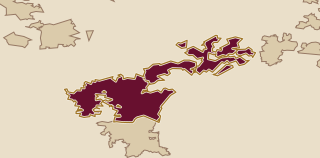
The estate sits on limestone hills towards Villespassans, about two kilometres from Saint-Chinian. Saint-Chinian is not one uniform landscape: Mas Champart lies in its southern sector, where clay, limestone and sandstone replace the schist found farther north. That distinction matters in the vineyard. Carignan on limestone is described by the estate as more fruity and delicate, while clay brings a livelier expression; the resulting reds can combine Mediterranean fruit with acidity and grip rather than simply broad ripeness.
How it is made
The cellar
Mas Champart farms organically and uses compost or manure in Mediterranean soils affected by drought and heat. Red grapes are hand-harvested, then fermented with natural yeasts in concrete and enamelled-steel vats. Gentle extraction and three to five weeks in vat draw colour and tannin without treating the reds as heavy wines by default. During vat ageing, the estate does not clarify and filters lightly; fruit, acidity and earthy detail remain part of the finished texture.
Causse du Bousquet then takes a longer path. Its general blend is Syrah-dominant, with Grenache, Mourvèdre and Carignan from low-yielding parcels mainly on the limestone plateau. About two-thirds ages in Burgundian barrels of differing ages and one-third in vats, with bottling after 20 to 24 months. Barrel ageing adds breadth and spice to the Syrah-led fruit, while the vat portion keeps the limestone-grown fruit and tannin in view.
What they make
Côte d’Arbo is the red for immediate fruit and pepper. It is the estate’s vat-aged cuvée, and its stated profile is fruity, peppery and easy to drink, with length rather than overt oak. Its role is direct: supple Mediterranean red fruit, spice and a less barrel-shaped texture.
Causse du Bousquet works on a wider scale. Syrah leads a blend of Grenache, Mourvèdre and Carignan from limestone-plateau parcels, with barrel and vat ageing spread across nearly two years. The producer describes it as concentrated without heaviness, a table wine with sufficient structure to keep. It is the range’s clearest meeting point of dark fruit, acidity, tannin and slow élevage.
Wines to try
First bottle
Choose Causse du Bousquet 2023. It is a Saint-Chinian red built around Syrah, with Grenache, Mourvèdre, Carignan and Cinsault listed for this vintage. Dark plum, blackberry, lavender, earth and dried branch aromas lead into a dry, medium-bodied palate with medium-high acidity and chewy tannin. It comes first because it joins the estate’s limestone-plateau fruit, mixed Mediterranean grapes and long barrel-and-vat élevage in one bottle, while remaining practical at the table.