NoleaWorld of Wine

Coastal Region · South Africa

Producer profile

Glenelly Estate

A former Pichon Lalande owner built a gravity-flow winery on Simonsberg's lower slopes in Stellenbosch, farming without acidification and using wild yeast fermentation.

Place
South Africa
Known for
Estate Reserve Chardonnay; wild yeast fermentation; gravity-flow cellar
Wine context
Chardonnay
Editorial basis
World of Wine editorial profile · 4 sources

World of Wine editorial profile · Source list ↓

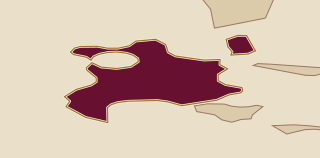
Atlas locationCoastal Region · South Africa33.92° S · 18.88° E

At A Glance

**Country**
South Africa
**Region**
Western Cape
**Appellation**
Stellenbosch
**Founder**
May de Lencquesaing
**Founded**
2003
**First Harvest**
2008
**Winery Completed**
2009
**Key Wines**
Estate Reserve Chardonnay, Estate Reserve Red Blend, Glass Collection

The Producer

May de Lencquesaing spent close to three decades running Château Pichon Longueville Comtesse de Lalande, one of the Médoc's most competitive second growths in Pauillac. When she finally bought her own farm in 2003, it was on the lower slopes of Simonsberg Mountain in Stellenbosch, South Africa. She was seventy-eight.

The estate she built is not a retirement project. Glenelly's winery, completed in 2009, was engineered around a single principle: move juice and wine by gravity alone. Four underground floors allow fruit to descend through the building at each stage of production, from sorting through fermentation to barrel ageing, without pumps or mechanical pressure. No acidification. No commercial yeast. The wines ferment on wild cultures from the estate's own atmosphere.

The first Glenelly harvest came in during 2008. The range divides into two tiers: the Glass Collection at entry level and the Estate Reserve as the production focus, covering Chardonnay and red blends from the Simonsberg slopes.

Place

Stellenbosch is South Africa's most planted serious red wine appellation, a wide basin of mountain-facing farms south-east of Cape Town. Simonsberg Mountain forms the appellation's eastern edge. Its lower slopes offer altitude above the valley floor and the cooling influence of elevation without the exposure of the summit, giving grapes a longer growing window and retaining the natural acidity that de Lencquesaing's no-acidification policy depends on.

The Simonsberg address means Glenelly sits inside the Stellenbosch Wine of Origin ward, a designation that appears on the Estate Reserve label. For a cellar philosophy built around leaving the wine alone, the choice of site matters: cool mornings, moderate afternoon warmth, and enough elevation to slow ripening are what make wild yeast fermentation and zero acid addition workable rather than risky.

Soil And Site

The estate occupies the lower slopes of Simonsberg, where the mountain's granite and sandstone-derived soils give way to the valley floor. Specific soil composition and block-by-block geology at Glenelly have not been published in sufficient detail to characterise further. What is confirmed is the slope position: above the valley heat, below the exposed ridge, on ground that has been farmed for vines since the estate's planting after the 2003 purchase.

Story

De Lencquesaing had wanted a farm outside France for twenty years. She said so plainly: "I have wanted to buy a vineyard outside of France for 20 years." That search ran through her final years at Pichon Lalande and ended in Stellenbosch in 2003. The intervening two decades were not idle; they produced a clear idea of what the farm should be and how the cellar should work.

She planted the Simonsberg property and hired a winemaker with training across Bordeaux, Alsace, and Napa. Planning began for a purpose-built cellar that would realise the minimal-intervention philosophy from the ground up rather than adapting existing infrastructure. The winery that opened in 2009 was designed to eliminate mechanical stress at every stage: gravity flow, no pumps, no acid additions, wild fermentation. The first Glenelly vintage from the estate's own fruit came in during 2008, a year before the building that would house all future production was finished.

Vineyards And Cellar

Glenelly farms red and white varieties on Simonsberg's lower slopes, though specific block counts, clone selections, and vine ages are not confirmed in detail. What shapes the wines most visibly is what happens after harvest.

The gravity-flow winery descends four underground floors into the hillside. Fruit arrives at the top, moves down through sorting and crushing, then continues to fermentation vessels and barrel storage below. No pump pressure is applied at any transfer point. The cellar team uses wild, naturally occurring yeasts for fermentation rather than inoculated commercial strains. The wild fermentation is slower and less predictable than cultured-yeast fermentation and produces a broader range of aromatic compounds.

No acidification is the other fixed point. In a warm-climate appellation such as Stellenbosch, where ripe grapes can shed acidity quickly, declining to add tartaric acid is a deliberate choice that asks the site rather than the cellar to supply the wine's freshness. The combination of wild yeast and no added acid defines Glenelly's cellar posture more clearly than any single wine does.

Wines

The range covers two named tiers.

The Glass Collection is the entry range, drawing on the estate's broader fruit selection for red blends and white wines at a lighter price point. It is intended as an everyday set of bottles from Simonsberg, accessible without demanding deep familiarity with the estate.

The Estate Reserve is where the production philosophy is most fully expressed. The Estate Reserve Chardonnay is the most documented bottle in the range, drawing on the estate's white fruit and the cellar's no-intervention approach. It carries oak on the nose alongside fruit, suggesting barrel contact, though the wild yeast character and absence of acid correction shape the palate as much as the wood does. The Estate Reserve tier also includes a red blend, though grape percentages and specific appellation detail for that wine are not confirmed.

Both tiers carry the Stellenbosch Wine of Origin designation. The range architecture places Glass Collection as the wider introduction and Estate Reserve as the statement tier.

In The Glass

The Estate Reserve Chardonnay 2022 opens with pineapple and apple on the nose, a fruit register typical of Stellenbosch Chardonnay at mid-weight ripeness, followed by mild mango and hints of oak. The oak is present but not dominant; the aromatic impression is fruit-forward before it turns woody.

On the palate, wild yeast fermentation tends to leave a richer, more complex mid-palate than a clean commercial ferment would, with yeast-derived texture and a broader aromatic spread. No acidification means the wine's freshness comes from the fruit itself rather than from tartaric addition; in a good Stellenbosch year this produces a palate with genuine fruit weight and enough natural lift to keep the wine from feeling heavy. The finish on the 2022 carries the oak integration further, with the fruit character persisting through a medium-length close.

A Bottle To Understand It

The Estate Reserve Chardonnay is the right first bottle. It is a Stellenbosch Chardonnay from a cellar that refuses to correct what the vineyard delivers: no acidification, no commercial yeast, gravity handling from arrival to bottling. The 2022 nose is pineapple, apple, and mild mango with a background of oak. The palate is fruit-driven and textured, with the richness that wild fermentation adds and the natural freshness that a well-placed Simonsberg site can hold without acid intervention. Start here to understand what de Lencquesaing built and why the cellar philosophy matters in the glass.

Anecdote

May de Lencquesaing had run Château Pichon Longueville Comtesse de Lalande in Pauillac for close to three decades. Somewhere in those years she started telling people she had wanted a vineyard outside France for twenty years. The decades overlapped. In 2003, at seventy-eight, with the Médoc career already behind her, she bought a property on the lower slopes of Simonsberg Mountain in Stellenbosch. She planted it, hired a winemaker with training across Bordeaux, Alsace, and Napa, and commissioned a cellar built in four underground floors so that wine would never need a pump. The first fruit came in during 2008. The cellar opened in 2009. Both the farm and the building arrived exactly as she had imagined them, only two decades later than she had first imagined them.

Final Word

Glenelly is a Stellenbosch estate built around a set of decisions that were made before the first vine went in: no acidification, no commercial yeast, a winery that moves wine by gravity alone. The Estate Reserve Chardonnay is where those decisions are most clearly audible in the glass.

Sources

Keep following the thread

Where to go next

mapFind Glenelly Estate on the mapKeep the producer, its region and nearby places together.learningUnderstand ChardonnayRead the quick library guide to Chardonnay, which is listed with this producer.