Who makes it
In the valley below Neive, a natural spring once served as the water source for the village and its animals. The Pola family named their estate after it: Fontanabianca, the white fountain. Franco Pola began the work in 1969, converting what his father Secondo had run as a general farm into a winery dedicated to the Neive commune's Nebbiolo, Dolcetto, Barbera and Arneis. Three generations later, Franco's son Aldo and daughter-in-law Luisella manage the estate alongside Matteo Pola, the winemaker son who represents the third generation at the helm.
Fontanabianca's two Barbaresco crus, Bordini and Serraboella, give the estate its Neive anchors. The winery itself sits in the Bordini hamlet, surrounded by vineyards. Every wine in the range is made from a single grape variety, a commitment the estate holds across all its bottlings.
Where it grows
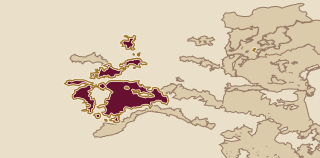
Neive is one of the four communes that make up the Barbaresco appellation in the Langhe hills of Piedmont. Barbaresco as a designation covers Nebbiolo grown within those communes, aged in oak, and produced under rules that separate it from the Barolo zone further west. Within Neive, Bordini and Serraboella are the named crus that Fontanabianca works. Both sites are in the same commune, so the estate's Barbaresco range never reaches beyond a single Neive address.
The Langhe Arneis and Barbera d'Alba bottlings draw from the same commune, keeping the whole estate concentrated in Neive's calcareous-clay soils.
How it is made
The cellar
The estate grows Nebbiolo for Barbaresco and Langhe Nebbiolo, Barbera for the Barbera d'Alba Superiore, Arneis for the Langhe Arneis, and Dolcetto for Dolcetto d'Alba, all within the commune of Neive. No wine blends across varieties.
Fermentation happens in temperature-controlled stainless-steel vats. For Barbaresco, Barbera d'Alba Superiore and Langhe Nebbiolo, the wine then moves into oak, using a combination of large barrels and smaller barriques, for a period that never exceeds fifteen months. The Barbera d'Alba Superiore spends twelve to thirteen months in this oak combination. Dolcetto and Arneis skip wood entirely, maturing only in stainless steel.
What they make
The Barbaresco crus, Bordini and Serraboella, sit at the top of the range. Both are pure Nebbiolo from named Neive sites, aged in a combination of large and small oak for no more than fifteen months. They show the aromatic depth and firm tannin that Barbaresco's calcareous-clay soils and Nebbiolo's long maceration potential can produce.
The Barbera d'Alba Superiore is a varietal Barbera aged twelve to thirteen months in oak. Oak softens Barbera's already moderate tannins and gives the wine some weight without masking the grape's natural acidity and mineral character. Peach, plum and cherry make up the aromatic frame; the palate shows mineral grip and lively acid.
Wines to try
First bottle
Sommo, the estate's Langhe Arneis, is the bottle to open first. Arneis is Piedmont's white grape, grown across the Langhe hills and the Roero zone, and Fontanabianca's version comes from Neive soils, vinified and matured entirely in stainless steel over three months. The wine is medium-bodied, with orange zest, stone fruit and herbal spice on the nose, a palate of white-apple fruit and mineral grip, and a finish with restrained natural sweetness. It shows the estate's approach to white wine: no oak, no extended ageing, nothing added beyond what Arneis brings from calcareous-clay ground. That directness is the Fontanabianca signature before Nebbiolo's weight and tannin come into the picture.