NoleaWorld of Wine

California · North Coast · United States

Producer profile

DAOU Family Estates

DAOU Family Estates grows Cabernet Sauvignon on the highest hilltop in Paso Robles's Adelaida District. Brothers Georges and Daniel Daou, who survived the Lebanese Civil War and trained as engineers at UC San Diego, founded the estate in 2007 after selling a healthcare technology company. Daniel serves as winemaker and tested over 100 estate yeast strains before settling his fermentation approach. The range runs from a widely distributed Cabernet blend through Reserve and Soul of a Lion at the top.

Place
United States
Known for
Cabernet Sauvignon and Bordeaux varieties, Paso Robles Adelaida District, high-elevation estate
Wine context
Cabernet Franc · Cabernet Sauvignon · Chardonnay · Malbec
Editorial basis
World of Wine editorial profile · 5 sources

World of Wine editorial profile · Source list ↓

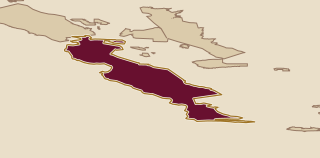
Atlas locationCalifornia · North Coast · United States35.64° N · 120.78° W

At A Glance

The Producer

DAOU Family Estates sits at the top of the Adelaida District in Paso Robles, California, on a 212-acre hilltop that is the highest point in the appellation. The estate grows Cabernet Sauvignon and the other Bordeaux varieties, Cabernet Franc, Merlot, Petit Verdot, and Malbec, and produces a range that runs from an accessible blended Cabernet through Reserve and Soul of a Lion designations at the top of the portfolio.

Georges and Daniel Daou founded the estate in 2007. Both brothers were trained as engineers at UC San Diego and built Daou Systems Inc., a healthcare information technology company, before turning to wine. Daniel serves as winemaker and co-proprietor and brought an engineer's methods to the cellar from the first vintage. Georges and Daniel also helped establish the Paso Robles CAB Collective, a regional consortium dedicated to Cabernet Sauvignon and related Bordeaux varieties, which gives the estate a formal stake in how the district defines itself.

In 2023, Treasury Wine Estates acquired DAOU for up to one billion dollars. Both Georges and Daniel stayed on, Georges as founder and Daniel as founder and chief winemaker.

Place

Paso Robles is a large appellation in San Luis Obispo County, inland from the California coast. The Adelaida District is its western edge, where the coastal ranges funnel cool Pacific air in through the afternoon, pushing diurnal temperature swings into ranges that slow ripening and hold acidity in the grapes.

The DAOU estate occupies the district's highest ground. Elevation works in two directions here: cooler nights lengthen the growing season, and the hilltop exposure increases wind exposure, which firms the grape skins and concentrates flavour without accelerating sugar accumulation. Cabernet Sauvignon at this altitude in Adelaida tends toward darker fruit, firm tannin, and enough acidity to support extended cellaring. The combination is why the brothers chose this specific parcel and why the range centres on Bordeaux varieties rather than warmer-climate grapes.

Soil And Site

The Adelaida District is known for its limestone and calcareous clay soils, which drain well and force vine roots deep into the hillside. Shallow, well-drained ground at elevation limits vine vigour and concentrates what the vine produces. DAOU's 212 acres farm with sustainable practices and mostly organic methods. The specific geology has not been detailed in available sources, but the combination of hilltop exposure, elevation, and the calcareous soil character typical of western Paso Robles shapes the structural profile that appears across the range.

Story

Georges and Daniel Daou grew up in Beirut. Both brothers were gravely injured when a rocket struck their family home at the start of the Lebanese Civil War. The family left Lebanon and settled in France. The brothers came to California years later to study engineering at UC San Diego.

After graduating, they founded Daou Systems Inc., a healthcare information technology company, and sold it. Wine had been a parallel interest, and the capital from the sale gave them the means to act on it. In 2007 they bought the hilltop parcel in the Adelaida District and founded DAOU Family Estates.

Daniel took the winemaker role and applied the same investigative habits he had used in technology to cellar work, testing fermentation variables and building the range methodically from a single estate. Production grew from 305,000 cases in 2019 to 590,000 cases in 2022, a scale that made DAOU one of the most widely distributed California Cabernet producers in the country. The 2023 acquisition by Treasury Wine Estates marked the end of the independent phase, though both founders remained.

Vineyards And Cellar

The estate farms 212 acres on the hilltop using sustainable methods and mostly organic practices. Vine management at this elevation focuses on preserving the long growing season that the cool Adelaida nights allow, harvesting when phenolic maturity aligns with retained acidity rather than chasing peak sugar.

Daniel Daou's engineering background shaped his approach to the cellar in a specific and measurable way. Before settling on the estate's fermentation protocol, he cultivated and tested over 100 yeast strains from the property itself, looking for the strains that expressed the fruit most clearly and held the wine's acidity in balance. The Bordeaux blending varieties, Cabernet Franc, Merlot, Petit Verdot, and Malbec, are farmed alongside the Cabernet Sauvignon and used to build complexity and soften tannin in the blended tiers.

Wines

The range moves through three tiers, each stepping up in vineyard selection and cellar time. The DAOU Cabernet Sauvignon forms the base: a Bordeaux blend drawn from the estate and bottled for wide distribution, offering dark fruit, firm tannin, and the structural profile of Adelaida elevation at an accessible price. Reserve Cabernet Sauvignon pulls from the estate's best blocks and receives extended cellar work, adding depth and grip to the same underlying character. Soul of a Lion is the top designation, a limited-production Cabernet Sauvignon with concentrated dark fruit, chewy tannin, and the structural weight to develop over a decade or more.

Chardonnay appears at the Reserve level, an outlier in a range defined by Bordeaux varieties. The 2020 Reserve Chardonnay opens with lemon verbena and golden delicious apple, with chalk dust and pineapple behind them: a fruit-forward white with enough textural presence to hold alongside the richer Cabernet-focused bottles in the range.

The Bordeaux variety focus is not accidental. The brothers helped establish the Paso Robles CAB Collective, a consortium of local wineries dedicated to Cabernet and other Bordeaux varieties.

In The Glass

The entry Cabernet Sauvignon shows dark cherry and blackcurrant, firm tannin from the hilltop elevation, and enough acidity to keep the fruit from reading as heavy. It drinks at a younger age than the Reserve tiers and delivers the estate's Adelaida profile in an approachable form.

The Reserve Cabernet Sauvignon adds concentration and a longer mid-palate. The fruit deepens into cassis and plum, the tannin firms without becoming angular, and the finish carries the mineral character that western Paso Robles elevation tends to produce. The yeast strain work in the cellar is visible here: the fermentation is clean and the fruit sits forward without being pushed.

Soul of a Lion moves into full Cabernet weight: dense, dark-fruited, with chewy but resolved tannin and a finish long enough to suggest a decade of potential in the bottle. The Reserve Chardonnay sits apart from the Cabernet arc, offering stone fruit and citrus with a chalky texture that keeps the wine from feeling broad.

A Bottle To Understand It

The Reserve Cabernet Sauvignon is the bottle that connects the estate's place, method, and founding logic. It is Cabernet Sauvignon from the highest elevation in Paso Robles, where the growing season is long and cool and the acidity holds alongside the dark fruit. In the glass it shows cassis and plum, firm and present tannin, and a mineral finish that reads as both warm-climate ripe and cooler-climate kept. Daniel Daou's fermentation work is clearest here: the wine is technically confident without being polished into neutrality. Start with the Reserve to understand what the hilltop produces and what the cellar chooses to do with it.

Anecdote

Georges and Daniel Daou were boys in Beirut when a rocket struck their family home at the start of the Lebanese Civil War. Both brothers were gravely injured. The family left Lebanon for France. Years later, the brothers came to California to study engineering at UC San Diego, graduated, built a healthcare information technology company called Daou Systems Inc., and sold it. With the proceeds, they bought a 212-acre hilltop in the Adelaida District of Paso Robles and planted Cabernet Sauvignon. Daniel taught himself to make wine by running trials, including more than 100 yeast strains cultivated from the estate itself, the same methodical approach he had applied in technology. The winery that started from a rocket-struck house in 1970s Beirut was producing close to 600,000 cases a year from that California hilltop by 2022.

Final Word

DAOU Family Estates built one of California's fastest-growing Cabernet programs on a single hilltop in western Paso Robles, starting from a clear thesis about elevation, Bordeaux varieties, and the Adelaida District's capacity for serious red wine. Treasury Wine Estates paid up to one billion dollars for that thesis in 2023, and both founders stayed to run it. The range remains centred on the estate, the appellation, and Cabernet Sauvignon at altitude.

Sources

Keep following the thread

Where to go next

mapFind DAOU Family Estates on the mapKeep the producer, its region and nearby places together.learningUnderstand Cabernet SauvignonRead the quick library guide to Cabernet Sauvignon, which is listed with this producer.