Who makes it
Celler Ardévol sits in Porrera, a village of steep lanes and old stone walls on the southern edge of DOQ Priorat in Catalonia. The Ardèvol family's vine-growing presence in the village is documented to the thirteenth century, though the modern winery did not exist until 1995, when Josep and Albert Ardèvol and Roser Galceran formed a partnership and began working the hillside parcels again. The first wine came out in 2000.
The cellar is small: ten hectares, hand-worked across three named plots, and now led by Max Ardèvol, who took charge after his father Josep died in 2020. What the estate produces reflects where it sits: steep ground, cool nights, and altitude that presses each grape variety into a narrower, firmer shape than Priorat's lower valley floors would allow.
Where it grows
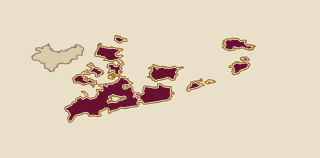
Porrera lies inside DOQ Priorat, the high-demand Catalan appellation built on llicorella, a dark, crumbling slate and mica schist that drains fast and forces vine roots deep. Yields in Priorat are low by design, partly because the soils are poor and partly because the appellation demands it.
Ardévol's three parcels sit between 400 and 500 metres, which is above the valley floor where several Priorat estates are concentrated. At this elevation, growing seasons run longer and cooler. The consequence in the wine is slower ripening, firmer acidity, and tannins that tend toward angular rather than plush. Grape selection by parcel reflects the altitude and aspect directly: warm south-facing slopes hold the varieties that need heat to ripen, the north-facing top parcel takes the one that does not.
How it is made
The cellar
All ten hectares are worked by hand. Farming follows organic and biodynamic principles with no herbicides, pesticides, or synthetic fertilisers. On slopes this steep and parcels this small, machine work is impractical in any case, but the commitment to farming without synthetic inputs also shapes how each vintage expresses the year.
In the cellar, grapes are pressed gently and macerated for an extended period before ageing in lightly toasted, fine-grained French oak barrels. Extended maceration on Cabernet Sauvignon and on the Syrah and Garnacha parcels extracts colour, tannin, and the aromatic depth that Priorat's slate soils encourage. The French oak, lightly toasted, adds a subtle wood frame without dominating the fruit. Fermentation vessel details are not in the public record.
What they make
The range runs to three wines, each tied to the cellar's founding decade.
Coma d'en Romeu is the oldest, released from the 2000 vintage onward. It draws principally from the La Coma d'en Romeu parcel at 400 metres: south-to-southeast facing, Cabernet Sauvignon dominant, and the warmest of the three sites. Expect dark fruit, firm tannin, and the mineral dryness that Priorat's llicorella imposes on almost everything grown here.
Wines to try
First bottle
Anjoli is the first bottle to open. The 2021 vintage is a 50/50 blend of Cabernet Sauvignon and Grenache, grown on Priorat's llicorella slate and aged in lightly toasted French oak. It is fully dry, with dark plum and blackberry fruit, a rounder mid-palate from the Grenache, and the firm, mineral finish that the slate soil produces across every Ardévol wine. The Cabernet Sauvignon anchors the whole; the Grenache opens it up. Start here for the clearest read on what this cellar does with altitude, slate, and time in French oak.