
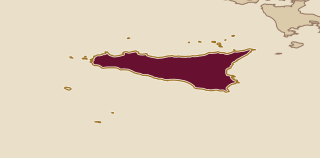
At A Glance
- **Location:** Menfi, southwestern Sicily, Agrigento province
- **Type:** Wine cooperative
- **Founded:** 1958
- **Annual production:** 18 million bottles
- **Key label:** Mandrarossa (premium tier)
- **Grape range:** 35 cultivars including Sauvignon Blanc, Carricante, Petit Verdot, Chardonnay
- **Organic:** Over 1,000 hectares certified organic
- **Exports:** More than 45 countries
The Producer
Cantine Settesoli began in 1958 when 68 Menfi growers decided their harvests were worth more pooled than sold separately. Today the cooperative produces 18 million bottles a year and exports to more than 45 countries, numbers that make it one of Sicily's largest wine operations. Scale alone, though, does not explain why the cooperative matters to a buyer.
What sets Settesoli apart is the Mandrarossa label, a premium tier carved from the cooperative's member pool by selecting grapes from fewer than 10% of its growers, those producing the best fruit from Menfi's limestone ridges above the Mediterranean. Mandrarossa launched in 1999 after two decades of internal terroir research, and consultant winemaker Alberto Antonini has shaped its production direction since. The cooperative's accessible Inycon range covers broader styles across white and red; Mandrarossa is where the site-specific work lives.
Place
Menfi sits on the southwestern coast of Sicily, in Agrigento province, where the land climbs above 300 metres before meeting consistent sea breezes off the Mediterranean. The elevation and the wind are not incidental: in this part of Sicily, where summer temperatures push hard, cooler air off the coast extends the ripening window and keeps acidity in the grapes. Limestone dominates the soils of the Mandrarossa vineyards, which gives the wines a firm mineral backbone and limits vine vigour, concentrating flavour in the fruit rather than spreading it across high-yield shoots.
Menfi is also a DOC zone, a legal appellation that covers wines produced from these coastal slopes. The Mandrarossa range works within and beyond Menfi, with one wine, the Sentiero delle Gerle Etna Bianco, sourced from Carricante grown on Etna's volcanic soils on the island's northeast coast, a deliberate territorial reach beyond the cooperative's home ground.
Soil And Site
The core Mandrarossa vineyards grow on limestone at elevations above 300 metres. Limestone drains freely, stresses the vine, and contributes a chalky mineral quality that carries through to the wine's finish. The sea breezes that cross the southwestern coast provide natural cooling during the growing season, reducing the risk of over-ripe, flat-alcohol wines and preserving aromatic freshness in whites. Mandrarossa's Sauvignon Blanc in particular depends on this combination: without the altitude and the wind, the grape would lose the citrus and herbal lift that define the Urra di Mare style.
The Etna Bianco parcel sits on a different geology entirely, volcanic basalt on the slopes of Etna, which gives Carricante grown there a pronounced mineral, almost saline character that the limestone terroir of Menfi does not produce.
Story
For its first years, the cooperative focused on production rather than bottling. The membership grew from 68 at founding in 1958 to 302 by 1965, but the bottle was someone else's problem. In the 1970s, the cooperative changed that: it invested in its own bottling plant, one of the first Sicilian cooperatives to do so, and simultaneously launched export operations. That decision gave Settesoli control over its own label, its own pricing, and its own route into foreign markets at a point when most Sicilian cooperatives were still selling to négociants.
The second shift came in the 1980s and 1990s, when the cooperative ran two decades of terroir studies and micro-vinification trials across its member vineyards. The work led to Mandrarossa in 1999: a premium label backed by rigorous site selection and, crucially, a grower payment model tied to fruit quality rather than weight. Growers selected for Mandrarossa were paid more for better grapes, an incentive that changed how the selected 10% farmed their vineyards. Alberto Antonini came in as consulting winemaker to sharpen the cellar work. Over 1,000 hectares now carry certified organic status across the cooperative's member farms.
Vineyards And Cellar
The cooperative farms 35 grape cultivars across its member vineyards, a range that covers both Sicilian natives and international varieties. The Mandrarossa vineyards on Menfi's limestone plateau are managed under strict quality protocols, with organic farming across more than 1,000 hectares reducing chemical inputs and allowing the limestone soils to express themselves more directly in the wine.
In the cellar, Mandrarossa's whites are handled with a cold-soaking technique known as cryomaceration, where the crushed grapes sit at 5 to 8°C for four to six hours before fermentation. This cold contact extracts aromatic compounds from the grape skins without pushing extraction into bitter territory, which is why the Urra di Mare opens with clear citrus and stone-fruit perfume rather than the coarser, more extractive aromas that warmer maceration would produce. Fermentation then runs at 16 to 18°C for 15 to 20 days, cool enough to preserve volatile aromatics, and the wine ages in steel for four months with no oak influence.
The Etna Bianco follows a longer, cooler path: 25 to 30 days of fermentation, then 13 to 15 months in steel with the wine left unfiltered from lighter sediments. That extended time on lees and the deliberate decision not to filter add texture and mineral depth to a wine already shaped by Etna's volcanic soils.
Timperosse, the cooperative's Petit Verdot, macerates and ferments together for four to six days at 18 to 22°C, a shorter extraction than the variety often receives, then ages in steel for four months. The approach keeps the wine fresher and less tannic than Petit Verdot typically produces in hotter climates.
Wines
Mandrarossa divides broadly into two groups: the Mediterranean whites grown at Menfi, and a territorial outlier from Etna.
Urra di Mare is 100% Sauvignon Blanc from Menfi's limestone slopes. Cryomaceration, cool fermentation in steel, and four months of ageing produce a wine that is straw-yellow with golden reflections and opens with citrus peel, peach, apricot, mint, and basil. The aromatics are bright and herbal, the texture clean and direct, with no oak softening and no residual sweetness. It is one of the more unusual Sauvignon Blancs in Italian wine: Mediterranean sun on limestone, cold-handling in the cellar, and a result that sits closer to a Marlborough or Loire model than to the broader whites of southern Italy.
Sentiero delle Gerle Etna Bianco DOC is Carricante from Etna, the ancient white grape of the volcano's eastern slopes. Cool fermentation over 25 to 30 days, followed by 13 to 15 months in steel without filtering, produces a wine with a mineral, slightly saline edge and more body than the Menfi whites. It is the most textured wine in the Mandrarossa range and the one that most directly shows the influence of volcanic soil.
Timperosse is 100% Petit Verdot. Short extraction at moderate temperatures and four months in steel keep the wine lifted and fruit-forward: dark plum and violet aromatics, firm but not heavy tannin, and a freshness that Petit Verdot rarely shows in hotter growing regions. The sea-cooled limestone conditions at Menfi are directly responsible for that lift.
Inycon Barrel Selection Chardonnay is 100% Chardonnay from Menfi, harvested in early August to capture ripeness before the peak summer heat flattens acidity. Oak-aged and vegan-certified, it sits at the accessible end of the cooperative's range.
In The Glass
Across the Mandrarossa whites, the house signature is aromatic clarity and acid freshness rather than weight. The Urra di Mare lifts off the glass with citrus, stone fruit, and a green herb current from the basil and mint notes that the cryomaceration draws out of the Sauvignon Blanc skins. In the mouth, the wine is clean, bright, and light-bodied, with a finish that cuts cleanly without lingering sweetness. There is no oak, no creaminess, nothing to pad the texture. The acidity is the point.
The Etna Bianco sits a register heavier. Carricante from volcanic soils produces a grainier texture and a mineral quality on the finish that reads almost stony, with more body behind the acidity than the Menfi whites carry. Extended lees contact adds a faint savoury layer to the fruit.
Timperosse moves into red territory with a warmth that the whites do not have, but it is lighter on its feet than most Mediterranean Petit Verdot: dark fruit, violet florals, firm tannins that compress without gripping, and a mid-palate freshness, so the wine is approachable young while giving it enough grip for food.
A Bottle To Understand It
Mandrarossa Urra di Mare Sauvignon Blanc is the first bottle. It is 100% Sauvignon Blanc grown on Menfi's limestone above the Mediterranean, cold-soaked for aromatic extraction, fermented cool in steel, and aged without oak for four months. In the glass it is straw-yellow and clear, with citrus, ripe peach, apricot, mint, and basil rising immediately from the wine. The palate is light and sharp, with a clean acid line and a finish that is herbal and dry. Sauvignon Blanc does not have a strong tradition in Sicily, and it shows exactly what Menfi's elevation, sea breezes, and limestone can do when the cellar keeps its hands off the wine.
Anecdote
In 1999, Cantine Settesoli launched Mandrarossa after two decades of terroir studies and microvinification experiments. Alberto Antonini was asked to join a team of experts as consulting winemaker.
Final Word
Cantine Settesoli invested in its own bottling plant in the 1970s and conducted two decades of terroir research. Mandrarossa is the fruit of both. Urra di Mare, made from 100% Sauvignon Blanc, undergoes cryomaceration at 5 to 8°C for four to six hours and fermentation at 16 to 18°C for 15 to 20 days, then ages in steel for four months.
Sources
- www.cantinesettesoli.it/en/about-us
- www.cantinesettesoli.it/en/timeline
- www.bkwine.com/features/wine-producer-profiles/mandrarossa-cantine-settesoli
- www.grape-experiences.com/wine-cooperatives-sicily-cantine-settesoli-mandrarossa-winery
- www.mandrarossa.it/en/innovative-wines/urra-di-mare
- www.mandrarossa.it/en/etna-wines/sentiero-delle-gerle-etna-bianco-doc
- www.mandrarossa.it/en/innovative-wines/timperosse
- www.inyconwines.com/barrel-selection/chardonnay