NoleaWorld of Wine

Piemonte · Italy

Producer profile

Bruna Grimaldi

Organic Langhe estate across Serralunga d'Alba and Grinzane Cavour, bottling Barolo, Dolcetto, Barbera, and Arneis since 1999 under Bruna Grimaldi's lead.

Place
Piemonte · Italy
Known for
Barolo from Serralunga d'Alba and Grinzane Cavour; Langhe Arneis aged on fine lees.
Wine context
Barbera · Nebbiolo
Editorial basis
World of Wine editorial profile · 3 sources

World of Wine editorial profile · Source list ↓

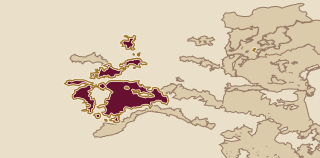
Atlas locationPiemonte · Italy44.66° N · 7.98° E

At A Glance

The Producer

Bruna Grimaldi is a family estate split across two communes in Langhe, Piedmont: Grinzane Cavour, where the family first farmed, and Serralunga d'Alba, where its most age-demanding Barolo parcels sit. The Grimaldi family sold grapes from 1957. Bruna formalised the estate label in 1999, twelve years after she took operational control following her winemaking studies in Alba. Her children Simone and Martina joined in 2015 and 2019 respectively, and the estate now bottles around 80,000 bottles a year across Barolo, Barbera d'Alba, Dolcetto d'Alba, and Langhe Arneis.

The estate gained organic certification in 2013. Vineyard work accounts for 70 percent of the family's annual labour, with 25 percent devoted to harvest, leaving only 5 percent for everything else.

Place

Serralunga d'Alba is one of the five Barolo communes and the one most associated with long development. Its soils are compact Helvetian sandstone, dense and poor in nutrients, which forces Nebbiolo roots deep and produces wines with firm tannin and a slow, decade-long arc toward full expression. Barolo from Serralunga rarely opens early; it needs time in bottle before the fruit and tannin reach equilibrium.

Grinzane Cavour, where the family is based, produces a different Barolo expression from Serralunga d'Alba. Together, the two communes give the estate a range of Nebbiolo expressions within a single appellation label.

The Langhe Arneis comes from the Langhe side of the Tanaro river. Arneis is a white grape native to Roero, the sandy-soiled plateau across the river from the Langhe hills, but it is planted in Langhe as well, producing a different texture than its Roero counterparts.

Soil And Site

Serralunga d'Alba's Helvetian sandstone is the defining soil for the estate's most structured Barolo. The stone is ancient marine sediment, compressed and mineral-rich, draining well but retaining just enough moisture to carry Nebbiolo through dry summers. The Badarina vineyard in Serralunga sits within this geology and produces Barolo with the tight fruit and firm tannin associated with the commune.

Story

Giacomo Grimaldi farmed a mixed operation in Grinzane Cavour in the early twentieth century. His son Giovanni moved the family toward dedicated winemaking after the Second World War, and when Giovanni married Clara, she brought the Badarina vineyards in Serralunga as a dowry. That land transfer, through marriage rather than purchase, gave the family its first foothold in Serralunga and its first named Barolo parcel.

Bruna studied winemaking in Alba in the 1980s and returned to take over the property in 1987. For twelve years she farmed, managed the estate, and sold wine without her name on a label. In 1999 the family established the Bruna Grimaldi label formally, putting her name on bottles that had been building toward that point since she was a student. Organic certification followed in 2013, and the next generation arrived: Simone in 2015, Martina in 2019. Three generations of decisions now converge in the current range.

Vineyards And Cellar

The estate farms organically across its Langhe parcels. Green harvesting largely determines wine quality. The family allocates 70 percent of its working time to the vineyard, 25 percent to harvest, and 5 percent to the rest of the year.

The Arneis is fermented at controlled temperature with no malolactic conversion, which preserves the grape's natural acidity and keeps the wine fresh rather than round. Fine lees stirring continues for approximately two months after fermentation, adding softness to the texture without adding weight. The Arneis can develop further complexity over three to five years.

The Barolo is vinified from Nebbiolo parcels in both communes, with the Badarina vineyard singled out for its own cuvee.

Wines

Barolo is the top of the range. The Badarina cuvee comes from the named Serralunga parcel and carries the character of that commune: tight red cherry, dried roses, and tobacco from Nebbiolo, with tannin that is firm and dry on entry and requires several years of bottle age before it softens. The Grinzane Cavour parcels produce a second Barolo expression with a broader profile and somewhat earlier accessibility. Both are age-worthy; neither is made for immediate drinking.

Barbera d'Alba fills the middle of the range. Barbera from Langhe is naturally high in acidity and low in tannin, producing a wine that is darker and more immediate than Barolo, often with sour cherry fruit and a clean finish.

Dolcetto is a low-acid, moderately tannic grape that produces deeply coloured, fruit-forward wine with bitter almond and dark plum character.

The Langhe Arneis is the estate's main white. The grape produces wine with white peach, pear, and faint almond on the nose, with medium acidity and a texture that the lees stirring pushes toward creamy without losing freshness. No malolactic conversion keeps the acid line clear.

In The Glass

The Arneis delivers white peach and dried pear from the first pour, with a texture that feels slightly rounded from the lees work. Acidity is present but not sharp, and the finish is clean and medium length. Opened at three years, the fruit has settled and something floral and nutty develops in its place.

A Bottle To Understand It

The Langhe Arneis is the right first bottle. It shows the estate's cellar approach clearly: controlled fermentation, no malolactic, two months on fine lees, and the patience to let a white wine gain complexity rather than simply be fresh. The texture is slightly fuller than typical Arneis, the acidity is clean and present, and the finish carries a faint nuttiness from the lees contact.

Anecdote

Bruna Grimaldi was one of three women in her winemaking class in Alba in the 1980s. The majority of her classmates were men from established families who would return to inherit running operations; Bruna returned to take over a property that had not yet decided what it wanted to be. She assumed control in 1987. For twelve years she managed the vineyards, made the wine, and sold it without her name appearing anywhere on the label. The family sold grapes and wine under other arrangements. In 1999 they formally established the Bruna Grimaldi label. Her name went on the bottle a decade after she had begun doing the work that earned it.

Final Word

Bruna Grimaldi is a mid-sized Langhe estate built on two communes, two centuries of family land decisions, and one woman's twelve-year gap between running a winery and putting her name on its bottles. The Barolo needs time. The Arneis rewards it differently. Both are made carefully, from organic vineyards, by a family that accounts for 70 percent of its year in the rows.

Sources

Keep following the thread

Where to go next

placeRead the Piemonte guideSee Bruna Grimaldi in the wider setting of Piemonte.mapFind Bruna Grimaldi on the mapKeep the producer, its region and nearby places together.learningUnderstand BarberaRead the quick library guide to Barbera, which is listed with this producer.