
NoleaWorld of Wine

Toscana · Italy

Producer profile

Azienda Agricola IL Palagio di Panzano di Monia Piccini

Monia Piccini makes Sangiovese-only wines from her family's estate above Panzano in Chianti, where two contrasting soil formations pull each parcel in a different direction.

Place
Italy
Known for
Single-variety Sangiovese estate in Panzano in Chianti, with two contrasting soil formations and a range where every wine carries a family name.
Wine context
Cabernet Sauvignon · Merlot · Sangiovese
Editorial basis
World of Wine editorial profile · 3 sources

World of Wine editorial profile · Source list ↓

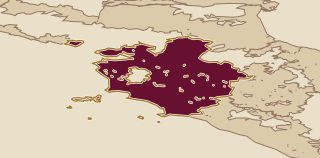
Atlas locationToscana · Italy43.55° N · 11.30° E

At A Glance

The Producer

Monia Piccini makes every wine at Il Palagio di Panzano from a single grape: Sangiovese. The estate sits above the village of Panzano in Chianti, inside the Chianti Classico DOCG zone in Tuscany, and Monia's family has been native to this village across multiple generations. She took over the winemaking operation in 2004 and released her first Chianti Classico in 2007. That debut vintage earned tre bicchieri from the Gambero Rosso Wine Guide, the highest mark in Italy's most widely followed annual rating system.

The range is deliberately compact and entirely personal. Each wine carries a name from the family: a grandmother, two daughters, a father. Monia has mapped the estate's soils and uses what she finds there to explain why each parcel produces a different wine.

Place

Panzano in Chianti is a small hilltop village in the heart of the Chianti Classico zone, positioned between Florence and Siena. The Chianti Classico DOCG appellation covers this stretch of Tuscany and requires wines to be made from at least 80 percent Sangiovese, with the best crus drawing exclusively on the grape.

Panzano occupies one of the higher points in the appellation. Altitude moderates the summer heat and extends the growing season, allowing Sangiovese to ripen slowly and retain the acidity that keeps the wines from feeling heavy. The village sits inside a natural amphitheatre formed by hills on three sides, a feature local growers call the Conca d'Oro.

The estate's soils split into two distinct geological formations. Pietraforte is a hard, fine-grained sandstone that drains quickly and pushes vines toward concentration. Formazione Sillano is a clay-limestone mix that retains more water and tends to produce broader, more textured fruit. Monia has done active soil mapping to understand which parcels fall on which formation and uses that knowledge to separate parcels at harvest and vinification.

Soil And Site

Pietraforte and Formazione Sillano are the two dominant geological formations across the estate. Both are common in the Chianti Classico zone but the balance between them varies from property to property and, within a property, from parcel to parcel.

Pietraforte sandstone drains fast. Vines on this formation are pushed to work harder, producing smaller berries with denser colour and firm tannin. Formazione Sillano, which contains more clay and calcium carbonate, holds moisture through dry summers and tends to give Sangiovese a broader mid-palate and rounder finish. Where both formations occur across the same estate, the contrast is a winemaking resource: separate vinification lets each formation express itself rather than averaging out.

Story

The property's documented history goes back to a monastery built on this hillside in the 800s. A castle followed in the thirteenth century. In 1776, the site became a hunting lodge. Dario Piccini bought it in 1965. When his daughter Monia took over the winemaking in 2004, she inherited a place with a long calendar of other purposes and set about giving it a clear modern one.

Monia's commitment to a single-variety approach was a deliberate narrowing. Chianti Classico allows international varieties in the blend, and many producers use small amounts of Merlot or Cabernet Sauvignon to soften or extend the wine. Monia chose to work only with Sangiovese. That choice puts the focus entirely on what the parcels and the soils can do with one variety across different vinification approaches.

The soil-mapping work came later in her tenure. By analysing the Pietraforte and Formazione Sillano formations across the estate's parcels, she built a physical map of why individual vineyards behave differently. The analysis gave her a rational basis for keeping parcels separate rather than blending them into a single Chianti Classico.

Vineyards And Cellar

The estate has two named single-vineyard parcels. San Martino has held organic certification since 2013. The organic regime excludes synthetic herbicides and pesticides and requires the grower to manage vine health through cover crops and manual interventions. For Sangiovese, which is sensitive to powdery mildew, organic farming demands more passes through the vineyard but produces fruit with cleaner skins and finer tannin.

Le Bambole is the other named parcel. It was the last vineyard Monia planted with her father. She named it for her two daughters. The parcel is farmed alongside the rest of the estate and its fruit goes into the single-vineyard wine that carries its name.

Oak ageing is used for the reds.

Wines

The range has four known bottles.

The Chianti Classico is the estate's appellation wine. It must contain at least 80 percent Sangiovese under DOCG rules; at Il Palagio it is made entirely from the grape. It is the wine that put the estate on the map: the 2007 was the inaugural release and it went directly to the top of the Gambero Rosso scale.

Le Bambole is a single-vineyard bottling from the parcel Monia planted with her father. As a named single-vineyard wine within the Chianti Classico zone, it sits above the appellation level in range terms and reflects the specific soil character of that parcel rather than the blended estate character of the Chianti Classico. Expect darker fruit, firmer tannin, and a longer line than the entry wine.

San Martino comes from the organically certified parcel. Organic farming at Panzano, where the altitude and natural ventilation reduce disease pressure, tends to produce fruit with more precise aromatics and finer tannin grip than the same variety farmed conventionally nearby. The wine carries that character.

Aldemara is a rosato, introduced around 2017, made from Sangiovese and named for Monia's grandmother. In Tuscany, Sangiovese rosato gives a wine with fresh red-fruit character, bright acidity, and a dry finish. The colour and weight sit between a Provencal pale and a full Cerasuolo.

In The Glass

The Chianti Classico opens with dark cherry and dried violet, the signature aromatics of Sangiovese grown at altitude with good diurnal temperature variation. The mouth entry is firm: the grape produces a naturally high-acid, medium-to-full-bodied wine, and the Pietraforte soils on part of the estate add tannin grip. There is a slight iron-edged minerality on the mid-palate that is common in wines from this sandstone formation. The finish is long and dry, with the characteristic Chianti Classico bitterness that cuts through food.

The single-vineyard wines, Le Bambole and San Martino, carry the same Sangiovese architecture but amplify different qualities. Le Bambole shows darker plum alongside the cherry, with a denser mid-palate from the specific parcel's soil. San Martino, from the organic plot, tends toward more lifted aromatics and a finer tannin texture.

Aldemara, as a rosato from Sangiovese, gives pale salmon colour, red cherry and watermelon on the nose, and a dry, mouth-watering finish driven by the grape's natural acidity.

A Bottle To Understand It

Start with the Chianti Classico. It is the wine Monia built the estate's reputation on, the grape she commits to exclusively, and the appellation that defines the village of Panzano. The Chianti Classico gives dark cherry, dried violet, firm but not aggressive tannin, and a long dry finish with mineral grip from the Pietraforte soils. The acidity is high enough to age the wine for several years but the wine is also approachable young alongside red meat, hard cheese, or a Florentine bistecca. No other bottle in the range introduces the estate's approach as directly.

Anecdote

When the 2007 Chianti Classico came back from Gambero Rosso with tre bicchieri, it was the estate's first commercially released vintage. Monia had taken over the winemaking three years earlier, working from a property that had changed hands and purpose many times over its history. The tre bicchieri rating, the highest mark in the most widely read Italian wine guide, is rarely awarded to debut releases in a competitive appellation where well-funded estates with decades of market presence compete for the same column inches. The 2007 did not come from a winery with a long reputation behind it. It came from a first attempt. The score did not guarantee what came next, but it confirmed that the combination of village, soils, and a winemaker who grew up on these hills produced something that a serious critical system noticed immediately.

Final Word

Il Palagio di Panzano is a small estate making an undiluted argument for what Panzano's soils and a single grape can do. Every bottle is Sangiovese; every parcel has a name and a person attached to it. The Chianti Classico is where that argument is clearest and most accessible.

Sources

Keep following the thread

Where to go next

mapFind Azienda Agricola IL Palagio di Panzano di Monia Piccini on the mapKeep the producer, its region and nearby places together.learningUnderstand SangioveseRead the quick library guide to Sangiovese, which is listed with this producer.