At A Glance
- **Location:** Montà d'Alba, Roero, Piemonte, Italy
- **Founded:** 1960 by Mario Pelassa
- **Size:** 15 hectares across two appellations
- **Grapes:** Arneis (white), Nebbiolo (red)
- **Key bottles:** Roero Arneis San Vito, Roero Antaniolo Riserva, Barolo San Lorenzo di Verduno
- **Territories:** Roero (left bank) and Verduno in the Langhe (right bank)
The Producer
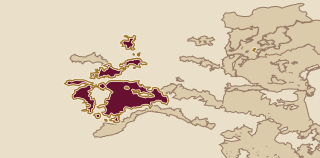
Mario Pelassa grew up in Montà d'Alba with modest means and founded his estate in 1960 on the Roero hills where he had lived his whole life. What he built was not a single-appellation domaine but a two-territory operation: parcels in the Roero on the left bank of the Tanaro River, and a vineyard in Verduno, a village commune on the right bank where Barolo is made. Fifteen hectares span both sides.
The range follows that geography cleanly. From the Roero come a white Arneis and a Nebbiolo Riserva. From Verduno comes the San Lorenzo Barolo. Three distinct wines, two distinct territories, one estate working both.
Place
The Tanaro River divides Piemonte's two great Nebbiolo territories. On the right bank sit the Langhe hills: Barolo, Barbaresco, and the tightly regulated village appellations within them. On the left bank sits the Roero, a softer, sandier terrain that produces Arneis whites and lighter-bodied Nebbiolo reds under its own appellation.
Verduno is a village at the northwestern edge of the Barolo zone, one of eleven communes entitled to produce Barolo. Its position and its soils, predominantly Helvetian marl and sand, push the wines toward floral aromatics and softer tannin rather than the firm, extracted profile of Serralunga d'Alba or Castiglione Falletto. A Verduno Barolo can be approached earlier than most and tends to lead with rose, violet, and delicate red fruit before earthier notes follow.
The Roero's sandy, calcareous soils suit Arneis, a white grape that ripens well there and retains freshness when handled carefully. Pelassa works both sides of the river, and the label tells you which territory you are in.
Soil And Site
Roero soils are predominantly sandy and calcareous, the result of ancient marine deposits that predate the Langhe's more compact Helvetian and Tortonian formations across the river. That sandy base drains well and keeps Arneis aromas bright. The Nebbiolo grown here for the Antaniolo Riserva faces a lighter, earlier-ripening environment than Barolo Nebbiolo on the right bank.
The San Lorenzo vineyard in Verduno sits on the Helvetian marls typical of that commune. The calcareous clay holds water through dry summers and moderates ripening, contributing to the perfumed, finer-tannin character that separates Verduno Barolo from the bigger styles of the Serralunga ridge.
Story
Mario Pelassa did not inherit a functioning estate. He started one. When he formally founded Azienda Agricola Daniele Pelassa in 1960, he chose to build across two territories rather than concentrate on one side of the river, a decision that shaped the range the estate still produces. The white Arneis from the Roero and the Barolo from Verduno are not an accident of acquisition; they reflect a deliberate two-territory logic built into the estate from the beginning.
That logic persists in how the wines are made today. Arneis goes into stainless steel on the lees to preserve its native freshness. The Roero Nebbiolo takes 18 months in large oak casks. The Barolo from San Lorenzo has silk-smooth tannins and a perfumed nose with delicate fruit notes, floral hints, and earthy character.
Vineyards And Cellar
Grapes are hand-harvested and softly pressed. Before fermentation begins, grapes are picked from the bunch, a selection step that removes any damaged or underripe material and concentrates the quality of what goes into the vat. Fermentation runs at controlled temperatures to hold the fruit character intact, particularly important for Arneis, which is prone to oxidation if handled roughly.
New plantings use careful clonal selection, choosing vine material suited to the specific soil and exposure of each parcel rather than defaulting to high-yielding commercial clones. Red wines complete malolactic fermentation in wood or steel before bottling.
The Arneis San Vito spends 8 months on the lees in stainless steel, adding texture and roundness without any oak influence, then 2 more months in bottle before release. The Antaniolo Riserva ages 18 months in large oak casks followed by 12 months in bottle, a timeline that builds depth in the Nebbiolo without imposing heavy oak flavour. The San Lorenzo Barolo follows a similar oak-and-bottle arc suited to Verduno's naturally softer tannin profile.
Wines
The range divides cleanly by territory and colour.
Roero Arneis San Vito is the white wine, made from Arneis grown on the left-bank sandy soils of the Roero. Arneis is a native Piemontese grape, once close to disappearing, now the defining white of the appellation. The San Vito ages sur lie for 8 months in stainless steel and 2 months in bottle. The palate is textured and round without heaviness, with stone fruit, white blossom, and a clean, saline finish that comes from the lees contact and the cool fermentation. Annual production reaches around 35,000 bottles, making it the estate's broadest release.
Roero Antaniolo Riserva is Nebbiolo from the Roero, aged 18 months in large oak casks and 12 months in bottle before release. Roero Nebbiolo is lighter in colour and tannin than Barolo, with red cherry, dried rose, and earthy tobacco on the nose, and a leaner, more immediately accessible palate. Annual production is approximately 4,300 bottles. The long oak and bottle ageing builds complexity without adding the oak weight you might expect; large casks soften rather than flavour.
Barolo San Lorenzo di Verduno is the Barolo, from the San Lorenzo vineyard in the Verduno commune. Verduno sits at the western edge of the Barolo zone where the wines are characteristically floral and silky rather than tannic and austere. The San Lorenzo shows a perfumed nose of rose, violet, and delicate red fruit alongside earthy notes, and a palate where the tannins are smooth rather than grippy.
In The Glass
The Arneis San Vito opens with white peach, apricot blossom, and a faint almond note typical of the Arneis grape. In the mouth it fills out quickly from the lees contact, carrying more weight than you might expect from a cool-fermented white, but the acidity holds the line and the finish stays clean and mineral. It is not a neutral wine; Arneis has its own slightly bitter, herbal edge that the lees ageing sharpens without amplifying.
The Antaniolo Riserva is where Roero Nebbiolo shows its own argument. Lighter in body than the Barolo, it gives dried cherry, leather, and tobacco with a lifted floral edge, and the tannins, though present, have softened through the oak and bottle ageing into something close to silk. The acidity keeps it fresh and food-friendly.
The San Lorenzo Barolo sits apart from bigger, more extracted styles of the appellation. Rose petal and violet dominate the nose with strawberry and a touch of tar underneath. The mouthfeel is finer than a Serralunga or La Morra Barolo; the tannins knit into the fruit rather than sitting on top of it, and the finish lengthens through earthy, mineral notes. It is a Barolo that rewards attention at the table rather than years of waiting in a cellar, though it ages well.
A Bottle To Understand It
Start with Barolo San Lorenzo di Verduno. It is the wine that explains both the estate's geographic reach and its production philosophy in one glass. The San Lorenzo vineyard in Verduno produces a Barolo with silk-smooth tannins, a perfumed nose of rose and violet, delicate red fruit, and earthy depth, a profile shaped by Verduno's softer soils and the estate's preference for large-cask ageing over heavy new oak. It is more immediately approachable than Barolo from harder, more tannic communes, which makes it the right first encounter with both the estate and the Verduno village style. Find it alongside roasted lamb or aged Piemontese cheese.
Anecdote
In the 1950s, Mario Pelassa was still a boy in Montà d'Alba. His family had modest means, and he found an early solution: he loaded wine onto his bicycle and pedalled the route from Montà d'Alba to Turin, selling what he carried and bringing the money home. He made that journey repeatedly, learning the trade on two wheels before he was old enough to sign a lease or register an estate. In 1960, he founded Azienda Agricola Daniele Pelassa in the same town where he had grown up, farming the same Roero hills he had ridden out from as a boy. The estate still works those hills today.
Final Word
Pelassa is a small estate doing something specific: making wine from both sides of the Tanaro River, which puts Arneis and Barolo under the same roof. The Verduno Barolo is the wine to reach for first, a perfumed, approachable version of one of Italy's most argued appellations, made by a family that has worked the same territory since 1960.