
Who makes it
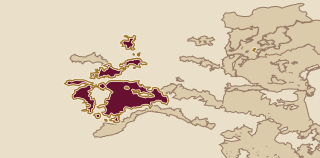
Davide Carlone farms 11 hectares of south-facing vineyard in the village of Grignasco, in the Novara province of Alto Piemonte, at the alpine foothills of northern Italy. His estate sits within the Boca DOC appellation, one of the oldest red wine zones in Piedmont, built on Nebbiolo blended with Croatina and Vespolina. The family's winemaking roots in this part of Alto Piemonte go back to the 1880s, through the Teruggi and Zanolini lines. Davide, born in 1968, spent his early years working alongside his grandfather Carlo in the vineyard and cellar, and started his own estate around 1991 from 3,500 square metres of vines. His sister Michela has been his working partner from that first season. Together they have built one of the estates most associated with the contemporary revival of Boca DOC.
The estate's flagship is the Boca Adele, a selection of the finest parcels composed of 75 percent Nebbiolo and 25 percent Vespolina, built to age for twenty years or more.
Where it grows
Boca DOC occupies a narrow band of hillside in Alto Piemonte, the northern arc of Piedmont that stretches between the Apennines and the Alps. The appellation sits at genuine altitude: Carlone's vineyards run from 380 to 450 metres on slopes that face south and southwest, giving the Nebbiolo here a slower, cooler ripening season than the Nebbiolo of Barolo or Barbaresco to the south. That elevation shows in the wine: higher acidity, firmer tannin, and a cooler aromatic register than the Langhe.
Boca was once substantial. After World War II the appellation covered roughly 40,000 hectares. By the time Davide Carlone planted his first vines, fewer than three hectares were still farmed commercially. The vineyards had been abandoned as the population moved to the industrial cities. The Boca that Carlone entered in the early 1990s was an appellation on paper with almost no wine.
How it is made
The cellar
Carlone farms organically throughout, with no herbicides and no synthetic fertilizers. Weed control is mechanical. Vine supports are made from local wood and stone; willow ties replace plastic. The only conventional inputs are copper and sulfur, both permitted under organic protocols.
In the cellar, grapes are hand-harvested and fermented with indigenous yeasts, without added commercial strains. Nebbiolo for the Boca wines is fully destemmed and left on the skins for around a month, building colour, tannin, and aromatic depth. Vespolina for the single-varietal bottling has fourteen to eighteen days of skin contact, producing a wine with more immediate fruit and softer grip. The Boca DOC wines age in large Slavonian oak botti: old casks, large volume, slow oxygen exchange, no new oak flavour. The single-varietal wines, Croatina, Vespolina, and Erbaluce, age in stainless steel, keeping them leaner and closer to the grape character.
What they make
The range has two tiers within Boca DOC and a supporting set of single-varietal bottles.
The Boca is the estate-level bottling: Nebbiolo blended with Croatina and Vespolina in proportions that shift slightly by vintage, fermented with wild yeasts and aged in large oak botti. It has the firm tannin and high acidity typical of Nebbiolo from volcanic soil at altitude, with red fruit, dried flowers, and a long, dry finish.
Wines to try
First bottle
Start with the Boca Adele. It is 75 percent Nebbiolo and 25 percent Vespolina, grown on volcanic porphyry between 380 and 450 metres, fermented with indigenous yeasts, and aged in large old Slavonian oak botti. No new oak, no added aromatic weight. The wine carries sour cherry, dried rose, white pepper, and cranberry, with firm granular tannins and a high, persistent acidity that keeps the finish clean and long. The 2020 vintage received 92 points from Vinous.