
NoleaWorld of Wine

Oregon · United States

Producer profile

Adelsheim Vineyard

The first winery in Oregon's Chehalem Mountains, farming Pinot Noir and aromatic whites across more than 200 acres on one volcanic and sedimentary ridge since 1978.

Place
Oregon · United States
Known for
Chehalem Mountains Pinot Noir and cool-climate aromatic whites from estate-farmed parcels on volcanic and sedimentary soils.
Wine context
Chardonnay · Pinot Grigio / Pinot Gris · Pinot Noir
Editorial basis
World of Wine editorial profile · 4 sources

World of Wine editorial profile · Source list ↓

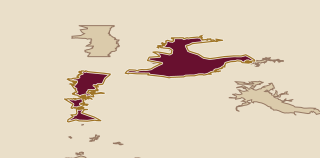
Atlas locationOregon · United States45.34° N · 123.05° W

At A Glance

**Country**
United States
**Region**
Oregon
**AVA**
Chehalem Mountains, Willamette Valley
**Grapes**
Pinot Noir, Pinot Gris, Chardonnay, Pinot Blanc
**Founded**
1978
**Owners**
Jack and Lynn Loacker
**Winemaker**
Gina Hennen
**Production**
approx. 50,000 cases per year

The Producer

Adelsheim Vineyard sits in the Chehalem Mountains, a compact volcanic and sedimentary ridge northwest of Newberg that rises above the broader Willamette Valley floor. David and Ginny Adelsheim purchased 19 acres there in 1971, when the sub-appellation had no commercial winery at all. When the winery opened in 1978 it was the first in the Chehalem Mountains, and the estate has farmed the area ever since.

Today Adelsheim grows Pinot Noir, Pinot Gris, Chardonnay, and Pinot Blanc across 11 vineyard sites totaling more than 200 acres, most of them inside the Chehalem Mountains AVA. Gina Hennen has directed winemaking since 2017, and Rob Alstrin serves as CEO. The winery produces approximately 50,000 cases per year, all from estate-farmed fruit.

Place

The Chehalem Mountains AVA is a distinct sub-appellation within the Willamette Valley, Oregon's principal cool-climate wine region. The ridge runs northeast to southwest between the Tualatin Valley and the Yamhill River lowlands, and its vineyards sit between roughly 200 and 1,000 feet in elevation. That range of altitude means cooler temperatures on the upper slopes and warmer pockets lower down, which translates directly to differences in ripeness, acidity, and aromatic concentration across the estate.

The Willamette Valley's climate is shaped by marine air moving in from the Pacific through the Coast Range gaps. Summers are long, dry, and warm by day but cool overnight. The diurnal shift, sometimes 30 to 40 degrees Fahrenheit between afternoon and midnight, slows the final weeks of ripening and preserves acidity in the grapes. For Pinot Noir, that slow closing of the growing season is what keeps the wine fresh rather than heavy. For Pinot Gris and Pinot Blanc, it means aromatic brightness and enough acid to carry the wine through a meal.

Soil And Site

The Chehalem Mountains sit at the junction of three distinct soil types that define much of the Willamette Valley. Jory, a deep iron-rich volcanic basalt soil derived from the Missoula Floods and Cascade eruptions, dominates the upper slopes and drains freely, stressing the vines just enough to concentrate flavor. Willakenzie, a marine sedimentary soil, appears on mid-slope positions and tends toward earlier ripening and softer tannin in Pinot Noir. Laurelwood, a silty wind-deposited loess, covers some of the lower elevations and holds moisture differently than either of the other two.

Adelsheim's two largest confirmed estate sites illustrate this spread. Ribbon Springs, 125 acres acquired in 1995, and Boulder Bluff, 15 acres acquired in 2003, together represent different elevations and soil contacts within the mountain range. Farming across varied soil types within one AVA gives the cellar enough material to build a range from a single home territory.

Story

David Adelsheim was among the first generation of American winemakers who looked at the Willamette Valley as a serious home for Pinot Noir. In 1971 he bought land in the Chehalem Mountains before anyone had built a commercial winery there. Seven years later, when Adelsheim opened, it became the first winery in the sub-appellation. That early position put the estate at the center of what would become one of the defining conversations in American wine: whether Oregon could produce Pinot Noir that competed with Burgundy.

By 1994 the winery had grown large enough to need outside capital. Jack and Lynn Loacker came in as co-owners that year, holding a minority stake while David Adelsheim remained the operational and public center of the estate. For 23 years the arrangement held. In 2017 the Loackers completed a full buyout, and David Adelsheim stepped back after nearly five decades of building the estate and shaping Oregon wine policy. The transition kept Adelsheim independently owned within the Chehalem Mountains rather than passing to a corporate group.

Under Dave Paige, who served as winemaker from 2001 to 2017, production doubled from 25,000 to 50,000 cases. The scale increase came through additional vineyard acquisition rather than purchased fruit, so the estate-farming model held through the expansion. Gina Hennen took over winemaking when Paige left in 2017, the same year the ownership transfer completed.

Vineyards And Cellar

Adelsheim farms 11 sites across more than 200 acres, overwhelmingly within the Chehalem Mountains AVA. The concentration of vineyards inside a single sub-appellation is a deliberate choice: the range is built around one address rather than spread across the Willamette Valley for variety. At that scale, the cellar team can farm each parcel for a specific purpose rather than blending across unrelated sites.

Ribbon Springs at 125 acres is the largest holding. Boulder Bluff at 15 acres is smaller and may be used for a more specific cuvee or for blending into the core range; the sourced record does not confirm the separation. Current winemaker Gina Hennen has spoken publicly about the estate's commitment to sustainable farming, though specific certifications beyond that framing are not confirmed. The cellar work is directed at making wines that reflect the Chehalem Mountains address: cool-climate acidity, restrained fruit weight, and the kind of aromatic clarity that comes from harvesting at moderate ripeness rather than waiting for maximum sugar accumulation.

Wines

The four core varieties at Adelsheim are Pinot Noir, Pinot Gris, Chardonnay, and Pinot Blanc. Pinot Noir is the estate's most important grape by reputation and almost certainly by volume, planted across multiple sites at different elevations to give the cellar a range of ripeness and tannin character. Chehalem Mountains Pinot Noir from these sites tends toward red fruit rather than dark, with firm acidity, moderate tannin, and a mid-weight body that falls between the lighter Dundee Hills style and the richer examples from the warmer Ribbon Ridge or Eola-Amity Hills.

Pinot Gris in Oregon is a fuller, richer expression than the leaner Alsatian model. At Adelsheim it carries stone fruit and ripe pear with a textural weight that comes from the warm days and cool nights of the Chehalem Mountains growing season. Pinot Blanc at this estate offers a crisper, more citrus-driven alternative to the Gris: less body, brighter acidity, and a cleaner line through the finish. Chardonnay completes the white range, and in the Willamette Valley context it is shaped primarily by cool temperatures and acidity rather than by oak or full malolactic richness.

In The Glass

Chehalem Mountains Pinot Noir opens with red cherry, dried cranberry, and a herbal edge that comes from cool-climate growing conditions rather than underripeness. In the mouth the acidity arrives early and stays through the finish, framing fruit that is bright rather than heavy. Tannin is present but fine-grained on the Jory and Willakenzie soils, and the wine closes with a mineral dryness rather than a sweet oak impression.

The white wines read in a different register. Pinot Gris shows stone fruit weight and a mouth-filling texture across the mid-palate, with the acidity preventing the wine from feeling flat. Pinot Blanc is leaner: lemon and green apple on the nose, a tighter body, and the kind of clean finish that works well alongside food. Chardonnay from cool Willamette Valley sites is more interested in acidity and freshness than in richness, and Adelsheim's Chardonnay follows that pattern with a nervous, mineral quality through the mid-palate.

A Bottle To Understand It

The Chehalem Mountains Pinot Noir is the right first bottle. It is the variety the estate was built around, grown on the sub-appellation the winery helped establish, and made in a style that demonstrates what cool Oregon growing conditions actually produce. Expect red cherry, earth, and firm acidity rather than the dark-fruited richness of warmer New World Pinot. The tannin is present without being harsh, the finish is dry and clean, and the wine is approachable on release but has enough acid to develop over three to five years. One bottle clarifies both the Chehalem Mountains address and what Oregon Pinot Noir can be when it is not pushed toward maximum ripeness.

Anecdote

In the summer of 2017, Jack and Lynn Loacker signed the paperwork that made them 100 percent owners of Adelsheim Vineyard. It completed a 23-year arrangement that had begun in 1994 when the Loackers first came in as minority partners, at a moment when the winery needed capital to grow. Through those two decades David Adelsheim had remained the visible center of the estate, shaping Oregon wine policy and planting more vineyards, while the Loackers held their stake quietly in the background. When the buyout finally closed, the winery did not change hands to a corporation or a foreign investment group. It passed to the family that had been part of it since before many of the estate's current vines were in the ground. Lynn Loacker put it plainly: they were now 100 percent owners. For a founding estate in the Chehalem Mountains, that counted as continuity.

Final Word

Adelsheim built the Chehalem Mountains as a wine address before the sub-appellation had a name. More than 50 years on, the estate grows all four of its core varieties across one ridge, makes wine from estate fruit only, and remains independently owned inside the mountains where David Adelsheim first planted vines. The bottles are an honest record of what that place produces.

Sources

Keep following the thread

Where to go next

placeRead the Oregon guideSee Adelsheim Vineyard in the wider setting of Oregon.mapFind Adelsheim Vineyard on the mapKeep the producer, its region and nearby places together.learningUnderstand Pinot NoirRead the quick library guide to Pinot Noir, which is listed with this producer.